THE
NEW YORK TIMES BESTSELLER
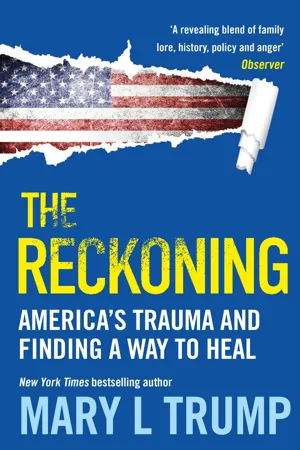
America is suffering from PTSD.
The Reckoning diagnoses its core causes and helps begin the healing process.
For four years, Donald J Trump inflicted an onslaught of overlapping and interconnected traumas upon the American people, targeting anyone he perceived as being an 'other' or an enemy. Women were discounted and derided, the sick were dismissed as weak and unworthy of help, immigrants and minorities were demonised and discriminated against and money was elevated above all else. In short, he transformed America into a macro version of his malignantly dysfunctional family.
How can Americans make sense of the degree to which their institutions and leaders have let them down? How can they negotiate a world in which all sense of safety and justice seems to have been destroyed? How can they - as individuals and as a nation - confront, process and overcome this loss of trust and the ways they have been forever altered by chaos, division and cruelty? And when the dust finally settles, how can they begin to heal, in the midst of ongoing health and economic crises and the greatest political divide since the Civil War?
Mary L Trump is uniquely positioned to answer these difficult questions. She holds a PhD in clinical psychology specialising in trauma, has herself been diagnosed with post-traumatic stress disorder and happens to be Donald J Trump's only niece. In
The Reckoning, she applies her unique expertise to the task of helping Americans confront an all-encompassing trauma, one that has taken an immense toll on their nation's health and well-being.
A new leader alone cannot fix the situation. Donald J Trump is only the latest symptom of a disease that has existed within the body politic since America's inception - from the original sin of slavery through its population's unceasing, organised commitment to inequality. An enormous amount of healing must be done to rebuild the lives of Americans, their faith in leadership and their hope for their nation. It starts with
The Reckoning.
- English
- ePUB (mobile friendly)
- Available on iOS & Android
eBook - ePub
About this book
Information
PART I
A Short History of American Failure: 1865–2020
CHAPTER 1
Atrocities
Technically, a “lynching” doesn’t require that the victim be hanged, even though hanging is what people usually think of when they hear the word. Rather, it refers to any extralegal mob action against an individual or individuals. In fact, hanging is the least of what happened to the more than sixty-five hundred Black men, women, and children who are known to have been murdered at the hands of white mobs from 1865 to 1950. The actual number of people killed was almost certainly much higher, and the vast majority of the victims had committed no crime, broken no social convention.
That is likely true of Luther Holbert, who was accused of killing a wealthy plantation owner named James Eastland during a dispute, and certainly true of his wife, who was accused of nothing and was not named in news reports. The two were hunted by a white mob through a hundred miles of swamps and brambles before being cornered by hunting dogs. Killing the Holberts at the place they were caught would not have served the cause of “justice.” Instead, they were brought back to the woods near Doddsville, Mississippi, the town from which they’d been driven, and tied to a tree. While a pyre was prepared, the men nearest them amputated Mr. and Mrs. Holbert’s fingers one by one and handed the severed digits out to the crowd of bystanders, which had grown to over six hundred men, women, and children, as souvenirs. Then the couple’s ears were cut off and also distributed. Luther Holbert was beaten so severely that one of his eyes popped out of its socket, hanging “by a shred.” Even that wasn’t enough. Large corkscrews were produced and inserted into and pulled out from the Holberts’ legs, torsos, and arms, over and over, until there was no more sport in it. Only then was the fire set. They were still alive.
This wasn’t an isolated act of barbarity. And it didn’t happen in the antebellum South. Mr. and Mrs. Holbert were free American citizens who were tortured and murdered in 1904, four decades after the end of the Civil War and just a year before one of my grandfathers was born. Apart from the couple, nobody who participated was held accountable.
The failures of Reconstruction, the period that immediately followed the Civil War, are legion, but our country’s profound issues around race reach much further back, to a time when the idea of race, and by extension racial division, was constructed in order to justify the enslavement and subjugation of Blacks. The postwar climate of leniency toward the treasonous leaders of the Confederacy, the lack of vigilance in protecting freed Black men and women, and the backsliding toward the ethos of the prewar South aren’t at all surprising, but the implications of these things continue to affect all of us to this day, and help to explain not only why we continue to be so divided but why we hate each other so much.
Reconstruction started with great promise. The Union had been saved and more than four million people were granted their freedom via the Thirteenth Amendment, which was ratified in December 1865. Although the question of slavery in the South had been resolved, Southern society would need to rebuild without the institution that had been the foundation of its economy and culture for centuries. The questions of how North and South would resolve their still-intense differences and how the newly freed men and women would be integrated into a society that had exploited and excluded them for almost 250 years remained to be answered.
Although now free, millions of Blacks emerged from their bondage destitute and without any appreciable means of support. Lincoln’s Proclamation of Amnesty and Reconstruction, issued eleven months after the 1863 Emancipation Proclamation, contained language that did not bode well for the promise of an integrated democracy. Although it required Southern states to abolish slavery, they were permitted to deal with Blacks in a way “consistent . . . with their present condition as a laboring, landless, and homeless class.” This paternalistic and degrading language implied not only that the enslaved were better off in the care of their “masters” and destined to be laborers (in this context, plantation workers), but more troublingly it suggested that the U.S. government viewed freedmen and freedwomen as having no rights to the wealth they had produced, which had enriched North and South alike.
Many Republicans, at the time the pro-abolition party, believed that the only way to ensure a smooth transition from slavery to freedom, and ensure freedmen and freedwomen’s rightful place in society as citizens, was targeted and sustained assistance. Toward this end, the Freedmen’s Bureau was established in March 1865. Its mandate included providing food, fuel, and other kinds of aid, establishing schools, moderating disputes between whites and Blacks, introducing a system of free labor, and ensuring equal justice. General William Tecumseh Sherman, in a letter to the Bureau’s commissioner, General Oliver Howard, wrote, “I fear you have Hercules’ task.” Giving Southern Blacks access to land was also seen as an essential part of its mandate. George Julian, a white congressman from Indiana and a fierce advocate of abolition, insisted that without land reform, speculators would reduce freedmen (as well as poor whites) to a situation “more galling than slavery itself.”
Early in 1865, General Sherman was encouraged by Secretary of War Edwin Stanton to meet with twenty leaders of the Savannah, Georgia, Black community. When Garrison Frazer, one of those leaders, was asked at the meeting to define freedom and describe the manner in which he believed freedmen and freedwomen could sustain themselves, he said, “The freedom . . . is taking us from under the yoke of bondage, and placing us where we could reap the fruit of our own labor, take care of ourselves and assist the Government in maintaining our freedom. The way we can best take care of ourselves is to have land, and turn it and till it by our own labor—that is, by the labor of the women and children and old men.”
Four days after this meeting, Sherman issued Special Field Order 15 and ordered that four hundred thousand acres of coastline from Charleston, South Carolina, south to Florida near Jacksonville be confiscated and divided into forty-acre plots. Brigadier General Rufus Saxton, the Bureau chief for South Carolina, Georgia, and Florida, settled thousands of Black people on these lands, and the Bureau commissioner, General Howard, followed suit, issuing an order of his own in July that as many freedmen and freedwomen be settled on these lands as quickly as possible.
But the assassination of Abraham Lincoln on April 14, 1865, a mere four days after General Robert E. Lee, commander of the Confederate army, surrendered to the Union army, threw the fate of Reconstruction into serious doubt before it had even begun. Radical Republicans—anti-slavery and pro-suffrage—were in control of Congress, but Democrat Andrew Johnson, Lincoln’s successor, was a former enslaver whose sympathies lay with the conquered South.
Despite the hardships of destitution, dislocations, and hostility, Blacks in the South began the complex and difficult work of building communities and making strides in three major areas—education, religion, and politics. As much as 80 percent of the Black population was illiterate at war’s end because Black literacy had been considered a threat to white dominance by the planter class. Before the Civil War, learning how to read and write was almost universally prohibited by enslavers, and any attempts to do so were severely punished. Even plantation owners who sought to teach the enslaved were heavily fined. This hostility also enforced the condition of dependence. As John W. Fields, who had been enslaved since birth, said, “Our ignorance was the greatest hold the South had on us.”
General Howard shared Southern Blacks’ views on the importance of education for advancing their interests, and overseeing schools was an important mission for the overstretched agency. Congress, however, had been ambivalent about the necessity of the Bureau in the first place and conflicted about its mission, so although the Bureau could oversee schools, it was not provided with the funds necessary to establish them.
Before the war, there had barely been a system of public education in the South. The children of rich whites went to private schools and the rest had to fend for themselves. The push among freed Blacks for statefunded education benefited all children, and by the end of Reconstruction over six hundred thousand Black children were attending Black schools. Similarly, the membership of Black Baptist churches swelled to 1.3 million by the 1880s.
Freedmen and freedwomen knew, however, that the single most important task for sustaining and extending their gains as citizens was to secure suffrage for all Black males. With the ratification of the Fifteenth Amendment in 1870, the franchise was extended and a dynamic political culture was formed in Black communities. Very quickly, strides were made to get Black men elected at all levels of government, and as many as two thousand succeeded.
In 1870, Hiram Revels was chosen by the Mississippi state legislature to fill the Senate seat vacated by Albert Brown when the state seceded from the Union. Revels was confirmed in the Senate by a vote of 48–8 to serve the remaining year of the term. Upon his confirmation, Massachusetts senator Charles Sumner said, “All men are created equal, says the great Declaration, and now a great act attests this verity. Today we make the Declaration a reality. . . . The Declaration was only half established by Independence. The greatest duty remained behind. In assuring the equal rights of all we complete the work.”
Four years later, Blanche Bruce, also from Mississippi, was elected and became in 1875 the first Black American senator to serve a full term. Although the momentousness of these achievements cannot be denied, neither can the fact that it would be another ninety-two years before another Black American served in the United States Senate, which shows just how fleeting the promise of Reconstruction really was. (To date, there have still been only eleven Black senators total in the more than 150 years since Hiram Revels’s election.)
One early problem in the transition from war to Reconstruction was that Lincoln never put a plan in place. He was interested in maintaining party unity and public support, particularly on the issue of Black suffrage, but he was also concerned that he not be seen as dictating to the South. Without swift and decisive action, questions that had been plaguing the country since its inception remained unsettled and carried the risk of hardening attitudes on both sides. Many people despaired that the question—namely, “What shall we do with the Negro?”—could be resolved at all.
And then there was the problem of the president who presided over the first years of Reconstruction. Before the war, Andrew Johnson had enslaved nine people, and before the 1863 Emancipation Proclamation went into effect he persuaded Lincoln to exempt Tennessee, his home state, from the provision to free its enslaved people.
Less than a month after taking office, Johnson began issuing pardons to white Southerners who “directly or indirectly participated in the existing rebellion.” Blacks were not invited to participate in the drafting of new Southern state constitutions. Instead of requiring the former Confederacy to grant even limited voting rights to Blacks, as Lincoln had been inclined to do, Johnson left the issue up to individual states. The move prompted Representative Thaddeus Stevens to say, “If we leave free Black people to the legislation of their late masters, we had better left them in bondage.” By 1866 the number of pardons Johnson had issued had increased to seven thousand.
Worse, he overturned the orders issued by General Sherman and the Freedmen’s Bureau that had distributed land to freedmen, effectively evicting Black families from land that had been explicitly set aside for them and returning it to the men who had committed treason for the purposes of enslaving the very people they were once again going to displace. Of the nearly five million Black Americans who lived in the South—90 percent of the entire Black population in the United States—in 1870 only thirty thousand, or 1 percent, owned land—a damning indictment of Johnson’s reversal.
It was in the context of these maneuvers that Congress, still missing representatives from the majority of Southern states, passed the Civil Rights Act of 1866, granting Black Americans full citizenship. Johnson vetoed the bill, saying it discriminated “in favor of the Negro, to whom, after long years of bondage, the avenues to freedom and intelligence have just now been suddenly opened. He must of necessity, from his previous unfortunate condition of servitude, be less informed as to the nature and character of institutions” than even foreigners immigrating to the United States.
Congress overrode the veto with a two-thirds majority in both chambers, but this was a crucial moment, and Johnson’s rhetoric mattered. The North may have technically won the war, but the country was still at a crossroads and he had the power to sway opinion. He was making it increasingly clear which side he was on.
In the meantime, the Bureau’s ability to fulfill its mission was severely hampered at every turn. Not surprisingly, there was a pressing need for doctors to treat freedmen and freedwomen. A medical division was created under the auspices of the Bureau and forty hospitals were set up across the South, but only 120 doctors were assigned to staff them. After requests for additional equipment and personnel were ignored, all forty were closed.
From the beginning, the seemingly insurmountable obstacles to Reconstruction included a failure to anticipate the enormity of the project of healing the rift between North and South, and integrating freedmen and freedwomen into a society that had so recently held them as chattel. Many, perhaps most, Northerners were not terribly concerned about the fate of Blacks beyond emancipation. As one Northern Republican put it, “[I have a] precious poor opinion of niggers . . . a still poorer one of slavery.” This attitude was not uncommon, which increasingly became evident as Reconstruction wore on. In a prescient statement, Charles Reason, a Black American educator, said, “The prejudice now felt against [freedmen] for bearing on their own persons the brand of slaves cannot die out immediately.”
Failure to gauge not only the scope of the social and economic task at hand but also how deeply entrenched such attitudes had been in the psyches of white people for generations explains why they prevailed. As historian Eric Foner notes, much policy at the time reflected this ambivalence and was also exemplified by the framing of two problems facing the Bureau by an army officer in July 1865: “Two evils against which the Bureau had to contend were cruelty on the part of the employer and shirking on the part of the Negroes.”
In the end, “shirking on the part of the Negro” was deemed to be the greater evil, an ugly stereotype of the “lazy Black” that failed to take into account that such “shirking,” if it even existed, was likely related to freed people’s resentment at being f...
Table of contents
- Cover
- Title
- Copyright
- Contents
- Introduction
- Part I: A Short History of American Failure: 1865–2020
- Part II: Here there be Monsters
- Part III: American Exceptionalism
- Part IV: The Reckoning
- Acknowledgments
- A Note on Sources
- References
- About the Author
Trusted by 375,005 students
Access to over 1.5 million titles for a fair monthly price.
Study more efficiently using our study tools.
Frequently asked questions
Yes, you can cancel anytime from the Subscription tab in your account settings on the Perlego website. Your subscription will stay active until the end of your current billing period. Learn how to cancel your subscription
No, books cannot be downloaded as external files, such as PDFs, for use outside of Perlego. However, you can download books within the Perlego app for offline reading on mobile or tablet. Learn how to download books offline
Perlego offers two plans: Essential and Complete
- Essential is ideal for learners and professionals who enjoy exploring a wide range of subjects. Access the Essential Library with 800,000+ trusted titles and best-sellers across business, personal growth, and the humanities. Includes unlimited reading time and Standard Read Aloud voice.
- Complete: Perfect for advanced learners and researchers needing full, unrestricted access. Unlock 1.5M+ books across hundreds of subjects, including academic and specialized titles. The Complete Plan also includes advanced features like Premium Read Aloud and Research Assistant.
We are an online textbook subscription service, where you can get access to an entire online library for less than the price of a single book per month. With over 1.5 million books across 990+ topics, we’ve got you covered! Learn about our mission
Look out for the read-aloud symbol on your next book to see if you can listen to it. The read-aloud tool reads text aloud for you, highlighting the text as it is being read. You can pause it, speed it up and slow it down. Learn more about Read Aloud
Yes! You can use the Perlego app on both iOS and Android devices to read anytime, anywhere — even offline. Perfect for commutes or when you’re on the go.
Please note we cannot support devices running on iOS 13 and Android 7 or earlier. Learn more about using the app
Please note we cannot support devices running on iOS 13 and Android 7 or earlier. Learn more about using the app
Yes, you can access The Reckoning by Mary L Trump in PDF and/or ePUB format, as well as other popular books in Política y relaciones internacionales & Historia de Norteamérica. We have over 1.5 million books available in our catalogue for you to explore.