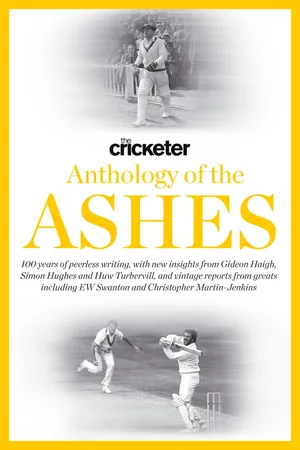
This superb anthology showcases 100 years of peerless writing on the Ashes from
The Cricketer magazine. Insightful new contributions from today's best cricket writers including Gideon Haigh, Simon Hughes and Huw Turbervill sit alongside vintage reports, features and comment pieces from greats including Pelham 'Plum' Warner, EW Swanton and Christopher Martin-Jenkins.
Relive the brilliance of Don Bradman, Harold Larwood, Jim Laker, Geoffrey Boycott, Ian Botham, Shane Warne, Adam Gilchrist, Andrew Flintoff and others in this fresh new take on the giants of the game. Featuring Simon Hughes' ultimate Ashes XI, Gideon Haigh's five greatest series and lively detours into the controversies and scandals which have defined sport's greatest contest, this definitive history from the world's foremost cricket magazine is as colourful as the Ashes themselves.
- 353 pages
- English
- ePUB (mobile friendly)
- Available on iOS & Android
eBook - ePub
The Cricketer Anthology of the Ashes
About this book
Information
Publisher
Allen & UnwineBook ISBN
9781760638276
Year
2017All-Time Ashes XI
THERE HAVE BEEN 341 Test matches between England and Australia featuring more than 1,000 players in the 135 years that the Ashes have been contested. It is a bitter rivalry that began when people still travelled about in horse-drawn cabs, life expectancy was 45 and Tinder was something you used to get the parlour fire going. The ancient duel has inspired good men to great deeds and so far 533 Ashes centuries have been scored – and, coincidentally, 533 five-wicket hauls taken, as well as 248 victories celebrated with considerable extravagance. It should be an invidious task choosing just 11 to represent an All-Time Ashes XI in an imaginary match at Lord’s against a World XI.
In fact, it is not. The team selected are all universally accepted greats of the game. Their inclusion brooks no argument. There are a few notable omissions, including Herbert Sutcliffe, the only Englishman to have a Test average of more than 60; Harold Larwood – the demon of Bodyline; Jeff Thomson, whose whiplash action and searing pace instilled real fear into opposing batsmen; Clarrie Grimmett, the first man to pass the milestone of 200 Test wickets; and, of course, Ricky Ponting – merciless destroyer of bowlers who became Australia’s leading run-scorer. You cannot forget ‘Fiery’ Fred Trueman either – first man to 300 Test wickets. They are all on the bench. It is only the sheer quality – and longevity – of the men in the final XI who keep them out.
The chosen team – five English and six Australians, including four knights of the realm – offer a tantalising mix of ancient and modern (although none are still playing, unless you can call a three-match series between Warne’s Warriors and Sachin’s Stars in American baseball stadiums as ‘playing’). There are 143 Test hundreds between them and 2,330 wickets. A beguiling all-English opening (batting) partnership of Jack Hobbs and Len Hutton would be a wonderful foil for an all-Australian opening bowling pairing of Dennis Lillee and Glenn McGrath.
Donald Bradman and Wally Hammond, the arch-batting rivals of the 1930s, are automatic picks at 3 and 4 – Hammond’s credentials outdoing Ponting – to be joined by Allan Border at No.5. If you are surprised by this and want to argue for Kevin Pietersen, or one of the Waugh twins or the mercurial Denis Compton perhaps, have a look at Border’s record. An average of more than 50 (one of only three men to achieve that in the 1980s when the all-conquering West Indies fast bowlers were running amok) and a world-record 153 consecutive Test appearances without ever being injured or dropped. AB was a ferocious fighter from his eyebrows to his toenails.
Just when the opposition bowlers will be praying for mercy, having suffered at the hands of that top five, in walk the two most devastating hitters in Ashes history – Ian Botham and Adam Gilchrist – to supply the turbo-thrust. Imagine being a bowler with these two in the middle and the score 500 for 5. Might be time to call the Samaritans.
But whatever total that group conjured up, there is a quintet of bowlers to make opposing batsmen’s lives a misery. Pace, menace and versatility from Lillee, relentless harassment from McGrath, Botham’s waspish swing and hostility, Jim Laker to exploit any slight dustiness in the pitch (how he would have loved DRS) and, of course, the superlative Shane Warne, the peerless wicket thief, to tease the batsmen, like a cat toying with a mouse before devouring him when he is ready.
This is a team of men who never countenance defeat; the word is not in their DNA. They have led and inspired their teams to momentous feats that have captured the interest of the world like no other sporting event bar the Olympics and the World Cup. They have given the Ashes its unique flavour and helped make the ancient little urn one of the most coveted trophies in sport.
No.1 Jack Hobbs
Jack Hobbs has the ultimate credentials for being included in the All-Time Ashes XI: he scored more centuries (199) than anyone else in the history of the game and was known as The Master. Twelve of these hundreds were against Australia (second only to Donald Bradman in Ashes records). He was the original run machine. With a colossal 61,760 first-class runs to his name, he is the definition of insatiable. Even Geoff Boycott addressed him as ‘sir’.
He was born John Berry Hobbs in 1882 in Cambridge. From an early age he was destined to be a batsman. His father was a professional net bowler at Fenner’s, then a groundsman and, finally, an umpire. The ideal combination. Prepare a lovely pitch for your son, bowl him a few in the nets to get his eye in and then offer a grave shake of the head whenever an opposing bowler appealed for lbw in the match. As the first of 12 children, Hobbs also eventually had an entire team of brothers and sisters to practise with. Yet his basic skills were honed alone – Bradmanlike – by hitting a tennis ball against the wall of a fives court with a stump. He never had any coaching.
He played for Cambridgeshire in his teens and his services were offered to Essex, the nearest first-class county, in 1904. He was rejected so went to join his idol Tom Hayward at Surrey. As it happened, his first Championship game was against Essex. Put straight in to open, he scored 155. Red faces all round Chelmsford, you would imagine. After nine more centuries in the next couple of years he got an England call-up for the Ashes tour of 1907–8 and made 83 in his first Test innings in Melbourne. He had to wait 23 innings for his first Test hundred (against South Africa) but after that reeled them off with elan. By 1911 he had eclipsed the legendary Victor Trumper as the best batsman in the world (although at that stage only England, Australia and South Africa played Test cricket).
With a light and compact build, Hobbs had a high, flowing backlift, great balance, and moved nimbly into position. Joe Root might be a modern comparison. He seemed to know instinctively where the ball was going to be before it was delivered, a mark of most great batsmen. With superb wrists and deft placement, he was exceptionally good on a tricky pitch. He was expert at dabbing an awkward ball short or wide of a fielder and strolling a run, and was prolific off the back foot.
He was a self-deprecating character, though, who permanently shunned the limelight and, if Surrey were going well on a flat track, often gave his wicket away to a toiling bowler and left the field chuckling to himself. According to his first regular England opening partner, Wilfred Rhodes, ‘he could have got 399 hundreds if he’d wanted’. The famous writer RC Robertson-Glasgow, who played for Somerset, described playing against Hobbs at The Oval as ‘like bowling to God on concrete’.
The First World War interrupted his serene progress to 100 hundreds (achieved in 1923) after which he forged an opening partnership for England with Yorkshire’s Herbert Sutcliffe that has no equals. They put on 3,249 runs together and averaged 87 for the first wicket (20 more than any other regular pair in Test history). Their partnership may have been a southern-polish–northern-grit cliché, but they shared 15 century-opening partnerships for England. One of these was a defiant, brilliant 172 on a brute of a ‘sticky-dog’ at The Oval. The saturated pitch required them to show incredible judgement and fortitude and take many blows on the body, and the partnership was instrumental in England winning the final Test of 1926 and regaining the Ashes for the first time since 1912. (This Test was, incidentally, the first in England that had been extended to a fourth day.)
Off the field Hobbs kept a low profile. He married his childhood sweetheart, was a regular churchgoer and never drank alcohol. When he finally equalled WG Grace’s record tally of 125 centuries he celebrated with a glass of ginger beer. He scored 100 hundreds after his 40th birthday and was still playing for Surrey (and going in first and scoring centuries) at the age of 51. He was knighted in 1953 and in 2000 came third (after Bradman and Sobers) in the Wisden poll to declare the greatest cricketers of the 20th century. He is the finest opening batsman who ever lived. There is really no argument about that.
*
Hobbs’ 1924–5 Ashes tour as summed up by ‘Ignotus’ in The Cricketer.
Hobbs is the master bat of his time, and his reputation had much to lose and little to gain by a further visit to Australia at the age of 42. That he enhanced his reputation – and no one will dispute it – was certainly remarkable. His scores in the Test matches were 115, 57, 154, 22, 119, 27, 66, 0, and 13, and his first-wicket partnership with Sutcliffe of 282 runs in the second match, when the Australians had made 600 runs, was a prodigious effort. In a word, he is indisputably our greatest living cricketer, a batsman pre-eminent in any age and unique in his own generation.
Plum Warner celebrates possibly Hobbs’ most significant England innings as he sets up victory in 1926 with Herbert Sutcliffe to regain the Ashes on his home ground.
When England went in again I must confess that I felt anxious. So much depended on a good start. Once again did Hobbs and Sutcliffe prove equal to the occasion, and I can only repeat what I have said of these two batsmen before, that they are even greater, if possible, in temperament than in skill. They are fit men indeed to go in first for England.
Finer cricket on a difficult wicket than Hobbs and Sutcliffe played I have never seen. Much, almost everything, indeed depended on them. If one or both had failed, England might easily have lost five or six men before lunch, for the ball took the spin quickly, and when the sun – which at first hid its face – came out after the first hour, the ball, particularly from Richardson’s bowling, kicked up frequently in a disconcerting manner.
But once again the two famous batsmen proved equal to the greatest emergency, and no praise can be too high for what they did. They have made their names immortal in the history of cricket.
Only three runs were made off nine overs from Richardson, and the manner in which both batsmen – and particularly Hobbs, who took charge for the most part at the end to which Richardson was bowling – gave the rising ball the ‘dead bat’ was masterly.
I have never seen Hobbs show himself a greater batsman than he did on Tuesday, and Sutcliffe was equally great. Tremendous was the applause when the two men came back to the pavilion at the luncheon interval, with the score at 161 – Hobbs 97, Sutcliffe 53. Almost immediately after lunch Hobbs completed his hundred, and pandemonium broke loose, the game being interrupted for several minutes while cheer after cheer rent the air. In all his long career he has never played a finer or more valuable innings.
That first wicket stand of our most famous pair of 172 made victory almost a certainty for us. Had either of them failed, we might well have been out for a total of 180 or 200.
That they did not fail us at a time of most desperate crisis was only in keeping with their reputation. Never had English cricket known a more dauntless pair: the greater the task the greater their endeavour.
No.2 Len Hutton
There is a terrible old joke that puts into perspective Len Hutton’s inestimable value to England. Two Yorkshire neighbours arrive at the Headingley Test but realise they have forgotten their sandwiches. Being a Yorkshireman, one goes back home to get them. When he returns he has a grave look on his face. ‘I’ve got bad news,’ he says. ‘’Ouse has burnt down, wife’s run off and kids are in’t street in tears.’ ‘And I’ve got bad news for thee too,’ says his mate. ‘’Utton’s out!’
It is said that northerners mature earlier than people from the south and, rather like Geoff Boycott and more recently Joe Root, Len Hutton was already the complete player at the age of 22. By this time he had already scored 2,888 runs in a season for Yorkshire and compiled the highest individual Test match score – 364 against the 1938 Australians at The Oval – in just his sixth appearance for England. This effort lasted 13 hours, during which he faced 847 balls, and is comfortably the longest Test innings (by balls faced) ever played. So his immaculate technique and immense staying power were already well established.
He was averaging 67 in Tests when the Second World War interrupted his progress, and a severe injury to his left arm in a training accident inconvenienced him for a while. But after the war he continued his monumental scoring feats – dealing with the twin handicaps of one arm shorter than the other and treacherous uncovered pitches – with sublime footwork and deft touch. He was prolific through the offside – his extra-cover drive was a national treasure – and it was said that his movements to the ball were every bit as slick and certain as Bradman’s. He was a pragmatist, too; when asked how do you play fast bowling, famously replying, ‘from t’other end’.
As much as his indefatigable batting, Hutton is legendary for becoming the first professional to captain England (in 1952), a post he ascended to despite not captaining Yorkshire who still insisted on having amateurs in charge. Preaching his simple mantras – ‘sell thy wicket dear and give ’em nowt’ – his promotion had instant results, enabling England to hold the Australians at bay for the first time in two decades in 1953.
The first four Tests of that series were drawn, after which England, thanks to Hutton’s determined 82 in England’s first innings on a dusty pitch at The Oval, took a precious first-innings lead. Jim Laker and Tony Lock routed the Aussies in the second innings, meaning England needed just 132 to regain the Ashes for the first time in 18 years.
The tension was palpable at a packed ground as Hutton and Bill Edrich set off in pursuit of this modest target, and on 24 Hutton set off for an unlikely third to deepish square leg and was run out. The Daily Telegraph’s EW Swanton wrote, ‘I have not known a similar moment of complete, quiet, stupefaction.’ Edrich and Compton held their nerve, however, and England won by eight wickets, not only regaining the urn but defeating Australia at home for the first time in 27 years.
There was no triumphant street parade or reception at 10 Downing Street (Winston Churchill wasn’t much of a cricket fan), but Hutton got his due recognition with a knighthood a couple of years later, Her Majesty the Queen politely overlooking his famous faux pas of asking Australia to bat in Brisbane in 1954–5 when he won the toss. They made 601 for 8 and won by an innings. It was practically the only blot on a magnificent career. Compton called him ‘the greatest opening batsman I have ever seen’.
A quiet man off the field, he was not quite as painstaking as chairman of England selectors as he had been as batsman and captain. Having selected Graham Gooch for his first Test in 1975 he asked the debutant if he had ever played against Australia before. ‘Well, yes,’ replied Gooch, ‘you chose me for the MCC XI against the Aussies two weeks ago’ [a match in which Gooch made 75]. ‘Did I?’ said Hutton. ‘Sorry, I don’t watch much cricket these days.’
*
The Cricketer reports on Hutton’s record-breaking innings at The Oval in 1938.
Of Hutton’s wonderful innings it is impossible to speak too highly. At the close of the second day’s play he had been batting for 11 hours and 5 minutes and 27 4s. On this day he never gave a semblance of a chance, and it was indeed a truly remarkable contribution of skill, concentration and endurance for a player who was only 22 on June 23. It may be urged that Hutton made his runs slowly, but he is nevertheless an extremely interesting batsman to watch.
Gradually Hutton approached Bradman’s record of 334 and though he failed to take advantage of a no-ball from O’Reilly a beautiful cut off Fleetwood-Smith, which sent the ball to the boundary, gave him the record. The crowd roared their approval and Bradman raced to shake hands with the young Yorkshireman. The Australians toasted him and the spectators sang ‘For he’s a jolly good fellow’ and cheered again and again.
In 1950–51, Hutton stamped his authority as the best batsman in the post-Bradman world, as seen by Ray Robinson.
Hutton’s play won him the rare distinction of being acknowledged by both sides as the greatest batsman ...
Table of contents
- Cover
- Title Page
- Contents
- List of Illustrations
- Introduction
- The Cricketer: a timeline
- 1 All-Time Ashes XI – Simon Hughes
- 2 The Five Greatest Ashes Series – Gideon Haigh
- 3 Diplomacy, Politics, Controversy: Five Ashes Flashpoints – James Coyne
- 4 15 Minutes of Fame – Huw Turbervill
- 5 The Best of The Cricketer – Jamie Crawley
- 6 The Ashes by Numbers – Philip Bailey
- About the authors
- Index
- Picture Section
- Copyright
Trusted by 375,005 students
Access to over 1.5 million titles for a fair monthly price.
Study more efficiently using our study tools.