Ingenious, charming, informative and full of delight. -
The Times
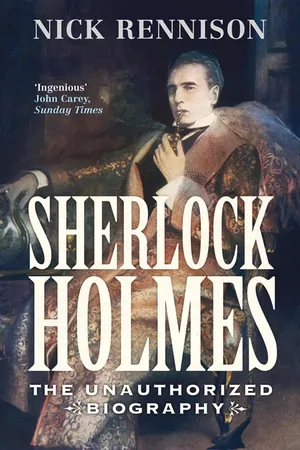
Sherlock Holmes: The Unauthorized Biography blends what we already know of the great sleuth's career with carefully documented social history to answer the questions admirers have long puzzled over. Nick Rennison reveals for the first time Holmes's influence on the political events of late-nineteenth-century England and his connections to the British criminal underworld. It also brings to light his close friendships with key figures of the day, including Oscar Wilde and Sigmund Freud; and exposes the truth about his cocaine use.
- 280 pages
- English
- ePUB (mobile friendly)
- Available on iOS & Android
eBook - ePub
About this book
Information
Subtopic
Literary BiographiesIndex
LiteratureCHAPTER ONE
‘MY ANCESTORS WERE COUNTRY SQUIRES’
THE VILLAGE OF HUTTON LE MOORS lies on the edge of the Yorkshire Moors, a dozen miles from the small town of Pickering. Despite the onslaught of the traffic passing along what is now the A170 to Scarborough, the heart of the village has changed surprisingly little in the past century and a half. Thirty or forty slateroofed cottages, many of them dating back to the seventeenth century, straggle along both sides of the road. A pub, the Green Man, and the village church of St Chad still provide the central focuses for village life. Half a mile beyond the older cottages, on the edge of the village, stands a small estate of 1950s council houses. They were built on land that the council bought after the Second World War from a Bradford mill-owning family by the name of Binns. Until the mid-1920s, Hutton Hall, a sixteenth-century manor house, stood on the site. Photographs of the house, which appeared in Country Life in May 1922, show a half-timbered frontage studded with mullioned windows and surmounted by the elaborate chimneys so typical of the period. Shots of the interior reveal impressive oak panelling and a large fireplace, adorned with the initials RH and dating back to the time of Elizabeth I, all of which were still in existence when the Binns family lived there. Here, on 17 June 1854, William Sherlock Holmes was born.
Holmes, as recorded by Watson, makes very few remarks about his family and upbringing but those few are clear and unequivocal enough. ‘My ancestors,’ he tells Watson in ‘The Adventure of the Greek Interpreter’, ‘were country squires, who seem to have led much the same life as is natural to their class.’ He tells us nothing more. In fact Holmes’s father, William Scott Holmes, inherited the remains of a substantial estate in north Yorkshire.
There had been Holmeses living in that part of Yorkshire for centuries. As far back as 1219 an Urkell de Holmes is mentioned in the records of York Assizes and, by the late Middle Ages, the Holmes family had risen from the ranks of yeomen farmers to the lesser gentry. The Walter Holmes from Kirkbymoorside, eight miles from Pickering, who is recorded as fighting with the Yorkist forces of Edward IV at the Battle of Towton in 1461, is almost certainly a direct antecedent of Sherlock and Mycroft. Walter had chosen the right side in the Wars of the Roses and he prospered as a consequence. Several years after the battle he was knighted by Edward and the family went up another rung on the social ladder. Walter survived the transition from a Yorkist monarchy to the reign of the Tudors with his status intact (he seems to have been one of the few Yorkshire baronets to have supported Henry VII before the Battle of Bosworth).
His grandson, Ralph, was to raise the Holmes profile even higher. In the mid-1530s, Sir Ralph, one of the century’s more opportunist converts to Protestantism, was in a position to benefit substantially from the dissolution of the monasteries. As the great landholdings of monastic establishments such as Fountains Abbey and Rievaulx Abbey came under the hammer, Sir Ralph and people like him were poised to pounce. Much of the property owned by Fountains Abbey was sold, at a knockdown price, to entrepreneur Sir Richard Gresham. However, Sir Ralph Holmes, an associate of Gresham, received his share of the spoils in the form of an estate at Hutton le Moors as well as other landholdings dotted around the Vale of York and the fringes of the moors. It was Sir Ralph, made prosperous by his part in the despoliation of monastic property, who built Hutton Hall, the house in which, 300 years later, his most famous descendant was to be born.
Under the later Tudors and Stuarts the family made a point of avoiding the religious and political controversies of the time. Sir Stamford Holmes was a member of successive Elizabethan and Jacobean parliaments but an undistinguished one. There are records of only two contributions by him to their proceedings. In one he intervened in a debate on shipping convicts to Barbados to suggest that the colonies in New England might also be a good destination for lawbreakers. He was reminded by a fellow MP that, since felons were being sent there as indentured labourers, they were already being used for this purpose. In the other he asked the Speaker whether the doors of St Stephen’s Chapel, Westminster, where Parliament met at the time, could be closed since he and other members were feeling the draught.
By the time of the confrontation between king and Parliament in the 1630s and 1640s, however, even the most lackadaisical of MPs and landowners were forced to choose sides. Although Sherlock Holmes, ascetic and intellectual, would probably be classified as one of life’s Roundheads, his ancestors chose the king’s cause and remained firm Royalists throughout the Civil War. Sir Symonds Holmes, grandson of Sir Stamford and great-great-grandson of Sir Ralph, fought with Prince Rupert’s cavalry at the Battle of Marston Moor in 1644. The family suffered for its loyalty although the Holmeses were not forced, like so many others, into exile during Cromwell’s rule.
At the Restoration, monarchists such as the Holmes who had kept the faith stood to prosper. Sir Richmond Holmes, son of Sir Symonds, moved south to London in the 1670s after his father’s death and thereafter spent more time on the fringes of Charles II’s court than he did on his Yorkshire properties. In attempting to carve out a career there, he began the slow slide into indebtedness that plagued the family for generations to come. Friendship with the likes of the dissolute Earl of Rochester, poet and philanderer, was an expensive indulgence and, by the time of his death in 1687, Sir Richmond owed large sums to half the moneylenders in the capital.
The eighteenth century saw a continuous decline in the fortunes of the family. As one scapegrace spendthrift succeeded another, the estate was sold bit by bit until only the old manor house at Hutton le Moors, first built in the 1550s, was left. Sir Selwyn Holmes, reputed to be an associate of Sir Francis Dashwood and a member of the infamous Hell-Fire Club, was the most notorious of a succession of Holmes ancestors who more resembled Sir Hugo Baskerville than they did their intellectual descendant, Sherlock. Sir Seymour Holmes, Sherlock’s great-grandfather, the last of these roistering Georgian roués who squandered most of the family inheritance, died of an apoplexy in 1810. He was succeeded in the baronetcy by his fourteen-year-old son. Sherlock Holmes’s grandfather, Sheridan Holmes, inherited little but debts and the family name. Then at Harrow, the school that the Holmes males had attended for generations, the young Sheridan was in no position to improve the family fortunes but sufficient funds were eventually found to see him through Christ Church, Oxford, and to allow him later to travel abroad. (He seems to have departed Oxford without a degree.) It was on foreign shores, if nothing else, that he was to meet his future wife.
The only exotic influence in his family tree claimed by Holmes is his grandmother, the woman Sir Sheridan Holmes married, who was ‘the sister of Vernet, the French artist’. ‘Art in the blood,’ he goes on to say, ‘is liable to take the strangest forms.’ The Vernets were a tribe of French painters, who produced distinguished artists in several generations. The patriarch of the family was Antoine Vernet (1689–1753), several of whose more than twenty children became artists. One, Claude-Joseph Vernet (1714–89), was so committed to his art that he arranged to be lashed to a ship’s mast during a storm at sea so that he could observe the effects of light and turbulent water at close hand. The most famous of the Vernets, whose youngest sister married Holmes’s paternal grandfather, was the grandson of Claude-Joseph, one Emile-Jean-Horace Vernet (1789–1863), known to his familt as Horace. Best known as a painter of scenes of military valour and derring-do, Horace was at the heart of the Parisian art establishment, serving as president of the French Academy from 1828 to 1834. His sister, Marie-Claude, was born in Paris in 1798. She was just nineteen when she met the Englishman who was to take her across the Channel to a life she could not have imagined as she was growing up in Napoleonic France.
We do not know the circumstances in which Sheridan Holmes, Sherlock’s paternal grandfather, first encountered his wife to be. He was certainly in Paris for several months in the spring and summer of 1818 – a few surviving letters confirm this. It may well be that Sheridan harboured artistic ambitions and, in order to pursue them, travelled to Paris where he was introduced to one of the extensive Vernet clan. The marriage took place in London at St George’s, Hanover Square, in the early summer of the following year. The entry in the church’s marriage register, with the bride’s name misspelled as Verner, still exists. Holmes owed more to his French ancestry than he ever admitted. It is worth noting that the composer Mendelssohn, who knew the Vernet family well, said of Horace that his mind was so orderly that it was like a well-stocked bureau in which he had but to open a drawer to find what he needed. He added that Horace’s powers of observation were so great that a single glance at a model was sufficient to fix the details of his or her appearance in his memory.
Sherlock’s father, William Scott Holmes, the eldest of three children, was born in Hutton le Moors on 26 November 1819. Comparison of his date of birth and the date of his parents’ marriage immediately reveals that Marie-Claude must have been pregnant with him as she walked down the aisle at St George’s. Two further children followed in rapid succession, Maria in 1821, and Emily in 1822, whereupon Sir Sheridan, who had probably suffered from ill health most of his life, went into a decline and died of consumption in the autumn of 1823 at the age of only twenty-seven. He was succeeded by his four-year-old-son, Sherlock Holmes’s father. Marie-Claude, still only in her mid-twenties and far from her Parisian birthplace, had to cope with her abrupt widowhood, living in an ancient and draughty house on the edge of the Yorkshire Moors with three young children to bring up alone. The new young baronet was educated, like so many of his forebears, at Harrow and Christ Church, Oxford, but he went one better than his father and graduated with a second-class degree in Classics in the spring of 1841. We do not know how he passed the next four years of his life. Perhaps, like his father, he travelled on the Continent but, if he did, he found no bride waiting for him in Paris. His own choice for a wife was made much nearer home.
On 12 July 1845, William Scott Holmes married Violet Mycroft at Hutton le Moors in the parish church of St Chad. The Mycrofts were another family of impoverished Yorkshire gentry who had lived at Marton Hall near the village of Nun Marton for centuries. There was little to distinguish them from dozens of other families of their class. The branch from which Violet descended had been clergymen for generations. Her father, Robert Mycroft, who married the couple, was rector of St Chad’s and we can assume that William and Violet had known one another since childhood. Robert’s grandfather, George Riley Mycroft, who was rector of Lastingham in the North Riding of Yorkshire for more than fifty years, gained some small renown as the author of The Beauties of Creation: or a New Moral System of Natural History, Displayed in the Most Curious Quadrupeds, Birds, Insects and Flowers of Northern England, published in York in 1727. George Mycroft, despite a desire to corral the natural world into his own moral view of the universe, was a scrupulous observer of the creatures he saw in his moorland parish and as a result his book was still being read at the end of the century. Erasmus Darwin, grandfather of Charles, makes a brief reference to ‘Mycroft’s remarkable acuity of observation’ in a letter of 1791. Violet herself had been born at Skelton, just outside York, where her father was then curate, on 11 May 1823.
Sherlock Holmes once remarked, ‘I have a theory that the individual represents in his development the whole procession of his ancestors, and that such a sudden turn to good or evil stands for some strong influence which came into the line of his pedigree. The person becomes, as it were, the epitome of the history of his own family.’ It is difficult to believe that, if he looked back at his own pedigree, he could gain much support for his theory. The life of Sir Symonds Holmes, the seventeenth-century ancestor who fought for the king in the Civil War, conducted experiments in microscopy (he was one of the first subscribers to Robert Hooke’s ground-breaking work Micrographia in 1665) and, in the 1660s, became an early member of the Royal Society, provides some evidence for an ancestral interest in the sciences. This link is strengthened by the fact that his mother’s great-grandfather found such fascination in the natural history of the North of England. It would later be reflected in his own scientific bent. Otherwise the centuries-long procession of Holmes’s ancestors differed little from many other families from the lower echelons of the English gentry.
Sherlock Holmes was the second child of his parents, arriving seven years after his brother Mycroft, born in 1847. Where did the name Sherlock originate? Conan Doyle, when in the mood to fuel the fantasy that he had invented Holmes, would claim that he had borrowed the name from a cricketer of the 1870s and 1880s, but the truth is more mundane. Sherlock, like Mycroft, was a family name. One of his great-uncles on his mother’s side had been Joseph Sherlock, an eighteenth-century lawyer in the town of Pickering, and the name had already been used for several children over two generations. The practice of using these family surnames as first names was a common one. There is an exact parallel in the naming of Holmes’s friend and agent, Arthur Conan Doyle, who took his middle name from his great-uncle, Michael Conan, a well-known editor and journalist.
In the seven years that separated the births of the two Holmes brothers, Violet Holmes – if the veiled hints that survive in a handful of letters are to be trusted – had twice been pregnant and twice lost the child through a miscarriage. In such matters, Victorians of her class used euphemisms more often than direct language but the references to her ‘most delicate state of health’ and her ‘two sad losses’ seem fairly clear. If we assume that Sherlock Holmes was born after his mother had lost two previous babies, it would explain much about his early childhood. We have little evidence on which to base speculation about his first years of life but what there is does suggest that he proved an anxiety to his family from the first. That anxiety can only have been increased by Violet’s past history. A fragment of a letter that survives in the Vernet family archives in France, dated 21 November 1854, is almost certainly from Marie-Claude Holmes, in her Yorkshire exile, to her brother Horace, and the ‘petit enfant’ who is described as ‘faible’ is probably the five-month-old Sherlock. If Sherlock was ‘faible’ in his first year of life, he soon became stronger. There is no evidence that, physically, he was anything other than robust but from his early childhood onwards his parents worried about the mental and emotional development of their younger son.
In the 1880s, Watson described his room-mate’s sudden swings of mood. ‘Nothing could exceed his energy,’ Watson says, ‘when the working fit was upon him; but now and again a reaction would seize him, and for days on end he would lie upon the sofa in the sitting-room, hardly uttering a word or moving a muscle from morning to night.’ This was surprising enough behaviour in an adult, although Watson seems to have adapted to it with remarkable good humour. In a child, however, the sudden withdrawing into silence and immobility, the days when the young Holmes refused to respond at all to the world around him, were alarming to his parents. Another letter, this one from Sherlock’s father to an old college friend, speaks of the boy’s ‘strange indifference to the daily round of our bucolic life’ and of the impossibility of sending him away to school.
There is no doubt that Sherlock Holmes was a difficult and worrying child but is there any evidence that he was, as some ingenious commentators have suggested, autistic? In the mid-nineteenth century autism still awaited clinical definition and description. (The word was coined in 1911 by the Swiss psychiatrist Eugen Bleuler* and it was not until the 1940s that detailed case descriptions were published.) Yet there are certainly similarities between stories of Holmes, both as a child and as an adult, and modern case histories of autistic individuals. The odd detachment from the everyday world, the peculiar fixations on particular objects and the careful classification of them (his monographs on the 140 different varieties of pipe, cigar and cigarette tobacco ash, for example), the inability to understand or empathize fully with other people’s emotions and the heightened acuity of some senses – these all mirror ways in which the autistic interact with the world. Yet the final judgement must surely be that Holmes was not autistic in today’s definition of the word. No autistic person would have been able to sustain such a wide-ranging and demanding career as he did over nearly fifty years. No autistic person would have reacted with such a sudden outburst of suppressed emotion as does Holmes in ‘The Adventure of the Three Garridebs’ when he believes that Watson has been shot.
As his father’s letter shows, however, there could be no question of Sherlock attending school. In 1860, the thirteen-year-old Mycroft, previously tutored at home by his father and by local clergyman William Barnes, was sent south to attend Harrow. Perhaps surprisingly, he adapted with remarkable ease to the spartan environment of the school, and favourable reports of his academic prowess, particularly in mathematics, soon began to arrive in north Yorkshire. The six-year-old Sherlock was probably given his first lessons by his mother but they were to be cut short by tragedy. Violet Mycroft Holmes died on 23 August 1861. On her death certificate the cause of death is given as ‘consumption’ and she had no doubt been suffering from what the Victorians often called ‘the white death’ for years. Indeed, the state of her health may well have contributed to her miscarriages in the early 1850s.
Less than three years later, the family suffered another bereavement. Holmes’s grandmother, born Marie-Claude Vernet, died of heart failure on 18 January 1864. She was sixty-five and had lived for more than forty years in the wilds of the Yorkshire Moors, far from the Parisian salons and artists’ studios in which she had spent her youth. The losses of both mother and grandmother severely affected the Holmes brothers, but it was the younger Sherlock who was hit the hardest. Fourteen at the time of his mother’s death, Mycroft had been attending Harrow for barely a year. He came home for the funeral, returning afterwards to school and, in its bracingly unsentimental atmosphere, was forced to come to terms with the bereavement in order to survive from day to day.
The great public schools in the mid-nineteenth century were slightly more civilized than the self-contained worlds of Hobbesian nastiness and brutishness that they had been before Victoria came to the throne. The reforming zeal of headmasters like the legendary Thomas Arnold at Rugby brought improvements. But they still remained places where only the strong flourished and the weak went to the wa...
Table of contents
- Cover
- Sherlock Holmes
- Copyright
- Dedication
- Acknowledgements
- Introduction
- 1. ‘My ancestors were country squires’
- 2. ‘This inhospitable town’
- 3. ‘You have been in Afghanistan, I perceive’
- 4. ‘He is the Napoleon of Crime’
- 5. ‘You should publish an account of the Case’
- 6. ‘I’ve had to do with fifty murderers’
- 7. ‘The many causes célébres and sensational trials in which i have figured’
- 8. ‘I should never marry …’
- 9. ‘I travelled for two years in Tibet’
- 10. ‘I then passed through Persia …’
- 11. ‘I hear of Sherlock everywhere’
- 12. ‘Occasional indiscretions of his own’
- 13. ‘A small farm upon the downs’
- 14. ‘There’s an east wind coming’
- 15. ‘The greatest mystery for last’
- Select Bibliography
- Index
Trusted by 375,005 students
Access to over 1.5 million titles for a fair monthly price.
Study more efficiently using our study tools.
Frequently asked questions
Yes, you can cancel anytime from the Subscription tab in your account settings on the Perlego website. Your subscription will stay active until the end of your current billing period. Learn how to cancel your subscription
No, books cannot be downloaded as external files, such as PDFs, for use outside of Perlego. However, you can download books within the Perlego app for offline reading on mobile or tablet. Learn how to download books offline
Perlego offers two plans: Essential and Complete
- Essential is ideal for learners and professionals who enjoy exploring a wide range of subjects. Access the Essential Library with 800,000+ trusted titles and best-sellers across business, personal growth, and the humanities. Includes unlimited reading time and Standard Read Aloud voice.
- Complete: Perfect for advanced learners and researchers needing full, unrestricted access. Unlock 1.5M+ books across hundreds of subjects, including academic and specialized titles. The Complete Plan also includes advanced features like Premium Read Aloud and Research Assistant.
We are an online textbook subscription service, where you can get access to an entire online library for less than the price of a single book per month. With over 1.5 million books across 990+ topics, we’ve got you covered! Learn about our mission
Look out for the read-aloud symbol on your next book to see if you can listen to it. The read-aloud tool reads text aloud for you, highlighting the text as it is being read. You can pause it, speed it up and slow it down. Learn more about Read Aloud
Yes! You can use the Perlego app on both iOS and Android devices to read anytime, anywhere — even offline. Perfect for commutes or when you’re on the go.
Please note we cannot support devices running on iOS 13 and Android 7 or earlier. Learn more about using the app
Please note we cannot support devices running on iOS 13 and Android 7 or earlier. Learn more about using the app
Yes, you can access Sherlock Holmes by Nick Rennison,Nick Rennsion in PDF and/or ePUB format, as well as other popular books in Literature & Literary Biographies. We have over 1.5 million books available in our catalogue for you to explore.