John Gilligan is one of the most notorious and hated criminal figures in Irish history. His name is indelibly etched in the national psyche a quarter of a century after he crossed the line to organise the execution of the fearless, high-profile journalist Veronica Guerin. Gilligan's motive for the assassination was, in the words of the prosecution at a subsequent murder trial, 'the necessity of having to protect an evil empire'. At the time Gilligan was one of the most powerful and feared godfathers in the country who controlled a colossal drugs empire and the underworld's most dangerous mob.
Gilligan tells the story of a young man's rise through the ranks of gangland following his journey from petty thief to public enemy number one. He was part of the generation of young criminals - like the General, the Cahills, the Hutches - who ushered in the phenomenon of organised crime in Ireland and became household names in the process.
This close-up look at a criminal mastermind contains new details including a graphic account of the planning of the Guerin murder, drawn from a sealed statement which was never used, and the prison time and criminal activity which have occupied Gilligan since, up to his recent arrest in Spain on drug trafficking charges.
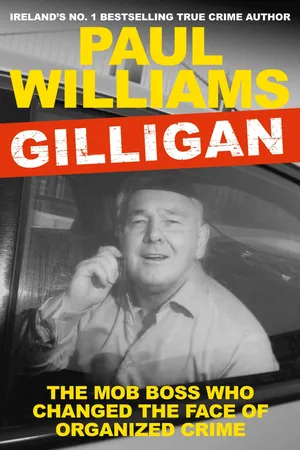
- 392 pages
- English
- ePUB (mobile friendly)
- Available on iOS & Android
eBook - ePub
About this book
Information
Print ISBN
9781838954918
Subtopic
Irish HistoryCHAPTER ONE
______
THE MAKING OF A MOBSTER
Special Criminal Court, Dublin, 15 March 2001
The old courthouse building in the centre of Dublin had been the venue for many noteworthy trials in Irish history since it opened its doors in 1797, including those of Irish freedom fighters Robert Emmet and Wolfe Tone. John Gilligan’s trial on charges of murder, possession of firearms and running a multi-million-euro drugs empire was another landmark case. It had been one of the most high-profile trials in the history of organized crime. The three judges of the non-jury, anti-mafia and anti-terrorist court had sat through forty-three days of evidence.
John Gilligan sat in the raised dock looking down into the court chamber with his customary smirk on his face. He was the last member of his once powerful gang to face justice. The mobster, whose rapid ascent as the country’s most powerful godfather ushered in a new era of violent organized crime in Ireland, had been tried in the special criminal court to prevent jury tampering.
On 15 March the judges returned to deliver their landmark verdict before a courtroom filled to capacity with police officers and the media. The judgment had been eagerly awaited as the trial gripped the nation. The courtroom was silent as the chairman, Mr Justice Diarmuid O’Donovan, stated:
While this court has grave suspicions that John Gilligan was complicit in the murder of the late Veronica Guerin, the court has not been persuaded beyond all reasonable doubt by the evidence which has been adduced by the prosecution that that is so and, therefore, the court is required by law to acquit the accused on that charge.
Gilligan had successfully used his favourite weapons of intimidation and fear to beat the rap for the murder of investigative journalist Veronica Guerin. For the same reasons he had also been acquitted of importing large amounts of firearms and ammunition.
The gang boss looked jubilant as he was acquitted of one of the most shocking murders in Irish history. But the three judges wiped the smile off his face when he was convicted of running the biggest drug trafficking operation ever seen in Ireland.
Gilligan had to wait until after lunch to hear his fate on the eleven drug charges. He wasn’t worried. He was confident that with the years he’d already served in prison awaiting trial he would be set free. The court, however, ensured that he would not be resuming his business anytime soon.
The diminutive mobster stood dumbfounded and ashen-faced in the dock as he was sentenced to twenty-eight years behind bars – the longest prison stretch ever handed down to a dope dealer.
Gilligan was taken into custody, leaving the court with a life sentence similar to the one he would have received had he been convicted of murder. The Irish State had shown its determination to put the country’s most notorious and hated criminal out of circulation once and for all.
The conviction marked the denouement of a vast criminal conspiracy that had culminated in the journalist’s murder in 1996 in an act of narco-terrorism which shocked the world. The assassination of the courageous young mother by a professional hit man had an unprecedented effect on the Irish public and caused a universal outpouring of revulsion, fear and anger. The national sentiment was symbolized by the wall of flowers in her memory which the ordinary citizens spontaneously erected at the gates of Dáil Éireann, expressing their outrage and demanding the government take action against mob bosses who considered themselves to be untouchable.
Gilligan had thrown down the gauntlet to the State with the implicit threat that anyone who interfered in his business was fair game regardless of who or what they were: politician, judge, cop, public servant or law-abiding citizen. He had gone far beyond the unofficial rules of engagement traditionally observed in the underworld.
The vast majority of criminals disapproved of the outrage, primarily because they could see it was bad for business and would have negative repercussions for all of them. They were right. The man who had brought a new level of organization to the business of crime would precipitate a fundamental reappraisal of the way international law enforcement and governments tackled the crime lords. The fightback would be spearheaded by the establishment of a revolutionary new body, the Criminal Assets Bureau (CAB), a unique innovation which became a template for similar units worldwide. The CAB would be given draconian powers to strike at the root of what criminality is all about – money.
In Gilligan’s homeland in Ballyfermot, west Dublin, an elderly man watched the TV news report on the gangland trial which had captivated the nation. Gilligan’s trial shone a rare light on the treacherous secret world of organized crime. It had laid bare a story that was both fascinating and shocking, involving intrigue, guns, drugs, violence, murder and money – eye-watering amounts of money. In just over two years Gilligan and his mob had conservatively profited to the tune of over €50 million in today’s values, through the importation of cannabis worth over €250 million on the streets. And those figures did not include money from the sale and supply of other drugs including heroin, ecstasy and cocaine, or firearms. The prosecution had argued that Gilligan’s motive for the murder of Veronica Guerin was ‘the necessity of having to protect an evil empire’.
The TV footage showed a convoy of police and military vehicles whisking Gilligan off to Portlaoise Prison, the State’s maximum-security detention centre. It was a scene that was more reminiscent of the aftermath of an Italian Mafia trial than an Irish one, reflecting the level of threat that he posed to civilized society. Against a cacophony of blaring sirens and clattering rotor blades from a police helicopter, several garda motorbike outriders, prison vans and jeeps carrying heavily armed soldiers raced through the streets of Dublin with the convoy’s VIP – very important prisoner. Watching the spectacle on the TV screen the old man’s mind wandered back in time to the Ballyfermot of 1960 and one of his first meetings with little John Gilligan.
He recalled being out for an evening stroll one night when he spotted a gaggle of excited little kids scurrying from cover at the edge of the golden wheat field that marked the border between the suburban sprawl and the countryside. It didn’t take much deduction to work out that the little terrors were up to no good. They giggled and nervously glanced back into the vast field of wheat that was ready for harvesting.
The man shouted as he saw a single pillar of smoke rising up from the crop about 500 feet into the field. Within minutes the clouds of black smoke were blocking out the sun as flames destroyed the wheat. He recalled:
I will never forget that day. Ever since the kids had moved out to the new council houses they were always messing in that field lighting fires, but this was the worst I ever saw. It was pure devastation.
One of the watching children, eight-year-old John Gilligan, lived on his road and the old man remembers that the boy’s face was full of excitement as fire engines rushed from the city to quell the inferno. When the fire threatened to spread to the nearby houses the boy laughed until tears streamed down his cheeks. This would not be the last time the eight-year-old caused panic and mayhem in his lifetime.
‘When you look back you never think that an innocent kid like that would turn out to be such a gangster,’ the elderly man reflected sombrely. ‘I always thought that he was a grand kid who just dabbled in a bit of ducking and diving...but don’t use my name, I wouldn’t like the trouble,’ he added cautiously.
The insistence on anonymity said a lot about little John Gilligan, the kid who had progressed from childish vandal and petty thief to international drug trafficker and boss of a dangerous criminal empire. Even old neighbours who had always liked and got on well with him and his family feared him. Despite being universally reviled by fellow criminals and law-abiding citizens alike, and safely locked away, a lot of people in ‘Ballyer’ still considered it safer to exercise discretion when it came to expressing their views on the mobster.
It was hardly surprising. Gilligan built his empire and fierce reputation through the use of fear and intimidation. It was how he had managed to escape a murder conviction. But the courts had ensured it was only a partial victory. He would have plenty of time to reflect on how he had ended up facing a rent-free, long-term stay at the pleasure of the State when he had gone to extraordinary lengths to avoid that exact outcome.
_________
John Joseph Gilligan was born on 29 March 1952 in a rundown tenement in Dublin’s north inner city. He was the fifth of eleven children, four boys and seven girls, born to Sally and John Gilligan, who both came from the area. Sally had been a factory worker until 1945 when it was her misfortune to marry John, a petty thief who also worked as a labourer at Dublin docks. John junior’s arrival coincided with a period of mass migration in the 1950s as families were transplanted from the squalor of the inner-city slums to new sprawling corporation estates on the edge of the capital.
The governments of the day had done commendable work in accelerating slum clearance schemes to alleviate the hardship experienced by impoverished Dubliners for centuries. Unfortunately the new public housing projects that gobbled up the countryside in Ballyfermot, Cabra, Crumlin, Inchicore, Donnycarney, Glasnevin and Marino would sow the seeds of a whole new set of social problems.
Despite providing more living space, privacy and decent sanitation, the new peripheral estates had little else by way of social infrastructure. For many of the tenants this was a lonely, alien world, far removed from the cramped streets of Dublin’s inner city. In the move to better living conditions, whole communities were uprooted and broken up.
The overall effect was a breakdown in social cohesion and an unravelling of the close bonds that had characterized the old neighbourhoods. The grinding poverty had also made the journey with them, with the new estates becoming unemployment black spots.
While the vast majority of people adapted and made decent lives for themselves, the gloomy estates also created criminogenic environments which would produce the armed robbers and drug traffickers of the future. It was on the streets of the inner city and the new suburban ghettos where the story of organized crime in Ireland began.
A new generation of young ruthless hoodlums emerged from the social ferment of the late 1960s and early 1970s and pioneered a new world called gangland. In the decades ahead the alumni of this underworld milieu would become household names – for all the wrong reasons.
John Gilligan was one of them.
__________
Gilligan was a baby when his family was allocated number 5, Lough Conn Road, Ballyfermot, in 1952. It was a modest three-bedroom house with running water and toilet facilities. Although a vast improvement on the slums, the new homes were still relatively small for the large families sent to colonize them. In a society dominated by Catholic doctrine, contraception was both illegal and a mortal sin. It was better to create too many mouths to feed among the poorer classes than offend against the moral law.
Lough Conn Road was on the edge of the maze of concrete streets and lines of houses that marked the newly established border between the rural and urban. A few hundred feet away were wheat fields, stretching as far as the eye could see. The open fields were dubbed the ‘Hollywood Hills’ by the newcomers. A kid could ramble across the rustic expanses of Clondalkin, Palmerstown and Ronanstown, which, over the following decades, would also be gobbled up for homes in the voracious urban expansion around the capital.
Like most of their neighbours, the Gilligans arrived in Ballyfermot carrying all their worldly possessions in prams and carts. When the residents began moving in, the infrastructure was still incomplete and the bus service did not go as far as the estates, forcing them to walk the final part of the journey.
Sally Gilligan had a tough life and was left to make the move alone with her five children under the age of seven. Faced with her husband’s indifference and abuse Sally had applied for one of the new houses in Ballyfermot herself. Unusually, she signed the paperwork, which, in a patriarchal era, was seen as the exclusive duty of the man.
John senior had little interest in the welfare of his young family. He was an alcoholic gambler and a professional thief with a penchant for violence. Small in physical stature, like his namesake son, he was regularly absent from home for long periods either because he was in jail or enjoying the life of a ‘bachelor’ crook in the inner city. He squandered his money on booze and racehorses, leaving his wife and children dependent on the charity of others.
Life in the Gilligans’ new home was characterized by deprivation and physical abuse. When John senior turned up, he regularly beat his wife and children in drunken rages. A family member later described how the crook would send John junior down to the bookies to place bets on horses and wait for the results. When his son invariably returned home with bad news, his father rewarded him with a beating. The children didn’t have toys like the other kids on the road and their father’s self-centred profligacy meant they often went hungry.
Gilligan senior was despised as a bully and a thug who, whenever he was broke, had no compunction about breaking into his neighbours’ homes to steal what little they had. The hallmark of his robberies was kicking in a lower door panel with the heel of his boot. One older detective who arrested him recalled how Gilligan couldn’t understand how the police knew so much about him.
Gilligan senior was one of our habitual thieves and he couldn’t work out why we kept catching him. He often gave us information in return for dropping charges. His son obviously picked up a lot of his characteristics. He was a nasty, evil little man.
While the neighbours reviled John senior, his wife and children were popular in the area. A common theme running through the ethnographies of criminal figures is the perception of the mother as the only source of stability in their otherwise dysfunctional and chaotic lives. Sally Gilligan, like many of the mothers in their neighbourhood, was left to raise a gaggle of hungry children, often alone and penniless, while desperately trying to keep them out of criminality.
Locals would recall how Sally Gilligan insisted that her children were turned out clean and tidy in the best clothes they possessed. They were considered good, helpful neighbours. Gilligan junior’s sisters were hard-working girls who helped babysit local children. One time when an elderly neighbour’s wife died, Sally Gilligan ensured that her kids helped out the widower. A former resident recalled, ‘You couldn’t ask for better neighbours than the Gilligans.’
Whenever John senior was in prison the neighbours would warn their children against gossiping about it as an expression of respect and sympathy for his long-suffering wife. ‘I remember my Da saying that that woman was too good for John Gilligan...
Table of contents
- Cover
- Title
- Copyright
- Contents
- Prologue
- Chapter One: The Making of a Mobster
- Chapter Two: Factory John
- Chapter Three: Heists
- Chapter Four: A Godfather of Crime
- Chapter Five: A Deadly Alliance
- Chapter Six: The Master Plan
- Chapter Seven: Getting Started
- Chapter Eight: The Soldier and the General
- Chapter Nine: Victory Over the Law
- Chapter Ten: Greed
- Chapter Eleven: The Gambler and the Mistress
- Chapter Twelve: The Inquisitive Crime Journalist
- Chapter Thirteen: Paradise Lost
- Chapter Fourteen: Unwanted Attention
- Chapter Fifteen: Prelude to Murder
- Chapter Sixteen: The Hit
- Chapter Seventeen: Prime Suspect
- Chapter Eighteen: The Investigation begins
- Chapter Nineteen: Blackmail and Dirty Tricks
- Chapter Twenty: Loose Ends
- Chapter Twenty-One: Gang Busters
- Chapter Twenty-Two: Closing in
- Chapter Twenty-Three: Battlelines
- Chapter Twenty-Four: Supergrasses
- Chapter Twenty-Five: Facing Justice
- Chapter Twenty-Six: Gilligan’s Last Stand
- Chapter Twenty-Seven: Back Inside
- Chapter Twenty-Eight: Freedom and Pain
- Acknowledgments
- Index
- Picture Sections
Trusted by 375,005 students
Access to over 1.5 million titles for a fair monthly price.
Study more efficiently using our study tools.
Frequently asked questions
Yes, you can cancel anytime from the Subscription tab in your account settings on the Perlego website. Your subscription will stay active until the end of your current billing period. Learn how to cancel your subscription
No, books cannot be downloaded as external files, such as PDFs, for use outside of Perlego. However, you can download books within the Perlego app for offline reading on mobile or tablet. Learn how to download books offline
Perlego offers two plans: Essential and Complete
- Essential is ideal for learners and professionals who enjoy exploring a wide range of subjects. Access the Essential Library with 800,000+ trusted titles and best-sellers across business, personal growth, and the humanities. Includes unlimited reading time and Standard Read Aloud voice.
- Complete: Perfect for advanced learners and researchers needing full, unrestricted access. Unlock 1.5M+ books across hundreds of subjects, including academic and specialized titles. The Complete Plan also includes advanced features like Premium Read Aloud and Research Assistant.
We are an online textbook subscription service, where you can get access to an entire online library for less than the price of a single book per month. With over 1.5 million books across 990+ topics, we’ve got you covered! Learn about our mission
Look out for the read-aloud symbol on your next book to see if you can listen to it. The read-aloud tool reads text aloud for you, highlighting the text as it is being read. You can pause it, speed it up and slow it down. Learn more about Read Aloud
Yes! You can use the Perlego app on both iOS and Android devices to read anytime, anywhere — even offline. Perfect for commutes or when you’re on the go.
Please note we cannot support devices running on iOS 13 and Android 7 or earlier. Learn more about using the app
Please note we cannot support devices running on iOS 13 and Android 7 or earlier. Learn more about using the app
Yes, you can access Gilligan by Paul Williams in PDF and/or ePUB format. We have over 1.5 million books available in our catalogue for you to explore.