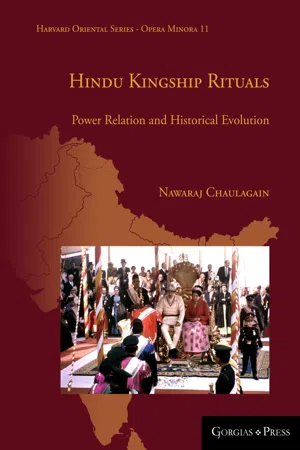
In recent decades, Nepal has witnessed a dramatic shift from its ancient form of Hindu kingship to a federal republican democratic secular order, with the official dissolution of monarchy in 2008. This study deals with the religious lives of the ??h kings of Nepal, concentrating on such major rituals as the "coronation" (r?jy?bhi?eka) and the autumnal navar?tri (Goddess-centered) festival. These are described in Hindu religious literature and in ritual handbooks and were practiced in the royal palaces of the ancient capital of Gorkh? and of Hanum?n?hok? (Kathmandu). The rituals are based on the sacred myths related to divine enthronement and the mythological victory of good over evil, but they were slanted primarily to the production of religious and socio-political sovereign power. The book argues that the Vedic, Tantric and other devotional activities empowered the king and constructed his personal and corporate identity. Such rituals were strongly political because, through them, various divine and human agencies invested the king with multiple powers and authorized him to rule by negotiating their own relations, domains of influence, and hierarchies. The book discusses how these rituals produced a sacred and divine king, sacred kingship and sacred space by establishing the king's connection (bandhu) and identification with many sources of power. They jointly created, perpetuated, and strengthened his power. Myths and rituals were used strategically and ideologically to legitimize the status of the king and enforce the use of power on others. Drawing on many examples from Nepalese history, this monograph also examines how myth and ritual were sites for dialogue, negotiation, resistance, subversion, and replacement of power. This study unravels how religion and politics were deeply intertwined in the ritual activities, and how the rituals, in their traditional deeply religious and devotional settings, exerted a maximum of socio-political powers for the king and his institutions.
- 314 pages
- English
- PDF
- Available on iOS & Android
eBook - PDF
About this book
Information
Table of contents
- ACKNOWLEDGMENTS
- Table of Contents
- Part I: Theoretical Approaches: Rituals, History and Power
- Part II: The Navaratri and Coronation Rituals
- Part III. The Kingship and Sacred Space: The Changing Configuration of a "Hindu" State
- Conclusion
- Appendix-I. Other Popular Royal Rituals and their Socio-political Implications
- Appendix-II. Coronation Program of King Birendra Bir Bikram Sahdev
- ABBREVIATIONS
- BIBLIOGRAPHY
- INDEX
Trusted by 375,005 students
Access to over 1.5 million titles for a fair monthly price.
Study more efficiently using our study tools.
Frequently asked questions
Yes, you can cancel anytime from the Subscription tab in your account settings on the Perlego website. Your subscription will stay active until the end of your current billing period. Learn how to cancel your subscription
No, books cannot be downloaded as external files, such as PDFs, for use outside of Perlego. However, you can download books within the Perlego app for offline reading on mobile or tablet. Learn how to download books offline
Perlego offers two plans: Essential and Complete
- Essential is ideal for learners and professionals who enjoy exploring a wide range of subjects. Access the Essential Library with 800,000+ trusted titles and best-sellers across business, personal growth, and the humanities. Includes unlimited reading time and Standard Read Aloud voice.
- Complete: Perfect for advanced learners and researchers needing full, unrestricted access. Unlock 1.5M+ books across hundreds of subjects, including academic and specialized titles. The Complete Plan also includes advanced features like Premium Read Aloud and Research Assistant.
We are an online textbook subscription service, where you can get access to an entire online library for less than the price of a single book per month. With over 1.5 million books across 990+ topics, we’ve got you covered! Learn about our mission
Look out for the read-aloud symbol on your next book to see if you can listen to it. The read-aloud tool reads text aloud for you, highlighting the text as it is being read. You can pause it, speed it up and slow it down. Learn more about Read Aloud
Yes! You can use the Perlego app on both iOS and Android devices to read anytime, anywhere — even offline. Perfect for commutes or when you’re on the go.
Please note we cannot support devices running on iOS 13 and Android 7 or earlier. Learn more about using the app
Please note we cannot support devices running on iOS 13 and Android 7 or earlier. Learn more about using the app
Yes, you can access Hindu Kingship Rituals by Nawaraj Chaulagain in PDF and/or ePUB format, as well as other popular books in History & Asian History. We have over 1.5 million books available in our catalogue for you to explore.