- 276 pages
- English
- ePUB (mobile friendly)
- Available on iOS & Android
eBook - ePub
About this book
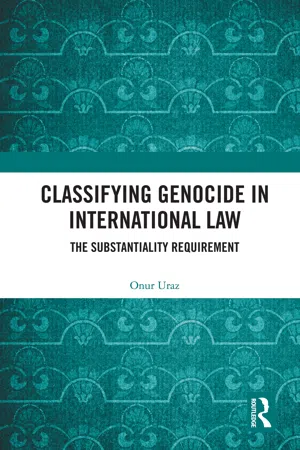
This book offers an in-depth examination into genocide law by focusing on one of the lesser examined, yet practically significant, issues: the 'substantiality requirement'. This refers to the requirement in international law that intended destruction should be directed towards a 'substantial' part of a protected group in order for an atrocity to qualify as genocide. This comprehensive and detailed study draws connections between different judicial approaches to 'substantiality' and the varying theoretical presumptions about the constitutive concepts of the crime. This prima facia doctrinal problem is used as a springboard to scrutinise the broader theoretical problems underlying the legal conceptualisation of genocide. The book systematically explores how the individualistic and collectivistic conceptions of the crime have been able to co-exist in case law and how the different approaches to assessing substantiality have played a backdoor role between these two conceptions. The work demonstrates that these two philosophical standpoints are far from effectively representing the reality of the protected groups and fully explaining the harm inherent to group destruction. The book revisits the recent philosophical and sociological studies on the crime and, considering ideas from the emerging 'relational approaches to genocide', offers a third way to understand the existing legal representation of the crime and, consequently, the idea of 'substantiality'. It demonstrates the practical significance of its theoretical debates and applies its novel perspective through a case study on South Sudan. This book will be highly useful to students and scholars with an interest in genocide studies, international criminal law and legal theory. It will also be of interest to policymakers engaged with issues around genocide.
Table of contents
- Cover
- Half Title
- Title
- Copyright
- Contents
- Table of Cases
- Acknowledgements
- Abbreviations
- 1 An Introduction to the Problem of the Identification and Justification of ‘Substantiality’ in Genocide Law
- 2 Emergence of the Substantiality Requirement as a De Facto Norm and Its Judicial Application
- 3 The Substantiality Requirement in the Legal Literature: Uncovering Binary and Substantialist Thinking
- 4 Beyond Binary and Substantialist Thinking: Embracing the Contingency in the Identification and Justification of ‘Substantiality’
- 5 Locating the Relevant ‘Part’ in Light of the Processual Nature of Group Destruction and the Contextuality of Genocidal Intent
- 6 A Four-Step Examination for Establishing the Crime of Genocide
- 7 A Case Study: The Question of Genocide in South Sudan and the Substantiality Requirement
- 8 Conclusion
- Bibliography
- Index
Trusted by 375,005 students
Access to over 1.5 million titles for a fair monthly price.
Study more efficiently using our study tools.
Frequently asked questions
Yes, you can cancel anytime from the Subscription tab in your account settings on the Perlego website. Your subscription will stay active until the end of your current billing period. Learn how to cancel your subscription
No, books cannot be downloaded as external files, such as PDFs, for use outside of Perlego. However, you can download books within the Perlego app for offline reading on mobile or tablet. Learn how to download books offline
Perlego offers two plans: Essential and Complete
- Essential is ideal for learners and professionals who enjoy exploring a wide range of subjects. Access the Essential Library with 800,000+ trusted titles and best-sellers across business, personal growth, and the humanities. Includes unlimited reading time and Standard Read Aloud voice.
- Complete: Perfect for advanced learners and researchers needing full, unrestricted access. Unlock 1.5M+ books across hundreds of subjects, including academic and specialized titles. The Complete Plan also includes advanced features like Premium Read Aloud and Research Assistant.
We are an online textbook subscription service, where you can get access to an entire online library for less than the price of a single book per month. With over 1.5 million books across 990+ topics, we’ve got you covered! Learn about our mission
Look out for the read-aloud symbol on your next book to see if you can listen to it. The read-aloud tool reads text aloud for you, highlighting the text as it is being read. You can pause it, speed it up and slow it down. Learn more about Read Aloud
Yes! You can use the Perlego app on both iOS and Android devices to read anytime, anywhere — even offline. Perfect for commutes or when you’re on the go.
Please note we cannot support devices running on iOS 13 and Android 7 or earlier. Learn more about using the app
Please note we cannot support devices running on iOS 13 and Android 7 or earlier. Learn more about using the app
Yes, you can access Classifying Genocide in International Law by Onur Uraz in PDF and/or ePUB format, as well as other popular books in Law & Courts. We have over 1.5 million books available in our catalogue for you to explore.