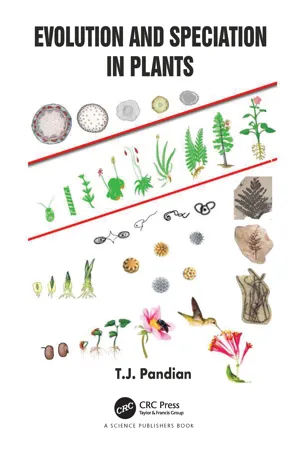
Plants are autotrophs and sessile, while animals are heterotrophs and motile. Sessility has imposed on plants 94% hermaphroditism, 23% selfing, 3% polyploidization and 39% clonality, in comparison to < 5% herma-phroditism, < 1% selfing and 2% clonality in motile animals. Whereas plants consist of 374,000 species but 1,664 variety/species, animals comprise 1,543,196 species and 210 variety/species. Hence, plants have undergone variety diversity, while animals have species diversity. In animals and plants, the species ratio is reduced from 4.1 animals : 1.0 plant to 1.4 for pollinating animals : 1.0 pollinated plants. In pollination, animals are benefited dietarily but plants are cross pollinated, generating new gene combinations – the raw material for evolution and speciation. For the reduced species diversity in plants, reasons are traced to 90% hermaphroditism, ~ 23% selfing and 39% clonality. Clonality decreases from 100% in 6-7 tissue typed sponges and 3 tissue typed algae drastically to 0.7% in 60 tissue typed worms but gradually to ~ 23% in 60 tissued typed angiosperms. About 12-15, 5-8 and 77-80% of all animal and plant species are distributed in marine, freshwater and terrestrial habitats, respectively. Animals have conserved the 'right' sequence of gametogenesis but plants have gone through a 'wrong' sequence prior to settling with right one albeit with double fertilization in angiosperms. Both animals and plants are 80% male heterogametics. Only 0.5% of them can afford semelparity. While 20 and 57% angiosperms are perennial trees and herbs, annual herbs make up 23% only. In all of them, 85, > 19 and < 1% are pollinated by fast flying animals, wind and water, respectively. Increasing pollen load enhances fruit- and seed-set. In contrast to animals, the life cycle of plants is direct but complicated. Unlike animals, plants have greatly contributed to weathering of rocks and the atmospheric gas composition during the geological past. From dormant spores and seeds of plants, life can be restored after thousands of years.
- 348 pages
- English
- ePUB (mobile friendly)
- Available on iOS & Android
eBook - ePub
Evolution and Speciation in Plants
About this book
Information
Table of contents
- Cover Page
- Title Page
- Copyright Page
- Preface
- Acknowledgements
- Table of Contents
- 1. General Introduction
- Part A: Environmental Factors
- Part B: Life History Traits
- Part C: Gametogenesis and Fertilization
- Part D: Germination and Development
- Part E: Past, Present and Future
- 23. References
- Author Index
- Species Index
- Subject Index
- Author’s Biography
Trusted by 375,005 students
Access to over 1.5 million titles for a fair monthly price.
Study more efficiently using our study tools.
Frequently asked questions
Yes, you can cancel anytime from the Subscription tab in your account settings on the Perlego website. Your subscription will stay active until the end of your current billing period. Learn how to cancel your subscription
No, books cannot be downloaded as external files, such as PDFs, for use outside of Perlego. However, you can download books within the Perlego app for offline reading on mobile or tablet. Learn how to download books offline
Perlego offers two plans: Essential and Complete
- Essential is ideal for learners and professionals who enjoy exploring a wide range of subjects. Access the Essential Library with 800,000+ trusted titles and best-sellers across business, personal growth, and the humanities. Includes unlimited reading time and Standard Read Aloud voice.
- Complete: Perfect for advanced learners and researchers needing full, unrestricted access. Unlock 1.5M+ books across hundreds of subjects, including academic and specialized titles. The Complete Plan also includes advanced features like Premium Read Aloud and Research Assistant.
We are an online textbook subscription service, where you can get access to an entire online library for less than the price of a single book per month. With over 1.5 million books across 990+ topics, we’ve got you covered! Learn about our mission
Look out for the read-aloud symbol on your next book to see if you can listen to it. The read-aloud tool reads text aloud for you, highlighting the text as it is being read. You can pause it, speed it up and slow it down. Learn more about Read Aloud
Yes! You can use the Perlego app on both iOS and Android devices to read anytime, anywhere — even offline. Perfect for commutes or when you’re on the go.
Please note we cannot support devices running on iOS 13 and Android 7 or earlier. Learn more about using the app
Please note we cannot support devices running on iOS 13 and Android 7 or earlier. Learn more about using the app
Yes, you can access Evolution and Speciation in Plants by T.J. Pandian in PDF and/or ePUB format, as well as other popular books in Biological Sciences & Biology. We have over 1.5 million books available in our catalogue for you to explore.