- 168 pages
- English
- ePUB (mobile friendly)
- Available on iOS & Android
About this book
The Open Access version of this book, available at http://www.routledge.com, has been made available under a Creative Commons [Attribution-Non Commercial-No Derivatives (CC-BY-NC-ND)] 4.0 license.
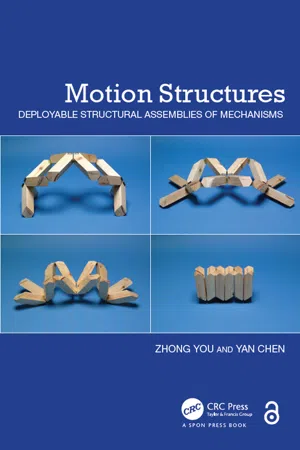
Motion structures are simply assemblies of resistant bodies connected by movable joints. Unlike conventional structures, they allow large shape transformations to satisfy practical requirements and they can be used in:
- shelters, emergency structures and exhibition stands
- aircraft morphing wings
- satellite solar panels and space antennas
- morphing core materials for composites
- medical implants for minimum invasive surgery.
Though traditionally the subject falls within structural engineering, motion structures are more closely related to other mechanisms, and they draw on the principles of kinematic and geometrical analysis in their design. Indeed their design and analysis can be viewed as an extension of the theory of mechanisms, such as rigid origami, and can make effective use of a wealth of mathematical principles.
This book outlines the relevant underlying theory of motion structural concepts, and uses a number of innovative but simple structures as examples.
Frequently asked questions
- Essential is ideal for learners and professionals who enjoy exploring a wide range of subjects. Access the Essential Library with 800,000+ trusted titles and best-sellers across business, personal growth, and the humanities. Includes unlimited reading time and Standard Read Aloud voice.
- Complete: Perfect for advanced learners and researchers needing full, unrestricted access. Unlock 1.4M+ books across hundreds of subjects, including academic and specialized titles. The Complete Plan also includes advanced features like Premium Read Aloud and Research Assistant.
Please note we cannot support devices running on iOS 13 and Android 7 or earlier. Learn more about using the app.
Information
Table of contents
- Cover
- Half Title
- Title Page
- Copyright Page
- Table of Contents
- Acknowledgements
- 1 Introduction
- 2 Fundamental concepts, methods and classification
- 3 Planar double chain linkages
- 4 Spatial rings and domes
- 5 Spatial motion structures based on the Bennett linkage
- 6 Spatial motion structures based on Bricard linkages
- 7 Layouts of spatial motion structures
- Notes
- References
- Index