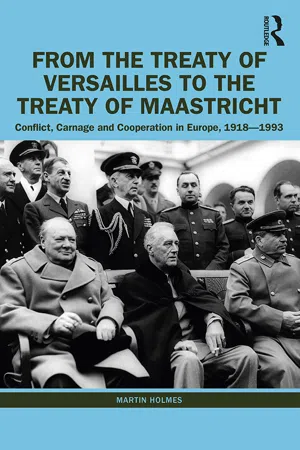
From the Treaty of Versailles to the Treaty of Maastricht
Conflict, Carnage And Cooperation In Europe, 1918 – 1993
- 320 pages
- English
- ePUB (mobile friendly)
- Available on iOS & Android
From the Treaty of Versailles to the Treaty of Maastricht
Conflict, Carnage And Cooperation In Europe, 1918 – 1993
About this book
This book examines European history and politics between two very well-known but flawed treaties: The Treaty of Versailles and the Treaty of Maastricht.
Taking the Treaty of Versailles, signed following World War I, as a starting point, the volume argues that while it was well-intentioned to the point of being utopian, it was also totally impractical, rearranging the map of Europe in a way which led to the tragic descent into conflict and barbarism in World War II. The volume then moves through the post war period, the outcome of the war producing the uneasy stability of a Cold War divided continent, and with the establishment of NATO in 1949, the process of European integration ushered in the era of cooperation. Under the influence of Charles de Gaulle, the newly created European Community acted as an association of sovereign states led by France and Germany, spurring economic growth and encouraging other countries to apply to join. After de Gaulle's retirement in 1969, this approach was progressively abandoned in favour of a federal model of integration in which member states transferred their sovereignty to the institutions of what became the European Union. Europe was to be transformed from a continent to a country. The book concludes by analysing the Maastricht treaty, which enshrined this process, as being as fatally flawed as the Versailles Treaty and charts the post-Maastricht slow decline of the European Union giving way to widespread Euroscepticism.
From the Treaty of Versailles to the Treaty of Maastricht will appeal to researchers and students alike interested in European history, politics and World War I and II.
Frequently asked questions
- Essential is ideal for learners and professionals who enjoy exploring a wide range of subjects. Access the Essential Library with 800,000+ trusted titles and best-sellers across business, personal growth, and the humanities. Includes unlimited reading time and Standard Read Aloud voice.
- Complete: Perfect for advanced learners and researchers needing full, unrestricted access. Unlock 1.4M+ books across hundreds of subjects, including academic and specialized titles. The Complete Plan also includes advanced features like Premium Read Aloud and Research Assistant.
Please note we cannot support devices running on iOS 13 and Android 7 or earlier. Learn more about using the app.
Information
Table of contents
- Cover
- Half Title
- Endorsements
- Title Page
- Copyright Page
- Table of Contents
- Acknowledgements
- Introduction
- 1. The legacy of the Versailles Treaty
- 2. Mussolini’s ‘Roman Empire’
- 3. Stresemann to Hitler: German foreign policy
- 4. The Spanish Civil War: International implications
- 5. Soviet foreign policy, 1918–1941
- 6. Chamberlain, Churchill and the appeasement debate
- 7. Diplomatic and military objectives of the Axis powers
- 8. The diplomatic and military objectives of the Allied powers
- 9. Origins of the Cold War in Europe, 1945–1949
- 10. Cold War America asserts its power: Anglo-French humiliation at Suez, 1956
- 11. The origins of European integration after 1945
- 12. Why the UK did not join the European Union in the 1950s
- 13. 1973 enlargement: The UK joins the EEC
- 14. 1973 Enlargement: Denmark and Ireland join, but Norway says ‘no’
- 15. De Gaulle to Brandt: European relations with the US, NATO and the USSR
- 16. From customs union to the Werner Report, 1957–1970
- 17. The 1970s crisis and the abandonment of the Werner Plan
- 18. Delors, German unification and Eastern Europe
- 19. Thatcher: Resisting Delors and opposing Maastricht
- Epilogue
- Select Bibliography
- Index