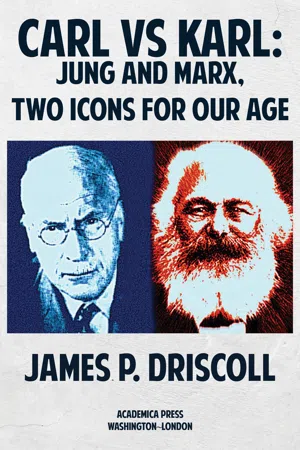
Carl vs. Karl
About this book
By drawing on Jung’s and Marx’s opposing ideas, James Driscoll’s Carl versus Karl: Jung and Marx, Two Icons for our Age develops fresh perspectives on urgent contemporary problems. Jung and Marx as thinkers, Driscoll contends, carry the projections of archetypal complexes that go back to the Biblical hostile brothers, Abel and Cain, and whose enduring tensions shape our postmodern era.
Marxism, because it elevates the group over the individual, is made to order for bureaucrats and bureaucracy’s patron archetype Leviathan. Jungian individuation offers a corrective rooted in the Judeo-Christian ethic’s affirmation of the ultimate value of free individuals. Although Marxism’s promise of justice gives it demagogic appeal, the party betrays that promise through opportunism and a primitive ethic of retribution. Marxism’s supplanting the Judeo-Christian ethic with bureaucracy’s “only following orders” Eichmann Code, Driscoll maintains, has created the moral paralysis of our time. As Jung and writers like Hannah Arendt, George Orwell, Aleksandr Solzhenitsyn, and Elias Canetti have warned us, the influence of our ever expanding bureaucracies is a grave threat to the survival of civilized humanity.
Among the primary issues Driscoll addresses are: the nature of justice and of the soul, individuation and freedom, and mankind’s responsibilities within the planetary ecology. Religion, ethics, economics, science, class divisions, immigration, financial fraud, abortion, and affirmative action are all illumined by his analysis of the powerful archetypes moving behind Jung and Marx.
Tools to learn more effectively

Saving Books

Keyword Search

Annotating Text

Listen to it instead
Information
Table of contents
- Cover
- Title Page
- Copyright
- Contents
- Dedication
- Acknowledgments
- Introduction: Archetypes & Icons
- Part I: Theory
- Part II: Praxis
- Epilogue: Jesus As Archetypal Activist
- Endnotes
- Bibliography
- Index
Frequently asked questions
- Essential is ideal for learners and professionals who enjoy exploring a wide range of subjects. Access the Essential Library with 800,000+ trusted titles and best-sellers across business, personal growth, and the humanities. Includes unlimited reading time and Standard Read Aloud voice.
- Complete: Perfect for advanced learners and researchers needing full, unrestricted access. Unlock 1.4M+ books across hundreds of subjects, including academic and specialized titles. The Complete Plan also includes advanced features like Premium Read Aloud and Research Assistant.
Please note we cannot support devices running on iOS 13 and Android 7 or earlier. Learn more about using the app