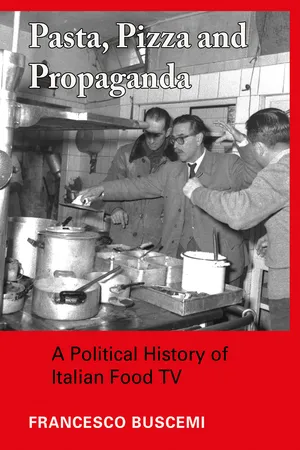
Pasta, Pizza and Propaganda
eBook - ePub

Pasta, Pizza and Propaganda

A Political History of Italian Food TV

  1. English
  2. ePUB (mobile friendly)
  3. Available on iOS & Android
eBook - ePub

Pasta, Pizza and Propaganda

A Political History of Italian Food TV

About this book

This book aims to develop a political history of Italian 'good food' on national television, and the central role of food in Italian culture. The focus is highly original and this is a unique interdisciplinary study at the intersection between food studies, media studies and politics.

The three protagonists of Pasta, Pizza and Propaganda are food, television and politics. These are the three main characters that interrelate, collaborate and fight behind the scenes, while in front of the camera the writers, intellectuals and celebrity chefs talk about, prepare or taste the best Italian dishes.

The book retraces the history of Italian food television from a political point of view: the early shows of the pioneers under strict Catholic control in the 1950s and 1960s, the left-wing political twist of the 1970s, the conservative riflusso or resurgence of the 1980s, the disputed Berlusconian era and the rise of the celebrity chefs, which, for better or for worse, makes Italy similar to the other western countries.

The history of Italy since the mid-1950s is retold through the lenses of food television. This lively book demonstrates that cooking spaghetti in a TV studio is a political act, and tries to uncover how it is possible that, while watching on TV how to make pizza, we become citizens.

The primary readership will be an academic audience, including those in the disciplines of food studies, media studies, politics and Italian studies, as well as potentially for those interested in Italian sociology and anthropology. There may be a potential wider readership because of the popularity of Italian food and food television.

Frequently asked questions

Yes, you can cancel anytime from the Subscription tab in your account settings on the Perlego website. Your subscription will stay active until the end of your current billing period. Learn how to cancel your subscription.
No, books cannot be downloaded as external files, such as PDFs, for use outside of Perlego. However, you can download books within the Perlego app for offline reading on mobile or tablet. Learn more here.
Perlego offers two plans: Essential and Complete
  • Essential is ideal for learners and professionals who enjoy exploring a wide range of subjects. Access the Essential Library with 800,000+ trusted titles and best-sellers across business, personal growth, and the humanities. Includes unlimited reading time and Standard Read Aloud voice.
  • Complete: Perfect for advanced learners and researchers needing full, unrestricted access. Unlock 1.4M+ books across hundreds of subjects, including academic and specialized titles. The Complete Plan also includes advanced features like Premium Read Aloud and Research Assistant.
Both plans are available with monthly, semester, or annual billing cycles.
We are an online textbook subscription service, where you can get access to an entire online library for less than the price of a single book per month. With over 1 million books across 1000+ topics, we’ve got you covered! Learn more here.
Look out for the read-aloud symbol on your next book to see if you can listen to it. The read-aloud tool reads text aloud for you, highlighting the text as it is being read. You can pause it, speed it up and slow it down. Learn more here.
Yes! You can use the Perlego app on both iOS or Android devices to read anytime, anywhere — even offline. Perfect for commutes or when you’re on the go.
Please note we cannot support devices running on iOS 13 and Android 7 or earlier. Learn more about using the app.
Yes, you can access Pasta, Pizza and Propaganda by Francesco Buscemi, Flavia Laviosa in PDF and/or ePUB format, as well as other popular books in Politics & International Relations & Art & Politics. We have over one million books available in our catalogue for you to explore.

Table of contents

  1. Cover
  2. Title
  3. Copyright
  4. Contents
  5. Figures
  6. Acknowledgements
  7. Introduction
  8. 1. Literature Review, Theoretical Framework and Methodology
  9. 2. 1954–70: Broadcasting Sacred Food
  10. 3. 1971–80: The Ephemeral Wind of Change
  11. 4. 1981–99: Going Back Home (and Back to the Kitchen)
  12. 5. 2000–12: Eating TV, Food on Berlusconian Television
  13. 6. 2012–Present: The Celebrity Chef, Italian Style
  14. Conclusion
  15. References
  16. Back cover