- 520 pages
- English
- ePUB (mobile friendly)
- Available on iOS & Android
About this book
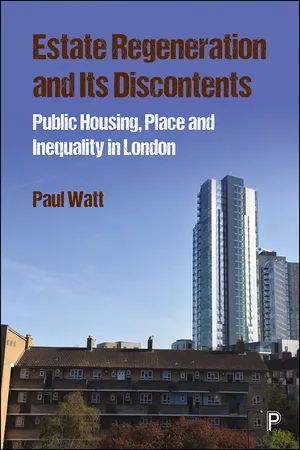
Public housing estates are disappearing from London's skyline in the name of regeneration, while new mixed-tenure developments are arising in their place. This richly illustrated book provides a vivid interdisciplinary account of the controversial urban policy of demolition and rebuilding amid London's housing crisis and the polarisation between the city's have-nots and have-lots.
Drawing on extensive fieldwork and interviews with over 180 residents living in some of the capital's most deprived areas, Watt shows the dramatic ways that estate regeneration is reshaping London, fuelling socio-spatial inequalities via state-led gentrification. Foregrounding resident experiences and perspectives both before and during regeneration, he examines class, place belonging, home and neighbourhood, and argues that the endless regeneration process results in degeneration, displacement and fragmented communities.
Frequently asked questions
- Essential is ideal for learners and professionals who enjoy exploring a wide range of subjects. Access the Essential Library with 800,000+ trusted titles and best-sellers across business, personal growth, and the humanities. Includes unlimited reading time and Standard Read Aloud voice.
- Complete: Perfect for advanced learners and researchers needing full, unrestricted access. Unlock 1.4M+ books across hundreds of subjects, including academic and specialized titles. The Complete Plan also includes advanced features like Premium Read Aloud and Research Assistant.
Please note we cannot support devices running on iOS 13 and Android 7 or earlier. Learn more about using the app.
Information
Table of contents
- Cover
- Title Page
- Copyright Page
- Dedication
- Contents
- List of figures, tables and photographs
- List of abbreviations
- Acknowledgements
- 1 Introduction
- Part I Policy analysis and research context
- Part II Estates before regeneration
- Part III Living through regeneration
- 13 Conclusion
- Appendix A: Methodology
- Appendix B: Profile of interviewees
- Notes
- References
- Index