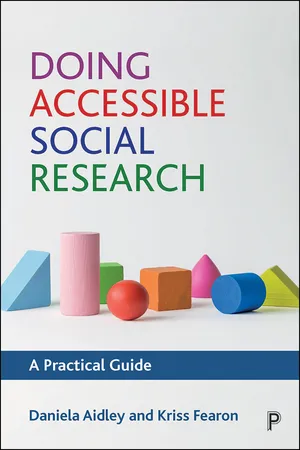
Doing Accessible Social Research
A Practical Guide
- 246 pages
- English
- ePUB (mobile friendly)
- Available on iOS & Android
Doing Accessible Social Research
A Practical Guide
About this book
Nearly 20% of the population has a disability. Despite this, mainstream research often does not explicitly address the methodological and practical issues that can act as barriers to disabled people's participation in social research. In this book, Aidley and Fearon provide a concise, practical introduction to making it easier for everyone to take part in research.
Requiring no prior knowledge about accessible research methods, the book:
• explains how removing barriers to participation will improve the quality of the research;
• covers the research process from design, to collecting data, to dissemination and publication;
• includes checklists and further reading, as well as useful examples and vignettes to illustrate how issues play out in practice.
This book will be invaluable to researchers from a variety of backgrounds looking to increase participation in their research, whether postgraduate students, experienced academic researchers, practitioners or professionals.
Frequently asked questions
- Essential is ideal for learners and professionals who enjoy exploring a wide range of subjects. Access the Essential Library with 800,000+ trusted titles and best-sellers across business, personal growth, and the humanities. Includes unlimited reading time and Standard Read Aloud voice.
- Complete: Perfect for advanced learners and researchers needing full, unrestricted access. Unlock 1.4M+ books across hundreds of subjects, including academic and specialized titles. The Complete Plan also includes advanced features like Premium Read Aloud and Research Assistant.
Please note we cannot support devices running on iOS 13 and Android 7 or earlier. Learn more about using the app.
Information
Table of contents
- Cover
- Title Page
- Copyright Page
- Dedication
- Contents
- List of checklists and tables
- Glossary
- Acknowledgements and thanks
- 1. Introduction
- 2. Research that includes disabled people
- 3. Research questions and research design
- 4. Sampling
- 5. Recruitment and the research setting
- 6. Face-to-face research
- 7. Online and remote research methods
- 8. Mixed media, triangulation and mixed methods
- 9. Writing up, publication and impact
- Appendix 1: Associations for people with disabilities based on profession or personal interest
- Appendix 2: Disability-focused charities and organisations
- Appendix 3: Checking accessibility yourself
- Appendix 4: Text relay services
- Appendix 5: Tagging languages in a document
- Appendix 6: Encrypting documents