- 218 pages
- English
- ePUB (mobile friendly)
- Available on iOS & Android
About this book
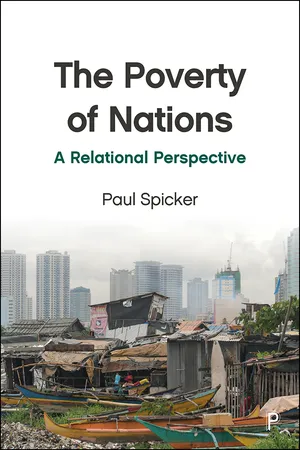
In this persuasive study, social welfare and policy expert Paul Spicker makes a case for a relational view of poverty.
Poverty is much more than a lack of resources. It involves a complex set of social relationships, such as economic disadvantage, insecurity or a lack of rights. These relational elements tell us what poverty is – what it consists of, what poor people are experiencing, and what problems need to be addressed.
This book examines poverty in the context of the economy, society and the political community, considering how states can respond to issues of inequality, exclusion and powerlessness. Drawing on examples of social policy in both rich and poor countries, this is an accessible contribution to the debate about the nature of poverty and responses to it.
Frequently asked questions
- Essential is ideal for learners and professionals who enjoy exploring a wide range of subjects. Access the Essential Library with 800,000+ trusted titles and best-sellers across business, personal growth, and the humanities. Includes unlimited reading time and Standard Read Aloud voice.
- Complete: Perfect for advanced learners and researchers needing full, unrestricted access. Unlock 1.4M+ books across hundreds of subjects, including academic and specialized titles. The Complete Plan also includes advanced features like Premium Read Aloud and Research Assistant.
Please note we cannot support devices running on iOS 13 and Android 7 or earlier. Learn more about using the app.
Information
Table of contents
- Cover
- Title Page
- Copyright Page
- Contents
- List of figures and tables
- About the author
- Introduction: Representations of poverty
- Part I: Poverty economic and social relationships
- Part II: Rich and poor countries
- Conclusion: Poverty and social science