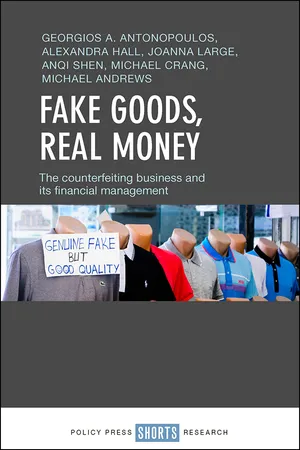
Fake Goods, Real money
The Counterfeiting Business and its Financial Management
- 88 pages
- English
- ePUB (mobile friendly)
- Available on iOS & Android
Fake Goods, Real money
The Counterfeiting Business and its Financial Management
About this book
The trade in counterfeit goods is growing and is increasingly linked to transnational organised crime. But little is known about the financial mechanisms that lie behind this trade.
This is the first account of the financial management of the counterfeiting business. Written by experts in a wide range of fields, it examines the financial and business structures in relation to the illicit trade in counterfeit products.
Based on interviews with active criminal entrepreneurs in the UK and abroad and other data, the authors explore 'organised crime' and mutating criminal markets, digital technologies and their criminological and sociological implications, and cultural values and practices. This book will make a significant contribution to our understanding of these timely issues.
Frequently asked questions
- Essential is ideal for learners and professionals who enjoy exploring a wide range of subjects. Access the Essential Library with 800,000+ trusted titles and best-sellers across business, personal growth, and the humanities. Includes unlimited reading time and Standard Read Aloud voice.
- Complete: Perfect for advanced learners and researchers needing full, unrestricted access. Unlock 1.4M+ books across hundreds of subjects, including academic and specialized titles. The Complete Plan also includes advanced features like Premium Read Aloud and Research Assistant.
Please note we cannot support devices running on iOS 13 and Android 7 or earlier. Learn more about using the app.
Information
Table of contents
- Coverpage
- Title page
- Copyright
- Contents
- List of abbreviations
- Notes on authors
- Acknowledgements
- one Introduction
- two Methodology and fieldword
- three The nature and dynamics of the counterfeiting business
- four Financial aspects of the counterfeit goods market
- five Conclusion and future directions
- References