eBook - ePub
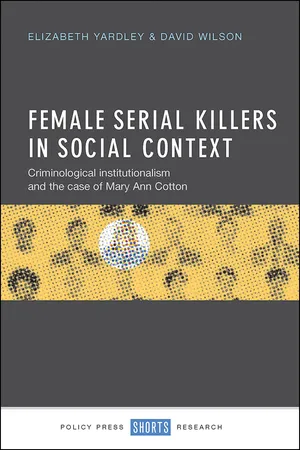
Female Serial Killers in Social Context
Criminological Institutionalism and the Case of Mary Ann Cotton
- 96 pages
- English
- ePUB (mobile friendly)
- Available on iOS & Android
eBook - ePub
Female Serial Killers in Social Context
Criminological Institutionalism and the Case of Mary Ann Cotton
About this book
To date, approaches to understanding serial murder have focused on individual cases rather than the social context in which they occurred. Written by leading criminologists and world experts on serial murder, this book marks a departure by situating nineteenth century serial killer Mary Ann Cotton within the broader social structure. Using archival records of her court appearances, local histories and newspaper articles, it uniquely explores how institutions such as the family, economy and religion shaped the environment she inhabited and her social integration through the roles of wife, mother, worker and criminal. Acknowledging that it takes a particular type of individual to commit serial murder, the book shows that it also takes a particular type of society to enable that murderer to go unseen. As the first work to analyse serial murder through the theoretical framework of institutional criminology and institutional anomie theory, it will equip criminologists with a methodological toolkit for performing institutional analysis.
Information
Table of contents
- Cover
- Title page
- Copyright
- Contents
- List of tables
- Preface
- 1 The trouble with female serial killers
- 2 Intersections and institutions: new pathways in making sense of female serial killers
- 3 Development of the case study
- 4 Mary Ann’s social roles
- 5 An institutional understanding of Mary Ann and future directions for research
- References
Trusted by 375,005 students
Access to over 1.5 million titles for a fair monthly price.
Study more efficiently using our study tools.
Frequently asked questions
Yes, you can cancel anytime from the Subscription tab in your account settings on the Perlego website. Your subscription will stay active until the end of your current billing period. Learn how to cancel your subscription
No, books cannot be downloaded as external files, such as PDFs, for use outside of Perlego. However, you can download books within the Perlego app for offline reading on mobile or tablet. Learn how to download books offline
Perlego offers two plans: Essential and Complete
- Essential is ideal for learners and professionals who enjoy exploring a wide range of subjects. Access the Essential Library with 800,000+ trusted titles and best-sellers across business, personal growth, and the humanities. Includes unlimited reading time and Standard Read Aloud voice.
- Complete: Perfect for advanced learners and researchers needing full, unrestricted access. Unlock 1.5M+ books across hundreds of subjects, including academic and specialized titles. The Complete Plan also includes advanced features like Premium Read Aloud and Research Assistant.
We are an online textbook subscription service, where you can get access to an entire online library for less than the price of a single book per month. With over 1.5 million books across 990+ topics, we’ve got you covered! Learn about our mission
Look out for the read-aloud symbol on your next book to see if you can listen to it. The read-aloud tool reads text aloud for you, highlighting the text as it is being read. You can pause it, speed it up and slow it down. Learn more about Read Aloud
Yes! You can use the Perlego app on both iOS and Android devices to read anytime, anywhere — even offline. Perfect for commutes or when you’re on the go.
Please note we cannot support devices running on iOS 13 and Android 7 or earlier. Learn more about using the app
Please note we cannot support devices running on iOS 13 and Android 7 or earlier. Learn more about using the app
Yes, you can access Female Serial Killers in Social Context by Yardley, Elizabeth,Wilson, David,Elizabeth Yardley,David Wilson in PDF and/or ePUB format, as well as other popular books in Social Sciences & Criminology. We have over 1.5 million books available in our catalogue for you to explore.