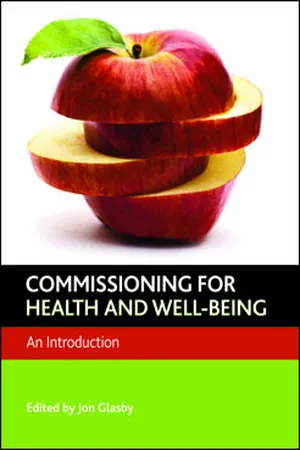
Commissioning for Health and Well-Being
eBook - ePub

Commissioning for Health and Well-Being

An Introduction

  1. 224 pages
  2. English
  3. ePUB (mobile friendly)
  4. Available on iOS & Android
eBook - ePub

Commissioning for Health and Well-Being

An Introduction

About this book

Commissioning is now a key task for health and social care - and yet policy aspirations often outstrip the infrastructure needed to support commissioners as they take difficult decisions about future services and to make commissioning a career of choice for future leaders.While commissioning was important under New Labour, it seems set to be even more fundamental now as commissioners think about future services in an era of austerity.

Against this background, this is the first comprehensive text on a key area of management practice, exploring what commissioning is, where it has come from and where it might be taking us.With a wide range of leading contributors from fields including health care, social care, local government, the book takes students, practitioners and managers through key stages of the commissioning cycle as well as addressing cross-cutting themes such as the economics of commissioning, user involvement and commissioning in an era of personalisation.

It is essential reading for everyone involved in the planning and delivery of health and social care - for social policy students, health and social care practitioners, managers and policy makers alike.

Frequently asked questions

Yes, you can cancel anytime from the Subscription tab in your account settings on the Perlego website. Your subscription will stay active until the end of your current billing period. Learn how to cancel your subscription.
At the moment all of our mobile-responsive ePub books are available to download via the app. Most of our PDFs are also available to download and we're working on making the final remaining ones downloadable now. Learn more here.
Perlego offers two plans: Essential and Complete
  • Essential is ideal for learners and professionals who enjoy exploring a wide range of subjects. Access the Essential Library with 800,000+ trusted titles and best-sellers across business, personal growth, and the humanities. Includes unlimited reading time and Standard Read Aloud voice.
  • Complete: Perfect for advanced learners and researchers needing full, unrestricted access. Unlock 1.4M+ books across hundreds of subjects, including academic and specialized titles. The Complete Plan also includes advanced features like Premium Read Aloud and Research Assistant.
Both plans are available with monthly, semester, or annual billing cycles.
We are an online textbook subscription service, where you can get access to an entire online library for less than the price of a single book per month. With over 1 million books across 1000+ topics, we’ve got you covered! Learn more here.
Look out for the read-aloud symbol on your next book to see if you can listen to it. The read-aloud tool reads text aloud for you, highlighting the text as it is being read. You can pause it, speed it up and slow it down. Learn more here.
Yes! You can use the Perlego app on both iOS or Android devices to read anytime, anywhere — even offline. Perfect for commutes or when you’re on the go.
Please note we cannot support devices running on iOS 13 and Android 7 or earlier. Learn more about using the app.
Yes, you can access Commissioning for Health and Well-Being by Glasby, Jon,Jon Glasby in PDF and/or ePUB format, as well as other popular books in Medicine & Health Policy. We have over one million books available in our catalogue for you to explore.

Information

Publisher
Policy Press
Year
2012
Print ISBN
9781847427939
eBook ISBN
9781447308133
Edition
1

Table of contents

  1. Front Cover
  2. Title Page
  3. Copyright Page
  4. Contents
  5. List of boxes, figures and tables
  6. List of abbreviations
  7. Notes on contributors
  8. Acknowledgements
  9. Introduction
  10. Part One: The commissioning cycle
  11. Part Two: Key themes
  12. Part Three: Conclusion and next steps
  13. References
  14. Notes