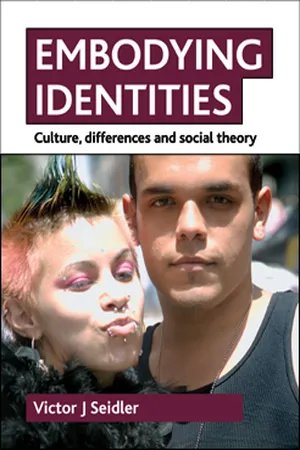
Embodying identities
eBook - ePub

Embodying identities

Culture, differences and social theory

  1. 248 pages
  2. English
  3. ePUB (mobile friendly)
  4. Available on iOS & Android
eBook - ePub

Embodying identities

Culture, differences and social theory

About this book

In the 1970s and 1980s, identities seemed to be 'fixed' through categories of class, 'race', ethnicity, gender, sexualities and religion. These days we have begun to recognise the diversity, fragmentation and fluidity of identities, but how do we create and shape our own?

The book shapes a new language of social theory that allows people to embody their differences with a sense of dignity and self-worth. It draws on diverse traditions from Marx, Weber and Durkheim, as well as more recent traditions of critical theory and post-structuralism, and will be of interest to sociology, politics, social work, philosophy and cultural studies students.

Frequently asked questions

Yes, you can cancel anytime from the Subscription tab in your account settings on the Perlego website. Your subscription will stay active until the end of your current billing period. Learn how to cancel your subscription.
No, books cannot be downloaded as external files, such as PDFs, for use outside of Perlego. However, you can download books within the Perlego app for offline reading on mobile or tablet. Learn more here.
Perlego offers two plans: Essential and Complete
  • Essential is ideal for learners and professionals who enjoy exploring a wide range of subjects. Access the Essential Library with 800,000+ trusted titles and best-sellers across business, personal growth, and the humanities. Includes unlimited reading time and Standard Read Aloud voice.
  • Complete: Perfect for advanced learners and researchers needing full, unrestricted access. Unlock 1.4M+ books across hundreds of subjects, including academic and specialized titles. The Complete Plan also includes advanced features like Premium Read Aloud and Research Assistant.
Both plans are available with monthly, semester, or annual billing cycles.
We are an online textbook subscription service, where you can get access to an entire online library for less than the price of a single book per month. With over 1 million books across 1000+ topics, we’ve got you covered! Learn more here.
Look out for the read-aloud symbol on your next book to see if you can listen to it. The read-aloud tool reads text aloud for you, highlighting the text as it is being read. You can pause it, speed it up and slow it down. Learn more here.
Yes! You can use the Perlego app on both iOS or Android devices to read anytime, anywhere — even offline. Perfect for commutes or when you’re on the go.
Please note we cannot support devices running on iOS 13 and Android 7 or earlier. Learn more about using the app.
Yes, you can access Embodying identities by Seidler, Victor Jeleniewski,Victor Jeleniewski Seidler in PDF and/or ePUB format, as well as other popular books in Social Sciences & Sociology. We have over one million books available in our catalogue for you to explore.

Information

Publisher
Policy Press
Year
2010
Print ISBN
9781847423825
eBook ISBN
9781447317760

Table of contents

  1. Cover
  2. Title
  3. Copyright
  4. Contents
  5. Glossary
  6. Acknowledgements
  7. Preface
  8. one Introduction: identities, bodies and differences
  9. two Challenges: complexities / diversity / self-worth
  10. three Histories: beliefs / diasporas / belongings
  11. four Experiences: realities / psychologies / discourse
  12. five Differences: feminisms / enemies / equalities
  13. six Genders: desires / self-rejection / recognition
  14. seven Explorations: ‘race’ / violence / shame
  15. eight Transformations: masculinities / choices / futures
  16. nine Conflicts: complexity / cultures / youth
  17. ten Rejections: shame / fear / hatred
  18. eleven Postmodernities: individualisms / performances /sexualities
  19. twelve Spaces: virtual worlds / technologies / globalisation
  20. thirteen Conclusion: Embodied identities: experience, power, difference/s and social theory
  21. Bibliography