An examination of the true role of governance as a driver of high-quality strategic decision-making, which can help an organization achieve its strategic objectives more efficiently and effectively.
Many boards approach the subject of governance from a compliance perspective, which leaves value lying on the table. When boards complain that "we're spending too much time on governance", what they're usually referring to is 'compliance'. A compliance focus leads to an emphasis on governance as an area of subject-matter expertise, a cost, an overhead, a back-office activity, something which 'has to be done' to satisfy regulation and Code. It manifests itself through a culture of box-ticking. Directors and senior management perceive, and derive, little value from the exercise.
Seamus Gillen believes that governance is a commercial discipline, providing a fundamental underpin to the process of value creation, value protection and value preservation. Governance drives the quality of strategic decision-making that helps an organization achieve its strategic objectives more efficiently and effectively. High standards of governance create competitive advantage, a concept as applicable to not-for-profits and public sector bodies as to commercial entities. For organizations pursuing this approach, governance becomes a liberating theology, and a critical business enabler.
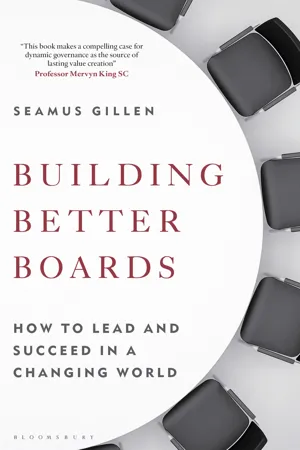
Building Better Boards resonates with professionals operating across international jurisdictions, and is inclusive rather than exclusive. The book emphasises, and demonstrates, that governance is a live issue, an ongoing priority area of board focus, with developments occurring around the world on, literally, a daily basis. It identifies good practice and progressive thinking across sectors and geographies. It builds on thought leadership and case studies, as well as regulatory guidance and Code principles. It offers new models and approaches based on real-life experience. All to provide boards and directors - as well as senior executives - with the means to leverage governance to achieve their strategic objectives. To help them lead and succeed in a changing world.
- 289 pages
- English
- PDF
- Available on iOS & Android
eBook - PDF
About this book
Information
Table of contents
- Cover
- Half Title
- Copyright Page
- Contents
- Preface
- Chapter One: A short history of governance
- Chapter Two: The purpose of an organization
- Chapter Three: The purpose of the board
- Chapter Four: The importance of stakeholders
- Chapter Five: The Purpose Ecosystem
- Chapter Six: The governance of strategy
- Chapter Seven: Addressing an uncertain future
- Chapter Eight: The impact of board composition on decision-making
- Chapter Nine: The essential elements of board governance
- Chapter Ten: Measuring a board’s effectiveness
- Index
Trusted by 375,005 students
Access to over 1.5 million titles for a fair monthly price.
Study more efficiently using our study tools.
Frequently asked questions
Yes, you can cancel anytime from the Subscription tab in your account settings on the Perlego website. Your subscription will stay active until the end of your current billing period. Learn how to cancel your subscription
No, books cannot be downloaded as external files, such as PDFs, for use outside of Perlego. However, you can download books within the Perlego app for offline reading on mobile or tablet. Learn how to download books offline
Perlego offers two plans: Essential and Complete
- Essential is ideal for learners and professionals who enjoy exploring a wide range of subjects. Access the Essential Library with 800,000+ trusted titles and best-sellers across business, personal growth, and the humanities. Includes unlimited reading time and Standard Read Aloud voice.
- Complete: Perfect for advanced learners and researchers needing full, unrestricted access. Unlock 1.5M+ books across hundreds of subjects, including academic and specialized titles. The Complete Plan also includes advanced features like Premium Read Aloud and Research Assistant.
We are an online textbook subscription service, where you can get access to an entire online library for less than the price of a single book per month. With over 1.5 million books across 990+ topics, we’ve got you covered! Learn about our mission
Look out for the read-aloud symbol on your next book to see if you can listen to it. The read-aloud tool reads text aloud for you, highlighting the text as it is being read. You can pause it, speed it up and slow it down. Learn more about Read Aloud
Yes! You can use the Perlego app on both iOS and Android devices to read anytime, anywhere — even offline. Perfect for commutes or when you’re on the go.
Please note we cannot support devices running on iOS 13 and Android 7 or earlier. Learn more about using the app
Please note we cannot support devices running on iOS 13 and Android 7 or earlier. Learn more about using the app
Yes, you can access Building Better Boards by Seamus Gillen in PDF and/or ePUB format, as well as other popular books in Business & Corporate Governance. We have over 1.5 million books available in our catalogue for you to explore.