Expanding the impact of Gilles Deleuze and Félix Guattari's philosophy to the disciplines of Christian Origins and Christian theology, this original study makes the case for understanding early Christianity through such Deleuzioguattarian concepts as the 'rhizome', the 'machine', the 'body without organs' and the 'multiplicity', using the theoretical tool of schizoanalysis to do so.
The reconstruction of the historical emergence of early Christianity, Bradley H. McLean argues, has been constrained by traditional assumptions about its historical and transcendental origins. These assumptions are ill-suited to theorizing the genesis, change and transformation of early Christianity in the first three centuries of the Common Era. To capture the dynamism of early Christianity, McLean applies Guattari's concept of the 'machine', to the analysis of early Christianity. Arguing that machines are both an unnoticed dimension of early Christianity, and a major analytical tool for the discipline, McLean highlights the potential of the philosophy of Deleuze and Guattari to challenge and reconfigure not just our knowledge of early Christianity, but all aspects of Hellenistic Judaism, and the Greco-Roman world, as well as our understanding of Jesus of Nazareth and the Jesus movement.
By subverting the concept of a single transcendental or historical origin of Christianity, this book facilitates new forms of dialogue and cooperation between Christians and co-religionists.
eBook - PDF
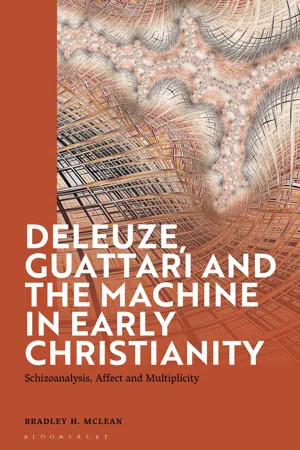
Deleuze, Guattari and the Machine in Early Christianity
Schizoanalysis, Affect and Multiplicity
- 263 pages
- English
- PDF
- Available on iOS & Android
eBook - PDF
Deleuze, Guattari and the Machine in Early Christianity
Schizoanalysis, Affect and Multiplicity
About this book
Information
Table of contents
- Cover
- Half Title
- Series
- Title
- Copyright
- Epigraph
- Contents
- Abbreviations
- Introduction
- 1 The rise of the Christ machines
- 2 Desiring production and early Christianities
- 3 The rhizome: Multiplicities and the virtual dimension of Christ groups
- 4 The autoproduction of a body of Christ without organs
- 5 Territorializations and deterritorializations: On becoming outlandish
- 6 Deterritorialization in the Gospels: A typology of lines
- 7 The stratification of Christ groups in the Roman despotic socius
- 8 Christ groups as social assemblages and abstract machines: Discourse and power
- 9 The God of religion and the schizo God
- 10 The myth of Eve: Falling into, and out of, delusion
- 11 On several regimes of signs and several Christs
- 12 The despotic Christ and the signifying despotic regime of signs
- 13 The passional Christ and the passional subjective regime of signs
- 14 What can Christ’s body do?
- 15 Molecular becomings of Christ: Becoming-woman
- 16 Christ becoming-animal: An affair of sorcery
- 17 Christ’s becomings-imperceptible: Martyrological, magical and cosmic
- 18 The nomad Jesus and the Galilean war machine
- Conclusion
- Bibliography
- Index
Trusted by 375,005 students
Access to over 1.5 million titles for a fair monthly price.
Study more efficiently using our study tools.
Frequently asked questions
Yes, you can cancel anytime from the Subscription tab in your account settings on the Perlego website. Your subscription will stay active until the end of your current billing period. Learn how to cancel your subscription
No, books cannot be downloaded as external files, such as PDFs, for use outside of Perlego. However, you can download books within the Perlego app for offline reading on mobile or tablet. Learn how to download books offline
Perlego offers two plans: Essential and Complete
- Essential is ideal for learners and professionals who enjoy exploring a wide range of subjects. Access the Essential Library with 800,000+ trusted titles and best-sellers across business, personal growth, and the humanities. Includes unlimited reading time and Standard Read Aloud voice.
- Complete: Perfect for advanced learners and researchers needing full, unrestricted access. Unlock 1.5M+ books across hundreds of subjects, including academic and specialized titles. The Complete Plan also includes advanced features like Premium Read Aloud and Research Assistant.
We are an online textbook subscription service, where you can get access to an entire online library for less than the price of a single book per month. With over 1.5 million books across 990+ topics, we’ve got you covered! Learn about our mission
Look out for the read-aloud symbol on your next book to see if you can listen to it. The read-aloud tool reads text aloud for you, highlighting the text as it is being read. You can pause it, speed it up and slow it down. Learn more about Read Aloud
Yes! You can use the Perlego app on both iOS and Android devices to read anytime, anywhere — even offline. Perfect for commutes or when you’re on the go.
Please note we cannot support devices running on iOS 13 and Android 7 or earlier. Learn more about using the app
Please note we cannot support devices running on iOS 13 and Android 7 or earlier. Learn more about using the app
Yes, you can access Deleuze, Guattari and the Machine in Early Christianity by Bradley H. McLean in PDF and/or ePUB format, as well as other popular books in Philosophy & Christian Theology. We have over 1.5 million books available in our catalogue for you to explore.