- English
- ePUB (mobile friendly)
- Available on iOS & Android
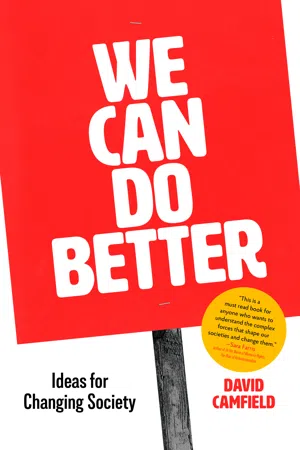
About this book
The view that capitalism is an inherently flawed, exploitative, crisis-prone, oppressive system is not new. But neoliberal capitalism's flaws are increasingly dangerous in Western countries and globally as corporations exert growing influence on governments, as the endless pursuit of profits pushes our climate to the breaking point and as far-right politics dominate the media. Solutions are needed. Fast.
In We Can Do Better, David Camfield lays out a theoretical basis for political and social change that fuses critical Marxism with insights from anti-racist queer feminism. This reconstructed historical materialism treats capitalism and class as inextricably interwoven with gender, race and sexuality. After discussing today's most influential social theories, Camfield uses this theory to analyze a range of issues that face our world today, including climate change, growing social insecurity and the persistence of sexism and racism. Camfield argues that the key to achieving change for the better is social struggle, and he offers ideas about moving from social theory to social action.
Frequently asked questions
- Essential is ideal for learners and professionals who enjoy exploring a wide range of subjects. Access the Essential Library with 800,000+ trusted titles and best-sellers across business, personal growth, and the humanities. Includes unlimited reading time and Standard Read Aloud voice.
- Complete: Perfect for advanced learners and researchers needing full, unrestricted access. Unlock 1.4M+ books across hundreds of subjects, including academic and specialized titles. The Complete Plan also includes advanced features like Premium Read Aloud and Research Assistant.
Please note we cannot support devices running on iOS 13 and Android 7 or earlier. Learn more about using the app.
Information
Table of contents
- Cover
- Praise
- Title Page
- Copyright
- Contents
- Epigraph
- We Can Do Better
- About This Book
- PART ONE
- Chapter 1
- Chapter 2
- Chapter 3
- PART TWO
- Chapter 4
- Chapter 5
- Chapter 6
- Chapter 7
- PART THREE
- Chapter 8
- Chapter 9
- Chapter 10
- Chapter 11
- Chapter 12
- Chapter 13
- PART FOUR
- Chapter 14
- Chapter 15
- Chapter 16
- Notes
- Suggestions for Further Reading
- Glossary
- References
- Acknowledgements
- Index