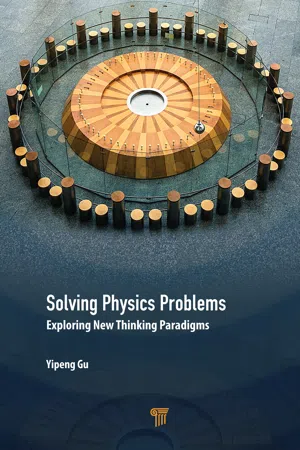
This book provides a complete, consistent, and open system for studying physics problems, which not only provides high-quality teaching materials for the field of physics education (especially for Physics Olympiad training) but also points out a new direction for physics education. In this book, a form of methodology, which can comprehensively present cogitation discipline, is built up for analyzing and solving complex physics problems. The text analyzes plenty of physics problems (classical mechanics) from both theoretical and philosophical points of view to reveal the way of exerting this form. As a set of methodology reflecting the cogitation discipline, the thinking paradigm proposed in this book (called the MLQ-(ST)C paradigm) is a theoretical tool to develop people's acquisition of this ability. The paradigm successfully deconstructs the elements and the structure in physical thinking and then eliminates the obstacles of people's underlying thinking, so that all the thinking built on it can be clear and ordered. The physics problems included in this book are significantly more difficult than similar books within the same theoretical domains involved, leading to better teaching and learning value.
- 784 pages
- English
- ePUB (mobile friendly)
- Available on iOS & Android
eBook - ePub
About this book
Key takeaways
AI-Generated Insights
Insight 1
Utilize the MLQ-(ST)C paradigm to deconstruct physical thinking and develop clear, ordered problem-solving strategies for complex physics scenarios.
Insight 2
Apply fundamental physical theories and principles to solve advanced problems in kinematics, dynamics, rigid body motion, vibration, two-body systems, and fluid mechanics.
Insight 3
Employ a deductive approach to analyze specific physical realities, integrating theoretical and philosophical perspectives to address challenging problems in classical mechanics.
Information
Table of contents
- Cover Page
- Half Title Page
- Title Page
- Copyright Page
- Table of Contents
- Preface
- Introduction: The MLQ-(ST)C Paradigm
- 1. Kinematics
- 2. Dynamics
- 3. Rigid Body
- 4. Vibration
- 5. Two-Body Model
- 6. Fluid
- Index
Trusted by 375,005 students
Access to over 1.5 million titles for a fair monthly price.
Study more efficiently using our study tools.
Frequently asked questions
Yes, you can cancel anytime from the Subscription tab in your account settings on the Perlego website. Your subscription will stay active until the end of your current billing period. Learn how to cancel your subscription
No, books cannot be downloaded as external files, such as PDFs, for use outside of Perlego. However, you can download books within the Perlego app for offline reading on mobile or tablet. Learn how to download books offline
We are an online textbook subscription service, where you can get access to an entire online library for less than the price of a single book per month. With over 1.5 million books across 990+ topics, we’ve got you covered! Learn about our mission
Look out for the read-aloud symbol on your next book to see if you can listen to it. The read-aloud tool reads text aloud for you, highlighting the text as it is being read. You can pause it, speed it up and slow it down. Learn more about Read Aloud
Yes! You can use the Perlego app on both iOS and Android devices to read anytime, anywhere — even offline. Perfect for commutes or when you’re on the go.
Please note we cannot support devices running on iOS 13 and Android 7 or earlier. Learn more about using the app
Please note we cannot support devices running on iOS 13 and Android 7 or earlier. Learn more about using the app
Yes, you can access Solving Physics Problems by Yipeng Gu in PDF and/or ePUB format, as well as other popular books in Mathematics & Biology. We have over 1.5 million books available in our catalogue for you to explore.