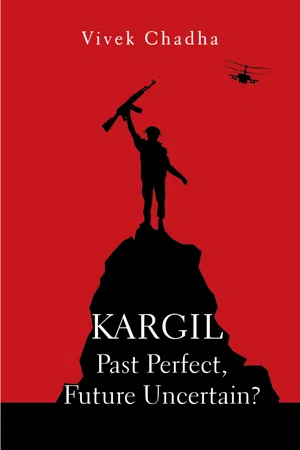
The Kargil conflict was fought 20 years ago. However, it continues to remain relevant for strategic analysts, military historians, academics, armed forces personnel and diplomats. This book, delves into the structures, planning processes and procedures adopted while pursuing diplomacy, higher direction of war and strategic communications, on both sides of the Line of Control during the Kargil conflict. In doing so, existing arguments are challenged and alternative conclusions drawn. This includes the debate around the decision not to cross the LoC during operations, the decision making process involved with the employment of air power and limitations of existing strategic communication structures of the armed forces, as observed during the conflict. The second part of the book employs Kargil and the succeeding 20 years, as the basis for analysing the changing character of war. This includes a study of its implications on the notion of victory and shifts needed while pursuing diplomacy, higher direction of war and strategic communications. It also introduces the concept of finite and infinite game theory to conflicts in the sub-continental context, in an attempt to contextualise it through a fresh perspective.
- English
- ePUB (mobile friendly)
- Available on iOS & Android
eBook - ePub
KARGIL Past Perfect, Future Uncertain?
About this book
Information
Subtopic
National SecurityTable of contents
- Cover
- Half Title
- Title
- Copyright
- Contents
- Acknowledgements
- Introduction
- 1. Turning the Tables: Kargil a Diplomatic Coup
- 2. The Higher Direction of War
- 3. Strategic Communications during the Kargil Conflict
- 4. The Challenge of Future Conflicts: Kargil and Beyond
- 5. Competing Notions of Victory: Case of Pakistan
- 6. The Case of China
- 7. The Future of Conflict
- Conclusion
Trusted by 375,005 students
Access to over 1.5 million titles for a fair monthly price.
Study more efficiently using our study tools.
Frequently asked questions
Yes, you can cancel anytime from the Subscription tab in your account settings on the Perlego website. Your subscription will stay active until the end of your current billing period. Learn how to cancel your subscription
No, books cannot be downloaded as external files, such as PDFs, for use outside of Perlego. However, you can download books within the Perlego app for offline reading on mobile or tablet. Learn how to download books offline
Perlego offers two plans: Essential and Complete
- Essential is ideal for learners and professionals who enjoy exploring a wide range of subjects. Access the Essential Library with 800,000+ trusted titles and best-sellers across business, personal growth, and the humanities. Includes unlimited reading time and Standard Read Aloud voice.
- Complete: Perfect for advanced learners and researchers needing full, unrestricted access. Unlock 1.5M+ books across hundreds of subjects, including academic and specialized titles. The Complete Plan also includes advanced features like Premium Read Aloud and Research Assistant.
We are an online textbook subscription service, where you can get access to an entire online library for less than the price of a single book per month. With over 1.5 million books across 990+ topics, we’ve got you covered! Learn about our mission
Look out for the read-aloud symbol on your next book to see if you can listen to it. The read-aloud tool reads text aloud for you, highlighting the text as it is being read. You can pause it, speed it up and slow it down. Learn more about Read Aloud
Yes! You can use the Perlego app on both iOS and Android devices to read anytime, anywhere — even offline. Perfect for commutes or when you’re on the go.
Please note we cannot support devices running on iOS 13 and Android 7 or earlier. Learn more about using the app
Please note we cannot support devices running on iOS 13 and Android 7 or earlier. Learn more about using the app
Yes, you can access KARGIL Past Perfect, Future Uncertain? by Vivek Chadha in PDF and/or ePUB format, as well as other popular books in Politics & International Relations & National Security. We have over 1.5 million books available in our catalogue for you to explore.