The melting pot has been the prevailing ideal for integrating new citizens through most of America’s history, yet contemporary elites often reject it as antiquated and racist. Instead, they advocate multiculturalism, which promotes ethnic boundaries and distinct group identities. Both models have precedents across the centuries, as Jens Heycke demonstrates in a contribution to the debate that incorporates an international, historical perspective.
Heycke surveys multiethnic polities in history, focusing on societies that have shifted between the melting pot and multicultural models. Beginning with ancient Rome, he demonstrates the appeal of a unifying, syncretic identity that diverse individuals can join, regardless of their ethnic or racial origins. He details how early Islam, with its ideal of an inclusive ummah, integrated diverse groups, and even different faiths, into a cohesive and flourishing society. Both civilizations eventually abandoned their integrative ideals in favor of a multicultural paradigm. The consequences of that paradigm shift are instructive for societies that seek to emulate it.
In the modern era, many nations have implemented multicultural policies like group preferences to compensate for past injustices or current disparities. Heycke examines some notable examples: Yugoslavia, Rwanda, and Sri Lanka. These nations were on a rough trajectory toward ethnic tolerance and comity, a trajectory that multicultural policies altered dramatically. They contrast with Botswana, a country that opposes group distinctions so resolutely that it prohibits the collection of racial and ethnic statistics.
Since World War II, ethnic conflicts have killed over ten million people. But the consequences of ethnic division go far beyond that. Heycke analyzes those consequences in an international statistical survey of ethnic fractionalization. This survey, combined with the extensive historical record of multiethnic societies, illustrates the staggering costs of accentuating group differences and the benefits of a unifying identity that transcends those differences.
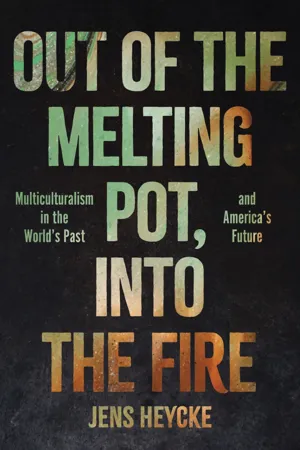
eBook - ePub
Out of the Melting Pot, Into the Fire
Multiculturalism in the World's Past and America's Future
- 272 pages
- English
- ePUB (mobile friendly)
- Available on iOS & Android
eBook - ePub
Out of the Melting Pot, Into the Fire
Multiculturalism in the World's Past and America's Future
About this book
Information
Subtopic
Social HistoryIndex
Social SciencesTable of contents
- Cover
- Title Page
- Copyright
- Contents
- Preface
- 1. A Brief Introduction to the Melting Pot
- 2. Lessons from Byzantine Race Riots
- 3. The Roman Melting Pot
- 4. The Multiculturalist Mexica
- 5. Islam, From Melting Pot to Millet
- 6. The Balkans—Millet, Multiculturalism, and Murder
- 7. Ethnic Identity Cards and Genocide in Rwanda
- 8. From Serendipity to Calamity in Sri Lanka
- 9. From Color Bar to Colorblind in Botswana
- 10. The Social and Economic Costs of Ethnic Division
- 11. Conclusion
- Appendix A: The Constitution of Medina
- Appendix B: Statistical Analyses
- Notes
- Index
Trusted by 375,005 students
Access to over 1.5 million titles for a fair monthly price.
Study more efficiently using our study tools.
Frequently asked questions
Yes, you can cancel anytime from the Subscription tab in your account settings on the Perlego website. Your subscription will stay active until the end of your current billing period. Learn how to cancel your subscription
No, books cannot be downloaded as external files, such as PDFs, for use outside of Perlego. However, you can download books within the Perlego app for offline reading on mobile or tablet. Learn how to download books offline
Perlego offers two plans: Essential and Complete
- Essential is ideal for learners and professionals who enjoy exploring a wide range of subjects. Access the Essential Library with 800,000+ trusted titles and best-sellers across business, personal growth, and the humanities. Includes unlimited reading time and Standard Read Aloud voice.
- Complete: Perfect for advanced learners and researchers needing full, unrestricted access. Unlock 1.5M+ books across hundreds of subjects, including academic and specialized titles. The Complete Plan also includes advanced features like Premium Read Aloud and Research Assistant.
We are an online textbook subscription service, where you can get access to an entire online library for less than the price of a single book per month. With over 1.5 million books across 990+ topics, we’ve got you covered! Learn about our mission
Look out for the read-aloud symbol on your next book to see if you can listen to it. The read-aloud tool reads text aloud for you, highlighting the text as it is being read. You can pause it, speed it up and slow it down. Learn more about Read Aloud
Yes! You can use the Perlego app on both iOS and Android devices to read anytime, anywhere — even offline. Perfect for commutes or when you’re on the go.
Please note we cannot support devices running on iOS 13 and Android 7 or earlier. Learn more about using the app
Please note we cannot support devices running on iOS 13 and Android 7 or earlier. Learn more about using the app
Yes, you can access Out of the Melting Pot, Into the Fire by Jens Kurt Heycke in PDF and/or ePUB format, as well as other popular books in Social Sciences & Social History. We have over 1.5 million books available in our catalogue for you to explore.