In the wake of the Red Army's signal victory at Stalingrad, which began when its surprise counteroffensive encircled German Sixth Army in Stalingrad region in mid-November 1942 and ended when its forces liquidated beleaguered Sixth Army in early February 1943, the Soviet High Command (Stavka) expanded its counteroffensive into a full-fledged winter offensive which nearly collapsed German defenses in southern Russia. Exploiting newly released Russian archival materials, After Stalingrad reveals the unbounded ambitions that shaped the Stavka's winter offensive and the full scope and scale of the Red Army's many offensive operations. For example, it reflects on recently rediscovered Operation Mars, Marshal Zhukov's companion-piece to the more famous Operation Uranus at Stalingrad. It then reexamines the Red Army's dramatic offensive into the Donbas and Khar'kov region during February, clearly demonstrating that this offensive was indeed conducted by three rather than two Red Army fronts. Likewise, it describes how the Stavka expanded the scale of its offensive in mid-February 1943 by ordering major strategic efforts, hitherto ignored, by multiple Red Army fronts along the Western (Orel-Smolensk) axis and, in Zhukov's forgotten operation Polar Star, along the Northwestern (Demiansk-Leningrad) axis as well. Finally, by restoring the full scope of these failed or partially failed Red Army offensives to history, this volume also reassesses the impact of Manstein's dramatic counterstrokes in the Donbas and Khar'kov regions, concluding that their impact was equivalent to that of a full-fledged strategic counteroffensive. This new study includes over 100 operational maps to highlight key aspects of the offensives.
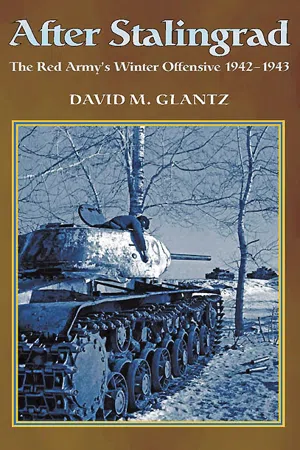
- 537 pages
- English
- PDF
- Available on iOS & Android
eBook - PDF
About this book
Information
Subtopic
Military & Maritime HistoryIndex
HistoryTable of contents
- List of Illustrations
- List of Maps
- List of Figures
- Preface
- 1. Overview
- PART 1 – SOVIET OFFENSIVE OPERATIONS WITHIN THE CONTEXT OF THE STALINGRAD OFFENSIVE (NOVEMBER 1942-JANUARY 1943)
- 2. The Kalinin and Western Fronts’ 2nd Rzhev-Sychevka Offensive (Operation Mars) (25 November–16 December 1942)
- 3. The Northwestern Front’s Demiansk Offensive (28 November 1942–6 January 1943)
- PART 2 – SOVIET OFFENSIVE OPERATIONS ALONG THE SOUTHWESTERN AXIS (FEBRUARY-MARCH 1943)
- 4. The Southwestern Front’s Voroshilovgrad (Donbas) Offensive (Operation Gallop [Skachok]) (29 January–18 February 1943)
- 5. The Southern Front’s Mariupol’ (Donbas) Offensive (16–22 February 1943)
- PART 3 – SOVIET OFFENSIVE OPERATIONS ALONG THE WESTERN (CENTRAL) AXIS (FEBRUARY-MARCH 1943)
- 6. The Briansk Front’s Orel Offensive and the Voronezh Front’s (60th and 38th Armies’) L’gov and Sumy Offensives (26 January–12 February 1943)
- 7. The Central, Briansk, and Western Fronts’ Orel, Briansk, and Smolensk Offensive (15 February–6 March 1943)
- 8. The Kalinin, Western, Briansk, and Central Fronts’ Orel, Briansk, and Smolensk Offensive (7–21 March 1943)
- PART 4 – SOVIET OFFENSIVE OPERATIONS ALONG THE NORTHWESTERN AXIS (FEBRUARY-MARCH 1943)
- 9. The Leningrad, Volkhov, and Northwestern Fronts’ Operation Polar Star (Demiansk) (15–28 February)
- 10. The Leningrad, Volkhov, Northwestern Front’s Truncated Operation Polar Star (Staraia Russa) (4 March–2 April 1943)
- 11. Conclusions
- Notes
- Bibliography
- Index
Trusted by 375,005 students
Access to over 1.5 million titles for a fair monthly price.
Study more efficiently using our study tools.
Frequently asked questions
Yes, you can cancel anytime from the Subscription tab in your account settings on the Perlego website. Your subscription will stay active until the end of your current billing period. Learn how to cancel your subscription
No, books cannot be downloaded as external files, such as PDFs, for use outside of Perlego. However, you can download books within the Perlego app for offline reading on mobile or tablet. Learn how to download books offline
Perlego offers two plans: Essential and Complete
- Essential is ideal for learners and professionals who enjoy exploring a wide range of subjects. Access the Essential Library with 800,000+ trusted titles and best-sellers across business, personal growth, and the humanities. Includes unlimited reading time and Standard Read Aloud voice.
- Complete: Perfect for advanced learners and researchers needing full, unrestricted access. Unlock 1.5M+ books across hundreds of subjects, including academic and specialized titles. The Complete Plan also includes advanced features like Premium Read Aloud and Research Assistant.
We are an online textbook subscription service, where you can get access to an entire online library for less than the price of a single book per month. With over 1.5 million books across 990+ topics, we’ve got you covered! Learn about our mission
Look out for the read-aloud symbol on your next book to see if you can listen to it. The read-aloud tool reads text aloud for you, highlighting the text as it is being read. You can pause it, speed it up and slow it down. Learn more about Read Aloud
Yes! You can use the Perlego app on both iOS and Android devices to read anytime, anywhere — even offline. Perfect for commutes or when you’re on the go.
Please note we cannot support devices running on iOS 13 and Android 7 or earlier. Learn more about using the app
Please note we cannot support devices running on iOS 13 and Android 7 or earlier. Learn more about using the app
Yes, you can access After Stalingrad by David M. Glantz in PDF and/or ePUB format, as well as other popular books in History & Military & Maritime History. We have over 1.5 million books available in our catalogue for you to explore.