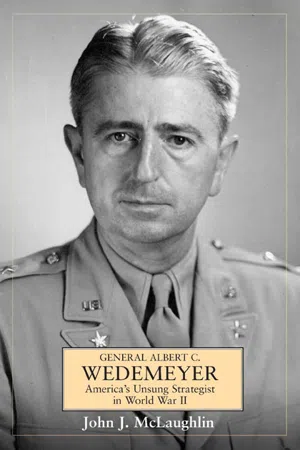
"…an engaging book about a little known general who was in the thick of strategizing on both the European and Asian fronts." — The Sunday Star Ledger Like many heroes of the Second World War, General Albert C. Wedemeyer's career has been largely overshadowed by such well-known figures as Marshall, Patton, Montgomery, and Bradley. Wedemeyer's legacy as the main planner of the D-Day invasion is almost completely forgotten today, eclipsed by politics and the capriciousness of human nature. Yet during America's preparation for the war, Wedemeyer was the primary author of the "Victory Program" that mobilized US resources and directed them at crucial points in order to secure victory over the Axis. In the late 1930s he had the unique experience of being an exchange student at the German Kriegsakademia, the Nazis' equivalent of Fort Leavenworth's Command and General Staff School. As the only American to attend, he was thus the only ranking officer in the US who recognized the revolutionary tactics of Blitzkrieg once they were unleashed, and he knew how to respond. As US involvement in the European conflagration approached, Wedemeyer was taken under the wing of George C. Marshall in Washington. Wedemeyer conceived the plans for US mobilization, which was in greater gear than realized at the time of Pearl Harbor. The Victory Program, completed in the summer of 1941, contained actual battle plans and called for the concentration of forces in England in preparation for an early cross-channel invasion into France. However, to Wedemeyer's great disappointment (reflecting Marshall's), he was not appointed to field command in the ETO once the invasion commenced; further, he had run afoul of Winston Churchill due to the latter's insistence on emphasizing the Mediterranean theater in 1943. Perhaps because of Churchill's animosity, Wedemeyer was transferred to the Burma-China theater, where a year later he would replace General Stilwell. Ultimately, Wedemeyer's service in the Asian theater became far more significant, though less known. Had the US political establishment listened to Wedemeyer's advice on China during the years 1943-48, it is possible China would not have been lost to the Communists and would have been a functioning US ally from the start, thus eliminating the likelihood of both the Korean and Vietnam Wars. Despite Wedemeyer's key position at the crux of modern history, his contributions have been overlooked in most accounts of World War II and the Cold War beyond. In this work we gain an intimate look at a visionary thinker who helped guide the Allies to victory in their greatest challenge, but whose vision of the post-war world was unfortunately not heeded.
- 352 pages
- English
- ePUB (mobile friendly)
- Available on iOS & Android
eBook - ePub
About this book
Information
Subtopic
ManagementIndex
HistoryTable of contents
- Cover Page
- Title Page
- Copyright
- Contents
- Dedication
- Acknowledgments
- Maps
- PREFACE
- INTRODUCTION
- CHAPTER 1: BEGINNINGS
- CHAPTER 2: THE EDUCATION OF A STRATEGIST
- CHAPTER 3: WRITING THE VICTORY PROGRAM
- CHAPTER 4: UNDERMINING THE VICTORY PROGRAM: RATTLESNAKE OR BOA CONSTRICTOR
- CHAPTER 5: WESTERN INFLUENCE ON CHINA
- CHAPTER 6: STILWELL'S WAR
- CHAPTER 7: EASED OUT TO ASIA
- CHAPTER 8: CHINA COMMANDER
- CHAPTER 9: GENERAL MARSHALL'S FAILED MISSION IN CHINA
- CHAPTER 10: WEDEMEYER'S 1947 MISSION TO CHINA
- CHAPTER 11: THE ROLE OF THE RUSSIAN BEAR
- CHAPTER 12: HOW THE COMMUNISTS TOOK CHINA
- CHAPTER 13: WEDEMEYER IN RETIREMENT
- CHAPTER 14: CONCLUSIONS
- APPENDIX I
- APPENDIX II
- APPENDIX III
- APPENDIX IV
- APPENDIX V
- APPENDIX VI
- NOTES
- BIBLIOGRAPHY
- CHRONOLOGY
- INDEX
Trusted by 375,005 students
Access to over 1.5 million titles for a fair monthly price.
Study more efficiently using our study tools.
Frequently asked questions
Yes, you can cancel anytime from the Subscription tab in your account settings on the Perlego website. Your subscription will stay active until the end of your current billing period. Learn how to cancel your subscription
No, books cannot be downloaded as external files, such as PDFs, for use outside of Perlego. However, you can download books within the Perlego app for offline reading on mobile or tablet. Learn how to download books offline
Perlego offers two plans: Essential and Complete
- Essential is ideal for learners and professionals who enjoy exploring a wide range of subjects. Access the Essential Library with 800,000+ trusted titles and best-sellers across business, personal growth, and the humanities. Includes unlimited reading time and Standard Read Aloud voice.
- Complete: Perfect for advanced learners and researchers needing full, unrestricted access. Unlock 1.5M+ books across hundreds of subjects, including academic and specialized titles. The Complete Plan also includes advanced features like Premium Read Aloud and Research Assistant.
We are an online textbook subscription service, where you can get access to an entire online library for less than the price of a single book per month. With over 1.5 million books across 990+ topics, we’ve got you covered! Learn about our mission
Look out for the read-aloud symbol on your next book to see if you can listen to it. The read-aloud tool reads text aloud for you, highlighting the text as it is being read. You can pause it, speed it up and slow it down. Learn more about Read Aloud
Yes! You can use the Perlego app on both iOS and Android devices to read anytime, anywhere — even offline. Perfect for commutes or when you’re on the go.
Please note we cannot support devices running on iOS 13 and Android 7 or earlier. Learn more about using the app
Please note we cannot support devices running on iOS 13 and Android 7 or earlier. Learn more about using the app
Yes, you can access General Albert C. Wedemeyer by John McLaughlin in PDF and/or ePUB format, as well as other popular books in History & Management. We have over 1.5 million books available in our catalogue for you to explore.