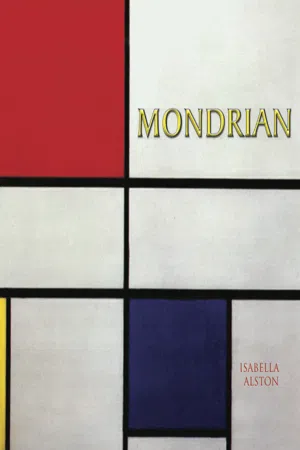
Piet Mondrian pioneered the de Stijl movement—Dutch for "The Style"—that emerged in the early 20th century and which served as an important transition from a focus on Symbolism and Realism to a new and growing focus on abstraction. The evolution of Mondrian's initial, traditional style, akin to that of The Hague School, through to his much later works in primary colors and geometric forms, which he called Neo-plasticism, is marked by rather sharp deviations in stylistic form and experimentation along the way, including Cubism and Fauvism. Much of Mondrian's work was greatly influenced by Theosophy, a movement considered to be the genesis of "New Age" beliefs, begun by the Russian occultist Helena Blavatsky in 1875. The goal of her followers was to find inner enlightenment. As Mondrian sought personal inner beauty and the reason for his existence, he sought the same in his art, reducing and simplying the subjects of his paintings to the true essence of what he perceived as their inner beauty and raison d'etre. In the company of artists such as Picasso and Dalí, Mondrian's body of work is without question one of the most evolutionary in style and imaginative in content, ranging from excellently executed realistic depictions to the most abstract interpretations of their subjects.
eBook - ePub
Mondrian
About this book
Information
Topic
ArtSubtopic
Artist MonographsTable of contents
- Cover
- Title Page
- Contents
- Piet Mondrian
- Index
Trusted by 375,005 students
Access to over 1.5 million titles for a fair monthly price.
Study more efficiently using our study tools.
Frequently asked questions
Yes, you can cancel anytime from the Subscription tab in your account settings on the Perlego website. Your subscription will stay active until the end of your current billing period. Learn how to cancel your subscription
No, books cannot be downloaded as external files, such as PDFs, for use outside of Perlego. However, you can download books within the Perlego app for offline reading on mobile or tablet. Learn how to download books offline
Perlego offers two plans: Essential and Complete
- Essential is ideal for learners and professionals who enjoy exploring a wide range of subjects. Access the Essential Library with 800,000+ trusted titles and best-sellers across business, personal growth, and the humanities. Includes unlimited reading time and Standard Read Aloud voice.
- Complete: Perfect for advanced learners and researchers needing full, unrestricted access. Unlock 1.5M+ books across hundreds of subjects, including academic and specialized titles. The Complete Plan also includes advanced features like Premium Read Aloud and Research Assistant.
We are an online textbook subscription service, where you can get access to an entire online library for less than the price of a single book per month. With over 1.5 million books across 990+ topics, we’ve got you covered! Learn about our mission
Look out for the read-aloud symbol on your next book to see if you can listen to it. The read-aloud tool reads text aloud for you, highlighting the text as it is being read. You can pause it, speed it up and slow it down. Learn more about Read Aloud
Yes! You can use the Perlego app on both iOS and Android devices to read anytime, anywhere — even offline. Perfect for commutes or when you’re on the go.
Please note we cannot support devices running on iOS 13 and Android 7 or earlier. Learn more about using the app
Please note we cannot support devices running on iOS 13 and Android 7 or earlier. Learn more about using the app
Yes, you can access Mondrian by Isabella Alston in PDF and/or ePUB format, as well as other popular books in Art & Artist Monographs. We have over 1.5 million books available in our catalogue for you to explore.