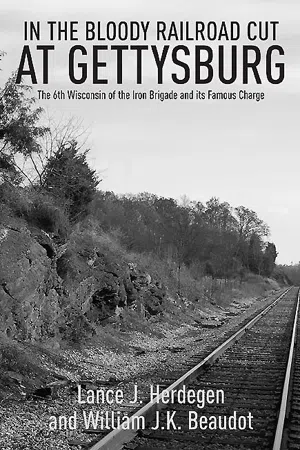
The storied Iron Brigade carved out a unique reputation during the Civil War. Its men fought on many hard fields, but they performed their most legendary exploits just outside a small Pennsylvania town called Gettysburg on the first day of July in 1863. There were many heroic actions that morning and afternoon, but the fight along an unfinished deep scar in the ground north of the Chambersburg Pike was one never forgotten, and is the subject of Lance J. Herdegen’s and William J. K. Beaudot’s award-winning (and long out of print) In the Bloody Railroad Cut at Gettysburg: The 6th Wisconsin of the Iron Brigade and its Famous Charge.The railroad cut fighting was led mainly by the “Calico Boys” of the 6th Wisconsin Volunteers. Detached from the balance of the Iron Brigade, the Badgers of the 6th charged nearly 200 yards to meet a Confederate brigade that had swung into what looked like an ideal defensive position along an unfinished railroad cut northwest of town. The fighting was close, brutal, personal, and bloody—and it played a key role in the final Union victory.The Wisconsin men always remembered that moment when they stood under “a galling fire” in an open field just north of the pike. Using hundreds of firsthand accounts, many previously unpublished, Herdegen and Beaudot carry their readers into the very thick of the fighting. The air seemed “full of bullets, ” one private recalled, the men around him dropping “at a fearful rate.” Pvt. Amos Lefler was on his hands and knees spitting blood and teeth with Capt. Johnny Ticknor of Company K down and dying just a handful of yards away. Pvt. James P. Sullivan felt defenseless, unable as he was to get his rifle-musket to fire because of bad percussion caps. Rebel buckshot, meanwhile, smashed the canteen and slashed the hip of Sgt. George Fairfield. Behind the Wisconsin men, Lt. Col. Rufus Dawes watched a “fearful” and “destructive” Confederate fire crashing with “an unbroken roar before us. Men were being shot by twenties and thirties.”While frantically loading and shooting, the Badgers leaned into the storm of bullets coming from the cut 175 yards away. The Westerners pushed slowly into the field and—at that very instant when victory or defeat teetered undecided—the “Jayhawkers” in the Prairie du Chien Company began shouting “Charge! Charge! Charge!” And so they did. Young Dawes lifted his sword and shouted “Forward! Forward Charge! Align on the Colors!” It was at that moment, remembered Cpl. Frank Wallar, a farmer-turned-soldier who would soon make his name known to history by capturing the flag of the 2nd Mississippi, “there was a general rush and yells enough to almost awaken the dead.”Out of print for nearly two decades, this facsimile reprint and its new Introduction share with yet another generation of readers the story of the 6th Wisconsin’s magnificent charge. Indeed it is their story, and how they remembered it. And it is one you will never forget.
eBook - ePub
In the Bloody Railroad Cut at Gettysburg
The 6th Wisconsin of the Iron Brigade and its Famous Charge
- 388 pages
- English
- ePUB (mobile friendly)
- Available on iOS & Android
eBook - ePub
In the Bloody Railroad Cut at Gettysburg
The 6th Wisconsin of the Iron Brigade and its Famous Charge
About this book
Information
Subtopic
American Civil War HistoryIndex
HistoryTable of contents
- Cover
- Title Page
- Copyright
- Table of Contents
- Photographs
- Maps
- Preface for the 2015 Edition
- Foreword
- Acknowledgments
- Introduction
- Chapter 1: Mickey of Company K
- Chapter 2: Wisconsin’s 6th
- Chapter 3: Greenhorn Patriots
- Chapter 4: Washington Camps
- Chapter 5: Marsh Creek
- Chapter 6: Go Like Hell
- Chapter 7: Gettysburg
- Chapter 8: Lancaster: 1884
- Appendix I: Capturing a Flag
- Appendix II: The Charge
- Appendix III: The Uniform of the Iron Brigade at Gettysburg, July 1, 1863
- Bibliography
Trusted by 375,005 students
Access to over 1.5 million titles for a fair monthly price.
Study more efficiently using our study tools.
Frequently asked questions
Yes, you can cancel anytime from the Subscription tab in your account settings on the Perlego website. Your subscription will stay active until the end of your current billing period. Learn how to cancel your subscription
No, books cannot be downloaded as external files, such as PDFs, for use outside of Perlego. However, you can download books within the Perlego app for offline reading on mobile or tablet. Learn how to download books offline
Perlego offers two plans: Essential and Complete
- Essential is ideal for learners and professionals who enjoy exploring a wide range of subjects. Access the Essential Library with 800,000+ trusted titles and best-sellers across business, personal growth, and the humanities. Includes unlimited reading time and Standard Read Aloud voice.
- Complete: Perfect for advanced learners and researchers needing full, unrestricted access. Unlock 1.5M+ books across hundreds of subjects, including academic and specialized titles. The Complete Plan also includes advanced features like Premium Read Aloud and Research Assistant.
We are an online textbook subscription service, where you can get access to an entire online library for less than the price of a single book per month. With over 1.5 million books across 990+ topics, we’ve got you covered! Learn about our mission
Look out for the read-aloud symbol on your next book to see if you can listen to it. The read-aloud tool reads text aloud for you, highlighting the text as it is being read. You can pause it, speed it up and slow it down. Learn more about Read Aloud
Yes! You can use the Perlego app on both iOS and Android devices to read anytime, anywhere — even offline. Perfect for commutes or when you’re on the go.
Please note we cannot support devices running on iOS 13 and Android 7 or earlier. Learn more about using the app
Please note we cannot support devices running on iOS 13 and Android 7 or earlier. Learn more about using the app
Yes, you can access In the Bloody Railroad Cut at Gettysburg by William J.K. Beaudot,Lance J. Herdegen in PDF and/or ePUB format, as well as other popular books in History & American Civil War History. We have over 1.5 million books available in our catalogue for you to explore.