Using a combination of new perspectives and new evidence, this book presents a reinterpretation of how 21st Army Group produced a successful combined arms doctrine by late 1944 and implemented this in early 1945. Historians, professional military personnel and those interested in military history should read this book, which contributes to the radical reappraisal of Great Britain's fighting forces in the last years of the Second World War, with an exploration of the reasons why 21st Army Group was able in 1944–45 to integrate the operations of its armor and infantry. The key to understanding how the outcome developed lies in understanding the ways in which the two processes of fighting and the creation of doctrine interrelated. This requires both a conventional focus on command and a cross-level study of Montgomery and a significant group of commanders. The issue of whether or not this integration of combat arms (a guide to operational fighting capability) had any basis in a common doctrine is an important one. Alongside this stands the new light this work throws on how such doctrine was created. A third interrelated contribution is in answering how Montgomery commanded, and whether and to what extent, doctrine was imposed or generated. Further it investigates how a group of 'effervescent' commanders interrelated, and what the impact of those interrelationships was in the formulation of a workable doctrine. The book makes an original contribution to the debate on Montgomery's command style in Northwest Europe and its consequences, and integrates this with tracking down and disentangling the roots of his ideas, and his role in the creation of doctrine for the British Army's final push against the Germans. In particular the author is able to do something that has defeated previous authors: to explain how doctrine was evolved and, especially who was responsible for providing the crucial first drafts, and the role Montgomery played in revising, codifying and disseminating it.
eBook - ePub
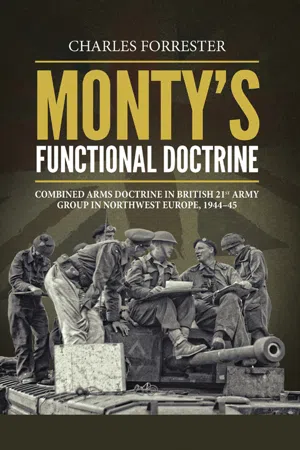
Monty's Functional Doctrine
Combined Arms Doctrine in British 21st Army Group in Northwest Europe, 1944–45
- 176 pages
- English
- ePUB (mobile friendly)
- Available on iOS & Android
eBook - ePub
Monty's Functional Doctrine
Combined Arms Doctrine in British 21st Army Group in Northwest Europe, 1944–45
About this book
Information
Subtopic
World War IIIndex
HistoryTable of contents
- Cover
- About the author
- Title
- Copyright
- Contents
- List of Plates
- List of Figures
- List of Maps
- List of Abbreviations
- Series Editor’s Preface
- Author’s Preface
- 1 The Influence of Army Structures, Motorisation, and Armoured Divisions on the British Army before 1944
- 2 The Interaction between Army Structures, Motorisation, and Armoured Divisions, and Montgomery’s thinking before 1944
- 3 Relevance of Manoeuvre v. Pitched Battle, and the Effects of Montgomery’s thinking, in early Normandy Operations
- 4 Significance of Middle-Level Command Responses to the Problems of Fighting and Defeating the German Panzers in Normandy
- 5 High-level Responses and Dimensions of Operational Practice in late 1944 and before the Rhine Crossing
- 6 Understanding the Interaction of Montgomery, Key Commanders and Circumstances in late 1944 and before the Rhine Crossing
- 7 The Reasons for, and Organisation of, Montgomery’s Pamphlet Writing Process of late 1944
- 8 The Pamphlets’ Doctrine and its Practical Expression
- 9 Monty’s Functional Doctrine: the Factors that Produced it; and his Framework of War
- Appendix
- Bibliography
Trusted by 375,005 students
Access to over 1.5 million titles for a fair monthly price.
Study more efficiently using our study tools.
Frequently asked questions
Yes, you can cancel anytime from the Subscription tab in your account settings on the Perlego website. Your subscription will stay active until the end of your current billing period. Learn how to cancel your subscription
No, books cannot be downloaded as external files, such as PDFs, for use outside of Perlego. However, you can download books within the Perlego app for offline reading on mobile or tablet. Learn how to download books offline
Perlego offers two plans: Essential and Complete
- Essential is ideal for learners and professionals who enjoy exploring a wide range of subjects. Access the Essential Library with 800,000+ trusted titles and best-sellers across business, personal growth, and the humanities. Includes unlimited reading time and Standard Read Aloud voice.
- Complete: Perfect for advanced learners and researchers needing full, unrestricted access. Unlock 1.5M+ books across hundreds of subjects, including academic and specialized titles. The Complete Plan also includes advanced features like Premium Read Aloud and Research Assistant.
We are an online textbook subscription service, where you can get access to an entire online library for less than the price of a single book per month. With over 1.5 million books across 990+ topics, we’ve got you covered! Learn about our mission
Look out for the read-aloud symbol on your next book to see if you can listen to it. The read-aloud tool reads text aloud for you, highlighting the text as it is being read. You can pause it, speed it up and slow it down. Learn more about Read Aloud
Yes! You can use the Perlego app on both iOS and Android devices to read anytime, anywhere — even offline. Perfect for commutes or when you’re on the go.
Please note we cannot support devices running on iOS 13 and Android 7 or earlier. Learn more about using the app
Please note we cannot support devices running on iOS 13 and Android 7 or earlier. Learn more about using the app
Yes, you can access Monty's Functional Doctrine by Charles Forrester in PDF and/or ePUB format, as well as other popular books in History & World War II. We have over 1.5 million books available in our catalogue for you to explore.