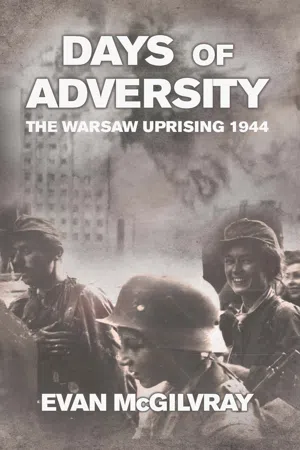
This work is a reexamination of the decisions regarding the 1944 Warsaw Uprising made by the leadership of the underground Polish Army (AK), as well as the questionable attitudes of senior Polish commanders in exile in London. The questions raised are, was the uprising necessary and why was it so poorly conducted by a totally indifferent leadership? The challenge is made that the Polish leaders in Warsaw and in London were clearly unfeeling. In Warsaw the uprising was allowed to happen and was doomed from the very beginning owing to poor generalship. The Soviets can be seen rather than to have betrayed the Poles, to have behaved in the same manner as they had always behaved to the Poles and Poland, that is underhanded and with great deceit. Therefore why did the Warsaw Poles rise up when encouraged by the Soviets? The Poles should have known that it was a trick. Despite plans laid down by the Allies to support such uprisings, as had been the case in Paris during August 1944, the Red Army watched the AK be destroyed by the Germans, to save themselves the same job. Once the uprising failed, the Polish leadership went into what could only be described as 'genteel' captivity, compared with the fate of hundreds of thousands of their countrymen and women who were herded out of Warsaw by German armed forces and sent to concentration camps, illegal prisoner of war camps or forced into slave labor. In the West senior Polish commanders did not consider a 100% casualty rate to be unacceptable as they pushed for Allied flights to resupply Warsaw. This callous disregard for life was part of the lack of understanding in the leadership of the reality of the Polish situation in 1944: the war was not about Poland but the complete defeat of Germany. If Polish freedom came out of this, then good, otherwise the Allies were not going to be diverted from the constant aerial bombardment of Germany, as the Allies swept eastward and westward towards Germany. This work is supplemented with Polish sources as well as interviews with five women who had been involved in the Warsaw Uprising as young women and girls in 1944. Now in their 80s these ladies kindly granted interviews with the author in Poland during 2012.
- 256 pages
- English
- ePUB (mobile friendly)
- Available on iOS & Android
eBook - ePub
About this book
Information
Subtopic
World War IIIndex
HistoryTable of contents
- Cover
- About the author
- Title
- Copyright
- Contents
- List of illustrations & maps
- List of abbreviations
- Preface
- Introduction
- 1 The Polish Underground State
- 2 Why the Rising?
- 3 The Military Aspect
- 4 A Declining Situation
- 5 The Battle for Aerial Support
- 6 The Polish Achilles’ Heel
- 7 Civilians: The Ladies of the Warsaw Uprising
- 8 Warsaw Abandoned and the Consequences of Failure
- Appendix
- Bibliography
Trusted by 375,005 students
Access to over 1.5 million titles for a fair monthly price.
Study more efficiently using our study tools.
Frequently asked questions
Yes, you can cancel anytime from the Subscription tab in your account settings on the Perlego website. Your subscription will stay active until the end of your current billing period. Learn how to cancel your subscription
No, books cannot be downloaded as external files, such as PDFs, for use outside of Perlego. However, you can download books within the Perlego app for offline reading on mobile or tablet. Learn how to download books offline
Perlego offers two plans: Essential and Complete
- Essential is ideal for learners and professionals who enjoy exploring a wide range of subjects. Access the Essential Library with 800,000+ trusted titles and best-sellers across business, personal growth, and the humanities. Includes unlimited reading time and Standard Read Aloud voice.
- Complete: Perfect for advanced learners and researchers needing full, unrestricted access. Unlock 1.5M+ books across hundreds of subjects, including academic and specialized titles. The Complete Plan also includes advanced features like Premium Read Aloud and Research Assistant.
We are an online textbook subscription service, where you can get access to an entire online library for less than the price of a single book per month. With over 1.5 million books across 990+ topics, we’ve got you covered! Learn about our mission
Look out for the read-aloud symbol on your next book to see if you can listen to it. The read-aloud tool reads text aloud for you, highlighting the text as it is being read. You can pause it, speed it up and slow it down. Learn more about Read Aloud
Yes! You can use the Perlego app on both iOS and Android devices to read anytime, anywhere — even offline. Perfect for commutes or when you’re on the go.
Please note we cannot support devices running on iOS 13 and Android 7 or earlier. Learn more about using the app
Please note we cannot support devices running on iOS 13 and Android 7 or earlier. Learn more about using the app
Yes, you can access Days of Adversity by Evan McGilvray in PDF and/or ePUB format, as well as other popular books in History & World War II. We have over 1.5 million books available in our catalogue for you to explore.