Dynamics of Skill Acquisition, Second Edition, provides an analysis of the processes underlying human skill acquisition. As the first text to outline the multidisciplinary ecological dynamics framework for understanding movement behavior, this heavily updated edition stays on the cutting edge, with principles of nonlinear pedagogy and methodologies from the constraints-led approach.
Students and practitioners across a variety of professions—including coaches, physical educators, trainers, and rehabilitation specialists—will appreciate the applied focus of this second edition. Movement models throughout the text provide examples for visualizing task constraints and enhancing the study and understanding of movement behavior. Athletes and sports teams are presented as specific complex adaptive systems, with information on designing learning environments and adapting programs to foster skill development.
Readers will learn the historical evolution of dynamical systems theory and the ecological dynamics framework. These foundational concepts illustrate the integration between intentional action, cognition, and decision making and their effects on performance and behavior. Complex theoretical concepts are explained in simple terms and related to practice, focusing on the implications of the work of pioneering researchers such as Nikolai Bernstein, Egon Brunswik, James Gibson, Scott Kelso, and Karl Newell. Case studies written by practitioners contain specific examples of the ecological dynamics framework in action, bringing theory to life. By learning how to identify and manipulate key constraints that influence learning skilled behavior, readers will gain insight into practice designs for creating positive learning experiences that enable individuals to develop and learn functional movements.
Throughout the book, learning features guide readers through material with clear direction and focus to improve understanding. Spotlight on Research sidebars provide detailed descriptions of important studies to connect theory, research, and application. Lab activities teach application skills beyond the content, ensuring reader understanding. In addition, chapter objectives, self-test questions, and Key Concept sidebars highlight important concepts in each chapter.
With the study of human movement now bridging many disciplines, including motor development, psychology, biology, and physical therapy, Dynamics of Skill Acquisition, Second Edition, provides a timely analysis of the ecological dynamics framework and presents a comprehensive model for understanding how coordination patterns are assembled, controlled, and acquired. The theoretical roots and development of the ecological dynamics framework provide application strategies for all people with an interest in movement coordination and control.
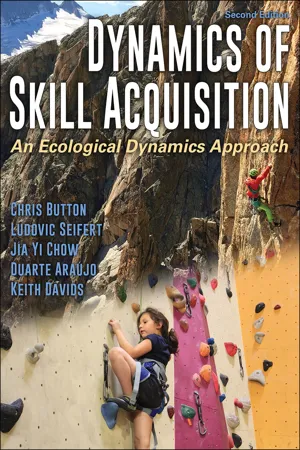
eBook - ePub
Dynamics of Skill Acquisition
An Ecological Dynamics Approach
- 288 pages
- English
- ePUB (mobile friendly)
- Available on iOS & Android
eBook - ePub
Dynamics of Skill Acquisition
An Ecological Dynamics Approach
About this book
Information
Table of contents
- Cover
- Title Page
- Copyright
- Contents
- Preface
- Acknowledgments
- Chapter 1. Athletes and Sports Teams Considered as Complex Adaptive Systems
- Chapter 2. Physical Constraints on Coordination: Dynamical Systems Theory
- Chapter 3. Informational Constraints on Coordination: An Ecological Psychology Perspective
- Chapter 4. Intentionality, Cognition, and Decision Making in Sport
- Chapter 5. Understanding the Dynamics of Skill Acquisition
- Chapter 6. How Interacting Constraints Support a Nonlinear Pedagogy
- Chapter 7. Redefining Learning: Practical Issues for Representative Learning Design
- Chapter 8. Designing Individualized Practice Environments
- Chapter 9. Practice for Sports Teams
- Chapter 10. Modified Perceptual Training for Athletes
- Chapter 11. Practitioners as Designers
- Chapter 12. Expertise and Talent Development in Sport
- Glossary
- References
- Index
- About the Authors
Trusted by 375,005 students
Access to over 1.5 million titles for a fair monthly price.
Study more efficiently using our study tools.
Frequently asked questions
Yes, you can cancel anytime from the Subscription tab in your account settings on the Perlego website. Your subscription will stay active until the end of your current billing period. Learn how to cancel your subscription
No, books cannot be downloaded as external files, such as PDFs, for use outside of Perlego. However, you can download books within the Perlego app for offline reading on mobile or tablet. Learn how to download books offline
Perlego offers two plans: Essential and Complete
- Essential is ideal for learners and professionals who enjoy exploring a wide range of subjects. Access the Essential Library with 800,000+ trusted titles and best-sellers across business, personal growth, and the humanities. Includes unlimited reading time and Standard Read Aloud voice.
- Complete: Perfect for advanced learners and researchers needing full, unrestricted access. Unlock 1.5M+ books across hundreds of subjects, including academic and specialized titles. The Complete Plan also includes advanced features like Premium Read Aloud and Research Assistant.
We are an online textbook subscription service, where you can get access to an entire online library for less than the price of a single book per month. With over 1.5 million books across 990+ topics, we’ve got you covered! Learn about our mission
Look out for the read-aloud symbol on your next book to see if you can listen to it. The read-aloud tool reads text aloud for you, highlighting the text as it is being read. You can pause it, speed it up and slow it down. Learn more about Read Aloud
Yes! You can use the Perlego app on both iOS and Android devices to read anytime, anywhere — even offline. Perfect for commutes or when you’re on the go.
Please note we cannot support devices running on iOS 13 and Android 7 or earlier. Learn more about using the app
Please note we cannot support devices running on iOS 13 and Android 7 or earlier. Learn more about using the app
Yes, you can access Dynamics of Skill Acquisition by Chris Button,Ludovic Seifert,Jia Yi Chow,Duarte Araujo,Keith Davids in PDF and/or ePUB format, as well as other popular books in Psychology & Developmental Psychology. We have over 1.5 million books available in our catalogue for you to explore.