AS CITIZENS OF A HISTORICALLY FRONTIER LAND, AMERICANS HAVE AN INHERENT DISTRUST OF THE CONFINEMENTS AND COMPLEXITIES OF THE CITY.
But this ingrained romanticism about the natural life—the authors insist—does not fully explain American anti-urbanism. They point out that not only men like Emerson and Melville, but cosmopolitan figures such as Henry James, John Dewey and Theodore Dreiser have considered the American city a sinister place. The great architect Frank Lloyd Wright wanted to demolish the metropolis and replace it with a revolutionary form of living. Even the world-famous industrialist Henry Ford has said, "We shall solve the City Problem by leaving the City."
Tracing back across a century and a half, exploring the fields of art, philosophy, and sociology, Morton and Lucia White reveal what important Americans have said about their cities, and why. The authors suggest that modern city planners and social scientists have something to learn from these great dissenters, from their troubling wisdom and their urgent prophecies.
From Thomas Jefferson to Frank Lloyd Wright our nation's most distinguished artists, leaders, and intellectuals have proclaimed open hostility toward the city. Unlike the Englishman's London or the Frenchman's Paris, they have found nothing to love in the sprawling American metropolis. This significant and thoughtful study analyzes for the first time the major intellectual reactions to urbanism that have appeared through a century and a half of American history and offers some provocative conclusions as to why our cities have been the traditional object of prejudice, fear, and distrust.
"A revealing analysis of American attitudes toward urbanization and urban life."—New York Times
"Excellent"—Harper's
"This lucid and imaginative book opens up new vistas in our understanding of our past and of our present."—Arthur Schlesinger, Jr.
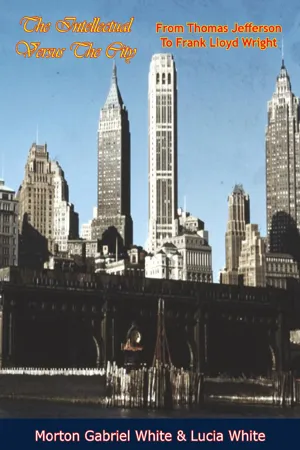
eBook - ePub
The Intellectual Versus The City
From Thomas Jefferson To Frank Lloyd Wright
- 253 pages
- English
- ePUB (mobile friendly)
- Available on iOS & Android
eBook - ePub
The Intellectual Versus The City
From Thomas Jefferson To Frank Lloyd Wright
About this book
Information
Subtopic
American Civil War HistoryIndex
HistoryTable of contents
- Title page
- TABLE OF CONTENTS
- DEDICATION
- PREFACE
- CHAPTER I - OPENING THEME
- CHAPTER II - THE IRENIC AGE - FRANKLIN, CRÊVECOEUR, AND JEFFERSON
- CHAPTER III - METAPHYSICS AGAINST THE CITY - THE AGE OF EMERSON
- CHAPTER IV - BAD DREAMS OF THE CITY - MELVILLE, HAWTHORNE, AND POE
- CHAPTER V - THE DISPLACED PATRICIAN - HENRY ADAMS
- CHAPTER VI - THE VISITING MIND - HENRY JAMES
- CHAPTER VII - THE AMBIVALENT URBANITE - WILLIAM DEAN HOWELLS
- CHAPTER VIII - DISAPPOINTMENT IN NEW YORK - FRANK NORRIS AND THEODORE DREISER
- CHAPTER IX - PRAGMATISM AND SOCIAL WORK - WILLIAM JAMES AND JANE ADDAMS
- CHAPTER X - THE PLEA FOR COMMUNITY - ROBERT PARK AND JOHN DEWEY
- CHAPTER XI - PROVINCIALISM AND ALIENATION - AN ASIDE ON JOSIAH ROYCE AND GEORGE SANTAYANA
- CHAPTER XII - ARCHITECTURE AGAINST THE CITY - FRANK LLOYD WRIGHT
- CHAPTER XIII - THE LEGACY OF FEAR
- CHAPTER XIV - THE OUTLINES OF A TRADITION
- CHAPTER XV - ROMANTICISM IS NOT ENOUGH
- CHAPTER XVI - IDEOLOGY, PREJUDICE, AND REASONABLE CRITICISM
- ACKNOWLEDGMENTS
Trusted by 375,005 students
Access to over 1.5 million titles for a fair monthly price.
Study more efficiently using our study tools.
Frequently asked questions
Yes, you can cancel anytime from the Subscription tab in your account settings on the Perlego website. Your subscription will stay active until the end of your current billing period. Learn how to cancel your subscription
No, books cannot be downloaded as external files, such as PDFs, for use outside of Perlego. However, you can download books within the Perlego app for offline reading on mobile or tablet. Learn how to download books offline
Perlego offers two plans: Essential and Complete
- Essential is ideal for learners and professionals who enjoy exploring a wide range of subjects. Access the Essential Library with 800,000+ trusted titles and best-sellers across business, personal growth, and the humanities. Includes unlimited reading time and Standard Read Aloud voice.
- Complete: Perfect for advanced learners and researchers needing full, unrestricted access. Unlock 1.5M+ books across hundreds of subjects, including academic and specialized titles. The Complete Plan also includes advanced features like Premium Read Aloud and Research Assistant.
We are an online textbook subscription service, where you can get access to an entire online library for less than the price of a single book per month. With over 1.5 million books across 990+ topics, we’ve got you covered! Learn about our mission
Look out for the read-aloud symbol on your next book to see if you can listen to it. The read-aloud tool reads text aloud for you, highlighting the text as it is being read. You can pause it, speed it up and slow it down. Learn more about Read Aloud
Yes! You can use the Perlego app on both iOS and Android devices to read anytime, anywhere — even offline. Perfect for commutes or when you’re on the go.
Please note we cannot support devices running on iOS 13 and Android 7 or earlier. Learn more about using the app
Please note we cannot support devices running on iOS 13 and Android 7 or earlier. Learn more about using the app
Yes, you can access The Intellectual Versus The City by Morton Gabriel White,Lucia White in PDF and/or ePUB format, as well as other popular books in History & American Civil War History. We have over 1.5 million books available in our catalogue for you to explore.