- 154 pages
- English
- PDF
- Available on iOS & Android
eBook - PDF
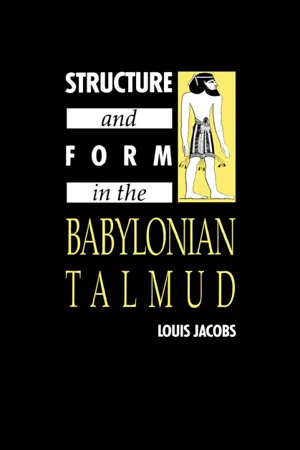
Structure and Form in the Babylonian Talmud
About this book
This book attempts to uncover the basic form and structure of the Babylonian Talmud, which is a centrally important text in Jewish studies. The contribution made by Dr Jacobs to the study of the Talmud consists in his presentation of the literary principles employed in its composition, and he here presents a clear survey indicating the manner in which earlier material was reworked in order to make each component, or sugya, into a carefully structured and self-consistent unit. Jacobs compares the editors' methods in this regard with the manner in which Shakespeare converted the variety of chronicles and source material available to him into a much more dramatic literary form, which - while preserving the kernel of the story - completely transformed its character and impact. Dr Jacobs' study constitutes an excellent introduction to the Babylonian Talmud and to the nature of rabbinic thinking.
Information
Topic
Theologie & ReligionSubtopic
Jüdische TheologieTable of contents
- Cover
- Half-title
- Title
- Copyright
- Dedication
- Contents
- Preface
- List of abbreviations
- The Babylonian Talmud: an introductory note
- 1 How much of the Babylonian Talmud is pseudepigraphic?
- 2 The Babylonian Talmud: an academic work
- 3 Rabbinic views on the order and authorship of the Biblical books
- 4 Literary analysis of the sugya in Bava Kama 11a—12b
- 5 Literary analysis of the sugya in Bava Kama 20a—21a
- 6 Literary analysis of the sugya on taking the blame on oneself
- 7 Literary analysis of the sugya of 'half and half'
- 8 Rabbi Joshua b. Hananiah and the elders of the house of Athens
- 9 Bavli and Yerushalmi on Rabban Gamaliel and Rabbi Joshua
- 10 Bavli and Yerushalmi on Rabbi Dosa and the Sages
- 11 The Rabbi Banaah stories in Bava Batra 58a—b
- 12 The device of addehakhi, 'just then'
- 13 Conclusion
- Glossary
- Notes
- Bibliography
Trusted by 375,005 students
Access to over 1.5 million titles for a fair monthly price.
Study more efficiently using our study tools.
Frequently asked questions
Yes, you can cancel anytime from the Subscription tab in your account settings on the Perlego website. Your subscription will stay active until the end of your current billing period. Learn how to cancel your subscription
No, books cannot be downloaded as external files, such as PDFs, for use outside of Perlego. However, you can download books within the Perlego app for offline reading on mobile or tablet. Learn how to download books offline
Perlego offers two plans: Essential and Complete
- Essential is ideal for learners and professionals who enjoy exploring a wide range of subjects. Access the Essential Library with 800,000+ trusted titles and best-sellers across business, personal growth, and the humanities. Includes unlimited reading time and Standard Read Aloud voice.
- Complete: Perfect for advanced learners and researchers needing full, unrestricted access. Unlock 1.5M+ books across hundreds of subjects, including academic and specialized titles. The Complete Plan also includes advanced features like Premium Read Aloud and Research Assistant.
We are an online textbook subscription service, where you can get access to an entire online library for less than the price of a single book per month. With over 1.5 million books across 990+ topics, we’ve got you covered! Learn about our mission
Look out for the read-aloud symbol on your next book to see if you can listen to it. The read-aloud tool reads text aloud for you, highlighting the text as it is being read. You can pause it, speed it up and slow it down. Learn more about Read Aloud
Yes! You can use the Perlego app on both iOS and Android devices to read anytime, anywhere — even offline. Perfect for commutes or when you’re on the go.
Please note we cannot support devices running on iOS 13 and Android 7 or earlier. Learn more about using the app
Please note we cannot support devices running on iOS 13 and Android 7 or earlier. Learn more about using the app
Yes, you can access Structure and Form in the Babylonian Talmud by Louis Jacobs in PDF and/or ePUB format, as well as other popular books in Theologie & Religion & Jüdische Theologie. We have over 1.5 million books available in our catalogue for you to explore.