eBook - PDF
The Common Peace
Participation and the Criminal Law in Seventeenth-Century England
- 254 pages
- English
- PDF
- Available on iOS & Android
eBook - PDF
About this book
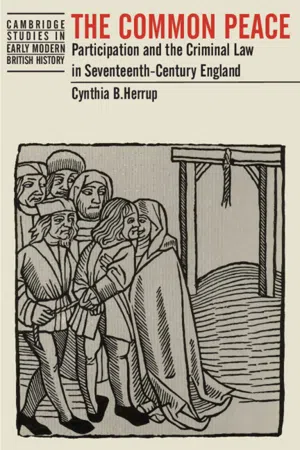
The Common Peace traces the attitudes behind the enforcement of the criminal law in early modern England. Focusing on five stages in prosecution (arrest, bail, indictment, conviction and sentencing), the book uses a variety of types of sources - court records, biographical information, state papers, legal commentaries, popular and didactic literature - to reconstruct who actually enforced the criminal law and what values they brought to its enforcement. A close study of the courts in eastern Sussex between 1592 and 1640 allows Dr Herrup to show that an amorphous collection of modest property holders participated actively in the legal process. These yeomen and husbandmen who appeared as victims, constables, witnesses and jurors were as important to the credibility of the law as were the justices and judges. The uses of the law embodied the ideas of these middling men about not only law and order but also religion and good government. By arguing that legal administration was part of the routine agenda of obligation for middling property holders, Dr Herrup shows how the expectations produced by legal activities are important for understanding the decades immediately before the outbreak of the English Civil War. As the first book to use early seventeenth-century legal records outside of Essex, The Common Peace adopts an explicitly comparative framework, attempting to trace the ways that social conditions influenced legal process as well as law enforcement in various counties. By blending social history, legal history and political history, this volume offers a complement to more conventional studies of legal records and of local government.
Information
Table of contents
- Cover
- Half-title
- Title
- Copyright
- Contents
- List of figures and tables
- Acknowledgments
- Glossary
- Abbreviations and conventions
- 1 The criminal law in early modern England
- 2 The setting
- 3 Judicial power and cooperation in eastern Sussex
- 4 From crime to criminal accusation
- 5 From accusation to indictment
- 6 From indictment to conviction
- 7 Becoming a criminal
- 8 The common peace
- Appendix 1 Summary of sampled courts
- Appendix 2 Status categories
- Bibliography
- Index
Trusted by 375,005 students
Access to over 1.5 million titles for a fair monthly price.
Study more efficiently using our study tools.
Frequently asked questions
Yes, you can cancel anytime from the Subscription tab in your account settings on the Perlego website. Your subscription will stay active until the end of your current billing period. Learn how to cancel your subscription
No, books cannot be downloaded as external files, such as PDFs, for use outside of Perlego. However, you can download books within the Perlego app for offline reading on mobile or tablet. Learn how to download books offline
Perlego offers two plans: Essential and Complete
- Essential is ideal for learners and professionals who enjoy exploring a wide range of subjects. Access the Essential Library with 800,000+ trusted titles and best-sellers across business, personal growth, and the humanities. Includes unlimited reading time and Standard Read Aloud voice.
- Complete: Perfect for advanced learners and researchers needing full, unrestricted access. Unlock 1.5M+ books across hundreds of subjects, including academic and specialized titles. The Complete Plan also includes advanced features like Premium Read Aloud and Research Assistant.
We are an online textbook subscription service, where you can get access to an entire online library for less than the price of a single book per month. With over 1.5 million books across 990+ topics, we’ve got you covered! Learn about our mission
Look out for the read-aloud symbol on your next book to see if you can listen to it. The read-aloud tool reads text aloud for you, highlighting the text as it is being read. You can pause it, speed it up and slow it down. Learn more about Read Aloud
Yes! You can use the Perlego app on both iOS and Android devices to read anytime, anywhere — even offline. Perfect for commutes or when you’re on the go.
Please note we cannot support devices running on iOS 13 and Android 7 or earlier. Learn more about using the app
Please note we cannot support devices running on iOS 13 and Android 7 or earlier. Learn more about using the app
Yes, you can access The Common Peace by Cynthia B. Herrup in PDF and/or ePUB format, as well as other popular books in History & British History. We have over 1.5 million books available in our catalogue for you to explore.