eBook - PDF
Stereographic Projection Techniques for Geologists and Civil Engineers
- 121 pages
- English
- PDF
- Available on iOS & Android
eBook - PDF
Stereographic Projection Techniques for Geologists and Civil Engineers
About this book
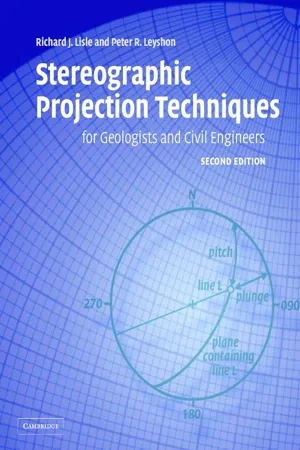
The stereographic projection is an essential tool in the fields of structural geology and geotechnics, which allows three-dimensional orientation data to be represented and manipulated. This book has been designed to make the subject as accessible as possible. It gives a straightforward and simple introduction to the subject and, by means of examples, illustrations and exercises, encourages the student to visualise the problems in three dimensions. Students of all levels will be able to work through the book and come away with a clear understanding of how to apply these vital techniques. This revised edition contains additional material on geotechnical applications, improved illustrations and links to useful web resources and software programs. It will provide students of geology, rock mechanics, geotechnical and civil engineering with an indispensable guide to the analysis and interpretation of field orientation data.
Information
Table of contents
- Cover
- Half Title
- Title Page
- Copyright
- Contents
- Preface
- Acknowledgements
- 1 Geological structures of planar type
- 2 Measuring and recording the orientation of planar structures
- 3 Geological structures of linear type
- 4 Measuring and recording the orientation of lines
- 5 Why do we need projections?
- 6 Idea of stereographic projection
- 7 Approximate method of plotting lines and planes
- 8 Exercises 1
- 9 The stereographic net
- 10 Precise method for plotting planes. Great circles and poles
- 11 Precise methods for plotting lines 1. Where the plunge of the line is known
- 12 Precise methods for plotting lines 2. Where the line is known from its pitch
- 13 The intersection of two planes
- 14 Plane containing two lines
- 15 Apparent dip
- 16 The angle between two lines
- 17 The angle between two planes
- 18 The plane that bisects the angle between two planes
- 19 Projecting a line onto a plane
- 20 Stereographic and equal-area projections
- 21 The polar net
- 22 Analysing folds 1. Cylindricity and plunge of axis
- 23 Analysing folds 2. Inter-limb angle and axial surface
- 24 Analysing folds 3. Style of folding
- 25 Analysing folds 4. The orientation of folds
- 26 Folds and cleavage
- 27 Analysing folds with cleavage
- 28 Faults 1. Calculating net slip
- 29 Faults 2. Estimating stress directions
- 30 Cones/small circles
- 31 Plotting a cone
- 32 Rotations about a horizontal axis
- 33 Example of rotation about a horizontal axis. Restoration of tilt of beds
- 34 Example of rotation. Restoring palaeocurrents
- 35 Rotation about an inclined axis
- 36 Example of rotation about an inclined axis. Borehole data
- 37 Density contouring on stereograms
- 38 Superposed folding 1
- 39 Superposed folding 2. Sub-area concept
- 40 Example of analysis of folds. Bristol area
- 41 Geometrical analysis of folds. Examples from SW England
- 42 Example of analysis of jointing. Glamorgan coast
- 43 Geotechnical applications. Rock slope stability
- 44 Assessing plane failure. Frictional resistance
- 45 Assessing plane failure. Daylighting
- 46 Assessing wedge failure
- 47 Exercises 2
- 48 Solutions to exercises
- Appendix 1 Stereographic (Wulff) equatorial net
- Appendix 2 Equal-area (Lambert/Schmidt) equatorial net
- Appendix 3 Equal-area polar net
- Appendix 4 Kalsbeek counting net
- Appendix 5 Classification chart for fold orientations
- Appendix 6 Some useful formulae
- Appendix 7 Alternative method of plotting planes and lines
- Availability of computer programs for plotting stereograms
- Further reading
- Index
Trusted by 375,005 students
Access to over 1.5 million titles for a fair monthly price.
Study more efficiently using our study tools.
Frequently asked questions
Yes, you can cancel anytime from the Subscription tab in your account settings on the Perlego website. Your subscription will stay active until the end of your current billing period. Learn how to cancel your subscription
No, books cannot be downloaded as external files, such as PDFs, for use outside of Perlego. However, you can download books within the Perlego app for offline reading on mobile or tablet. Learn how to download books offline
Perlego offers two plans: Essential and Complete
- Essential is ideal for learners and professionals who enjoy exploring a wide range of subjects. Access the Essential Library with 800,000+ trusted titles and best-sellers across business, personal growth, and the humanities. Includes unlimited reading time and Standard Read Aloud voice.
- Complete: Perfect for advanced learners and researchers needing full, unrestricted access. Unlock 1.5M+ books across hundreds of subjects, including academic and specialized titles. The Complete Plan also includes advanced features like Premium Read Aloud and Research Assistant.
We are an online textbook subscription service, where you can get access to an entire online library for less than the price of a single book per month. With over 1.5 million books across 990+ topics, we’ve got you covered! Learn about our mission
Look out for the read-aloud symbol on your next book to see if you can listen to it. The read-aloud tool reads text aloud for you, highlighting the text as it is being read. You can pause it, speed it up and slow it down. Learn more about Read Aloud
Yes! You can use the Perlego app on both iOS and Android devices to read anytime, anywhere — even offline. Perfect for commutes or when you’re on the go.
Please note we cannot support devices running on iOS 13 and Android 7 or earlier. Learn more about using the app
Please note we cannot support devices running on iOS 13 and Android 7 or earlier. Learn more about using the app
Yes, you can access Stereographic Projection Techniques for Geologists and Civil Engineers by Richard J. Lisle,Peter R. Leyshon in PDF and/or ePUB format, as well as other popular books in Physical Sciences & Geology & Earth Sciences. We have over 1.5 million books available in our catalogue for you to explore.