eBook - PDF
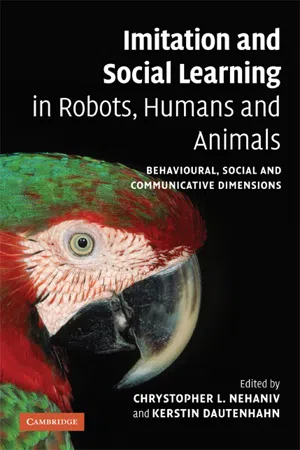
Imitation and Social Learning in Robots, Humans and Animals
Behavioural, Social and Communicative Dimensions
- 509 pages
- English
- PDF
- Available on iOS & Android
eBook - PDF
Imitation and Social Learning in Robots, Humans and Animals
Behavioural, Social and Communicative Dimensions
About this book
Mechanisms of imitation and social matching play a fundamental role in development, communication, interaction, learning and culture. Their investigation in different agents (animals, humans and robots) has significantly influenced our understanding of the nature and origins of social intelligence. Whilst such issues have traditionally been studied in areas such as psychology, biology and ethnology, it has become increasingly recognised that a 'constructive approach' towards imitation and social learning via the synthesis of artificial agents can provide important insights into mechanisms and create artefacts that can be instructed and taught by imitation, demonstration, and social interaction rather than by explicit programming. This book studies increasingly sophisticated models and mechanisms of social matching behaviour and marks an important step towards the development of an interdisciplinary research field, consolidating and providing a valuable reference for the increasing number of researchers in the field of imitation and social learning in robots, humans and animals.
Information
Topic
PsychologieSubtopic
Angewandte PsychologieTable of contents
- Cover
- Half-title
- Title
- Copyright
- Dedication
- Contents
- Plates
- Figures
- Tables
- Contributors
- Introduction: the constructive interdisciplinary viewpoint for understanding mechanisms and models of imitation and social learning
- Part I Correspondence problems and mechanisms
- Part II Mirroring and ‘mind-reading’
- Part III What to imitate?
- Part IV Development and embodiment
- Part V Synchrony and turn-taking as communicative mechanisms
- Part VI Why imitate? – Motivations
- Part VII Social feedback
- Part VIII The ecological context
- Index
Trusted by 375,005 students
Access to over 1.5 million titles for a fair monthly price.
Study more efficiently using our study tools.
Frequently asked questions
Yes, you can cancel anytime from the Subscription tab in your account settings on the Perlego website. Your subscription will stay active until the end of your current billing period. Learn how to cancel your subscription
No, books cannot be downloaded as external files, such as PDFs, for use outside of Perlego. However, you can download books within the Perlego app for offline reading on mobile or tablet. Learn how to download books offline
Perlego offers two plans: Essential and Complete
- Essential is ideal for learners and professionals who enjoy exploring a wide range of subjects. Access the Essential Library with 800,000+ trusted titles and best-sellers across business, personal growth, and the humanities. Includes unlimited reading time and Standard Read Aloud voice.
- Complete: Perfect for advanced learners and researchers needing full, unrestricted access. Unlock 1.5M+ books across hundreds of subjects, including academic and specialized titles. The Complete Plan also includes advanced features like Premium Read Aloud and Research Assistant.
We are an online textbook subscription service, where you can get access to an entire online library for less than the price of a single book per month. With over 1.5 million books across 990+ topics, we’ve got you covered! Learn about our mission
Look out for the read-aloud symbol on your next book to see if you can listen to it. The read-aloud tool reads text aloud for you, highlighting the text as it is being read. You can pause it, speed it up and slow it down. Learn more about Read Aloud
Yes! You can use the Perlego app on both iOS and Android devices to read anytime, anywhere — even offline. Perfect for commutes or when you’re on the go.
Please note we cannot support devices running on iOS 13 and Android 7 or earlier. Learn more about using the app
Please note we cannot support devices running on iOS 13 and Android 7 or earlier. Learn more about using the app
Yes, you can access Imitation and Social Learning in Robots, Humans and Animals by Chrystopher L. Nehaniv,Kerstin Dautenhahn in PDF and/or ePUB format, as well as other popular books in Psychologie & Angewandte Psychologie. We have over 1.5 million books available in our catalogue for you to explore.