eBook - PDF
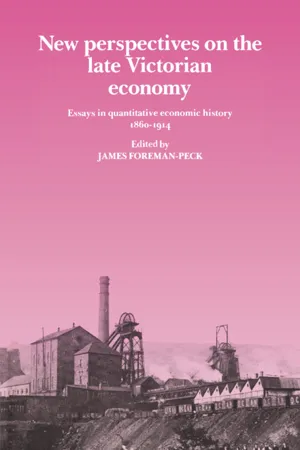
New Perspectives on the Late Victorian Economy
Essays in Quantitative Economic History, 1860–1914
- 368 pages
- English
- PDF
- Available on iOS & Android
eBook - PDF
New Perspectives on the Late Victorian Economy
Essays in Quantitative Economic History, 1860–1914
About this book
Through channels both open and concealed, the Victorian economy continues to influence us powerfully. Much economic thinking today gains support from perceptions of how the nineteenth-century British economy worked and how well it satisfied wants. Contemporary oligopolistic industrial structure is contrasted with Victorian self-regulating competition; the gross inequalities of Victorian laissez-faire are compared with support for the needy provided by the modern welfare state; and some regard Victorian values as vital principles of social organisation which should be regained. By examining the behaviour of the British economy between 1865 and 1914, the present work casts light upon some of these views. It does so in a variety of ways. New methods or evidence are deployed to establish accepted conclusions more firmly; unwarrantedly neglected aspects of the economy are analysed with present day concerns in mind; and traditional conclusions are reassessed. The book focuses upon three central themes: industrial organisation and technology, wages and living standards, and the monetary system. These are at the heart of discussions of productivity growth, the standard of living, well-being and poverty; the criteria by which the Victorian economic system should ultimately be judged.
Information
Table of contents
- Cover
- Half-title
- Title
- Copyright
- Contents
- List of contributors
- List of figures
- List of tables
- Preface
- 1 Quantitative analysis of the Victorian economy
- PART I TECHNOLOGY AND INDUSTRIAL ORGANISATION
- PART II DISTRIBUTION
- PART III THE MONETARY SYSTEM AND MONETARY POLICY
- Index
Trusted by 375,005 students
Access to over 1.5 million titles for a fair monthly price.
Study more efficiently using our study tools.
Frequently asked questions
Yes, you can cancel anytime from the Subscription tab in your account settings on the Perlego website. Your subscription will stay active until the end of your current billing period. Learn how to cancel your subscription
No, books cannot be downloaded as external files, such as PDFs, for use outside of Perlego. However, you can download books within the Perlego app for offline reading on mobile or tablet. Learn how to download books offline
Perlego offers two plans: Essential and Complete
- Essential is ideal for learners and professionals who enjoy exploring a wide range of subjects. Access the Essential Library with 800,000+ trusted titles and best-sellers across business, personal growth, and the humanities. Includes unlimited reading time and Standard Read Aloud voice.
- Complete: Perfect for advanced learners and researchers needing full, unrestricted access. Unlock 1.5M+ books across hundreds of subjects, including academic and specialized titles. The Complete Plan also includes advanced features like Premium Read Aloud and Research Assistant.
We are an online textbook subscription service, where you can get access to an entire online library for less than the price of a single book per month. With over 1.5 million books across 990+ topics, we’ve got you covered! Learn about our mission
Look out for the read-aloud symbol on your next book to see if you can listen to it. The read-aloud tool reads text aloud for you, highlighting the text as it is being read. You can pause it, speed it up and slow it down. Learn more about Read Aloud
Yes! You can use the Perlego app on both iOS and Android devices to read anytime, anywhere — even offline. Perfect for commutes or when you’re on the go.
Please note we cannot support devices running on iOS 13 and Android 7 or earlier. Learn more about using the app
Please note we cannot support devices running on iOS 13 and Android 7 or earlier. Learn more about using the app
Yes, you can access New Perspectives on the Late Victorian Economy by James Foreman-Peck in PDF and/or ePUB format, as well as other popular books in History & British History. We have over 1.5 million books available in our catalogue for you to explore.