- 308 pages
- English
- PDF
- Available on iOS & Android
eBook - PDF
About this book
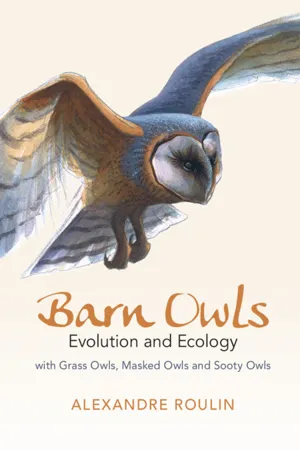
With heart-shaped face, buff back and wings, and pure white underparts, the barn owl is a distinctive and much-loved bird which has fascinated people from many cultures throughout history. How did the barn owl colonise the world? What adaptations have made this bird so successful? How is the increasing impact of human disturbance affecting these animals? Answering these questions and more, Roulin brings together the main global perspectives on the evolution, ecology and behaviour of the barn owl and its relatives, discussing topics such as the high reproductive potential, physiology, social and family interaction, pronounced colour variation and global distribution. Accessible and beautifully illustrated, this definitive volume on the barn owl is for researchers, professionals and graduate students in ornithology, animal behaviour, ecology, conservation biology and evolutionary biology, and will also appeal to amateur ornithologists and nature lovers.
Information
Table of contents
- Cover
- Half-title
- Dedication
- Title page
- Copyright information
- Contents
- Foreword
- Acknowledgements
- Why this Book?
- 1 Introduction
- 2 Conservation
- 3 Parasites and predators
- 4 Physiology in an ecological context
- 5 Morphology in an ecological context
- 6 Daily life: hunting, feeding and sleeping
- 7 Sexual behaviour
- 8 Reproduction
- 9 Parental care
- 10 Sibling interactions
- 11 Demography
- 12 Plumage polymorphism
- Conclusion
- Index
Trusted by 375,005 students
Access to over 1.5 million titles for a fair monthly price.
Study more efficiently using our study tools.
Frequently asked questions
Yes, you can cancel anytime from the Subscription tab in your account settings on the Perlego website. Your subscription will stay active until the end of your current billing period. Learn how to cancel your subscription
No, books cannot be downloaded as external files, such as PDFs, for use outside of Perlego. However, you can download books within the Perlego app for offline reading on mobile or tablet. Learn how to download books offline
Perlego offers two plans: Essential and Complete
- Essential is ideal for learners and professionals who enjoy exploring a wide range of subjects. Access the Essential Library with 800,000+ trusted titles and best-sellers across business, personal growth, and the humanities. Includes unlimited reading time and Standard Read Aloud voice.
- Complete: Perfect for advanced learners and researchers needing full, unrestricted access. Unlock 1.5M+ books across hundreds of subjects, including academic and specialized titles. The Complete Plan also includes advanced features like Premium Read Aloud and Research Assistant.
We are an online textbook subscription service, where you can get access to an entire online library for less than the price of a single book per month. With over 1.5 million books across 990+ topics, we’ve got you covered! Learn about our mission
Look out for the read-aloud symbol on your next book to see if you can listen to it. The read-aloud tool reads text aloud for you, highlighting the text as it is being read. You can pause it, speed it up and slow it down. Learn more about Read Aloud
Yes! You can use the Perlego app on both iOS and Android devices to read anytime, anywhere — even offline. Perfect for commutes or when you’re on the go.
Please note we cannot support devices running on iOS 13 and Android 7 or earlier. Learn more about using the app
Please note we cannot support devices running on iOS 13 and Android 7 or earlier. Learn more about using the app
Yes, you can access Barn Owls by Alexandre Roulin in PDF and/or ePUB format, as well as other popular books in Biological Sciences & Zoology. We have over 1.5 million books available in our catalogue for you to explore.