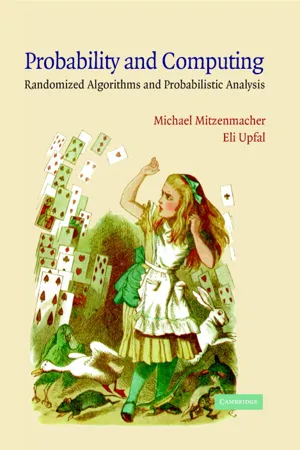
eBook - PDF
Probability and Computing
Randomized Algorithms and Probabilistic Analysis
- 370 pages
- English
- PDF
- Available on iOS & Android
eBook - PDF
Probability and Computing
Randomized Algorithms and Probabilistic Analysis
About this book
Randomization and probabilistic techniques play an important role in modern computer science, with applications ranging from combinatorial optimization and machine learning to communication networks and secure protocols. This 2005 textbook is designed to accompany a one- or two-semester course for advanced undergraduates or beginning graduate students in computer science and applied mathematics. It gives an excellent introduction to the probabilistic techniques and paradigms used in the development of probabilistic algorithms and analyses. It assumes only an elementary background in discrete mathematics and gives a rigorous yet accessible treatment of the material, with numerous examples and applications. The first half of the book covers core material, including random sampling, expectations, Markov's inequality, Chevyshev's inequality, Chernoff bounds, the probabilistic method and Markov chains. The second half covers more advanced topics such as continuous probability, applications of limited independence, entropy, Markov chain Monte Carlo methods and balanced allocations. With its comprehensive selection of topics, along with many examples and exercises, this book is an indispensable teaching tool.
Information
Table of contents
- Cover
- Title
- Copyright
- Contents
- Preface
- 1 Events and Probability
- 2 Discrete Random Variables and Expectation
- 3 Moments and Deviations
- 4 Chernoff Bounds
- 5 Balls, Bins, and Random Graphs
- 6 The Probabilistic Method
- 7 Markov Chains and Random Walks
- 8 Continuous Distributions and the Poisson Process
- 9 Entropy, Randomness, and Information
- 10 The Monte Carlo Method
- 11 Coupling of Markov Chains
- 12 Martingales
- 13 Pairwise Independence and Universal Hash Functions
- 14 Balanced Allocations
- Further Reading
- Index
Trusted by 375,005 students
Access to over 1.5 million titles for a fair monthly price.
Study more efficiently using our study tools.
Frequently asked questions
Yes, you can cancel anytime from the Subscription tab in your account settings on the Perlego website. Your subscription will stay active until the end of your current billing period. Learn how to cancel your subscription
No, books cannot be downloaded as external files, such as PDFs, for use outside of Perlego. However, you can download books within the Perlego app for offline reading on mobile or tablet. Learn how to download books offline
Perlego offers two plans: Essential and Complete
- Essential is ideal for learners and professionals who enjoy exploring a wide range of subjects. Access the Essential Library with 800,000+ trusted titles and best-sellers across business, personal growth, and the humanities. Includes unlimited reading time and Standard Read Aloud voice.
- Complete: Perfect for advanced learners and researchers needing full, unrestricted access. Unlock 1.5M+ books across hundreds of subjects, including academic and specialized titles. The Complete Plan also includes advanced features like Premium Read Aloud and Research Assistant.
We are an online textbook subscription service, where you can get access to an entire online library for less than the price of a single book per month. With over 1.5 million books across 990+ topics, we’ve got you covered! Learn about our mission
Look out for the read-aloud symbol on your next book to see if you can listen to it. The read-aloud tool reads text aloud for you, highlighting the text as it is being read. You can pause it, speed it up and slow it down. Learn more about Read Aloud
Yes! You can use the Perlego app on both iOS and Android devices to read anytime, anywhere — even offline. Perfect for commutes or when you’re on the go.
Please note we cannot support devices running on iOS 13 and Android 7 or earlier. Learn more about using the app
Please note we cannot support devices running on iOS 13 and Android 7 or earlier. Learn more about using the app
Yes, you can access Probability and Computing by Michael Mitzenmacher,Eli Upfal in PDF and/or ePUB format, as well as other popular books in Ciencia de la computación & Ciencias computacionales general. We have over 1.5 million books available in our catalogue for you to explore.