- 237 pages
- English
- PDF
- Available on iOS & Android
eBook - PDF
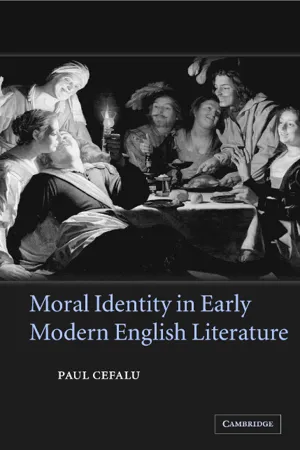
Moral Identity in Early Modern English Literature
About this book
Paul Cefalu's study explores the relationship between moral character and religious conversion in the poetry and prose of Sidney, Spenser, Donne, Herbert, and Milton, as well as in early modern English Conformist and Puritan sermons, theological tracts, and philosophical treatises. Cefalu argues that early modern Protestant theologians were often unable to incorporate a coherent theory of practical morality into the order of salvation. Cefalu draws on fresh historicist theories of ideology and subversion, but takes issue with historicist tendency to conflate generic and categorical distinctions among texts. He argues that imaginative literature, by virtue of its tendency to place characters in approximately real ethical quandaries, uniquely points out the inability of early modern English Protestant theology to merge religious theory and ethical practice. This study should appeal not only to literary critics and historians, but also to scholars interested in the history of moral theory.
Information
Table of contents
- Cover
- Half-title
- Title
- Copyright
- Dedication
- Contents
- Acknowledgments
- Introduction: English Protestant moral theory and regeneration
- Chapter 1 Shame, Guilt, and Moral Character in Early Modern English Protestant theology and Sir Philip Sidney’s Countess of Pembroke’s Arcadia
- Chapter 2 The three orders of nature, grace, and law in Edmund Spenser's The Faerie Queene, Book II
- Chapter 3 Conformist and puritan Moral Theory: from Richard Hooker's natural law theory to Richard Sibbes’s ethical occasionalism
- Chapter 4 The elect body in Pain: Godly fear and sanctification in John Donne's poetry and prose
- Chapter 5 Absent neighbors in George Herbert's "The Church,: or why Agape becomes Caritas in English Protestant devotional poetry
- Chapter 6 Moral pragmatism in the theology of John Milton and his contemporaries
- Epilogue: theorizing early modern moral selfhood
- Notes
- Index
Trusted by 375,005 students
Access to over 1.5 million titles for a fair monthly price.
Study more efficiently using our study tools.
Frequently asked questions
Yes, you can cancel anytime from the Subscription tab in your account settings on the Perlego website. Your subscription will stay active until the end of your current billing period. Learn how to cancel your subscription
No, books cannot be downloaded as external files, such as PDFs, for use outside of Perlego. However, you can download books within the Perlego app for offline reading on mobile or tablet. Learn how to download books offline
Perlego offers two plans: Essential and Complete
- Essential is ideal for learners and professionals who enjoy exploring a wide range of subjects. Access the Essential Library with 800,000+ trusted titles and best-sellers across business, personal growth, and the humanities. Includes unlimited reading time and Standard Read Aloud voice.
- Complete: Perfect for advanced learners and researchers needing full, unrestricted access. Unlock 1.5M+ books across hundreds of subjects, including academic and specialized titles. The Complete Plan also includes advanced features like Premium Read Aloud and Research Assistant.
We are an online textbook subscription service, where you can get access to an entire online library for less than the price of a single book per month. With over 1.5 million books across 990+ topics, we’ve got you covered! Learn about our mission
Look out for the read-aloud symbol on your next book to see if you can listen to it. The read-aloud tool reads text aloud for you, highlighting the text as it is being read. You can pause it, speed it up and slow it down. Learn more about Read Aloud
Yes! You can use the Perlego app on both iOS and Android devices to read anytime, anywhere — even offline. Perfect for commutes or when you’re on the go.
Please note we cannot support devices running on iOS 13 and Android 7 or earlier. Learn more about using the app
Please note we cannot support devices running on iOS 13 and Android 7 or earlier. Learn more about using the app
Yes, you can access Moral Identity in Early Modern English Literature by Paul Cefalu in PDF and/or ePUB format, as well as other popular books in Literature & English Literary Criticism. We have over 1.5 million books available in our catalogue for you to explore.