- 294 pages
- English
- PDF
- Available on iOS & Android
eBook - PDF
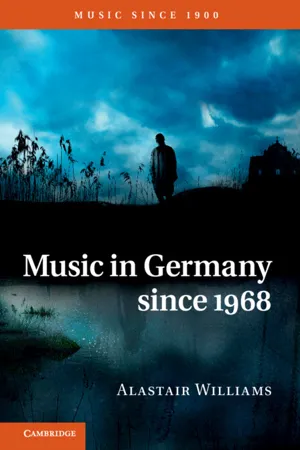
Music in Germany since 1968
About this book
Music in Germany since 1968 modifies the dominant historiography of music in post-war Germany by shifting its axis from the years of reconstruction after 1945 to the era following the events of 1968. Arguing that the social transformations of 1968 led to a new phase of music in Germany, Alastair Williams examines the key topics, including responses to serialism, music and politics, and the re-evaluation of tradition. The book devotes central chapters to Helmut Lachenmann and Wolfgang Rihm, as focal points for areas such as postmodernism, musical semiotics and action-based gestures. Further chapters widen the scope by considering the precursors and contemporaries of Rihm and Lachenmann, especially in relation to the idea of historical inclusion. Williams's study also assesses the development of the Darmstadt summer courses, addresses the significance of German reunification, and considers the role of Germany in a new stage of musical modernism.
Information
Subtopic
Musique d'opéraTable of contents
- Cover
- Contents
- Illustrations
- Music examples
- Acknowledgements
- Introduction
- 1 Contexts and institutions
- 2 Expanded horizons: established composers after 1968
- 3 The refusal of habit: Helmut Lachenmann
- 4 Music and signs: Wolfgang Rihm
- 5 Contemporaries of Lachenmann and Rihm: the younger generation
- Epilogue
- Notes
- Bibliography
- Index
Trusted by 375,005 students
Access to over 1.5 million titles for a fair monthly price.
Study more efficiently using our study tools.
Frequently asked questions
Yes, you can cancel anytime from the Subscription tab in your account settings on the Perlego website. Your subscription will stay active until the end of your current billing period. Learn how to cancel your subscription
No, books cannot be downloaded as external files, such as PDFs, for use outside of Perlego. However, you can download books within the Perlego app for offline reading on mobile or tablet. Learn how to download books offline
Perlego offers two plans: Essential and Complete
- Essential is ideal for learners and professionals who enjoy exploring a wide range of subjects. Access the Essential Library with 800,000+ trusted titles and best-sellers across business, personal growth, and the humanities. Includes unlimited reading time and Standard Read Aloud voice.
- Complete: Perfect for advanced learners and researchers needing full, unrestricted access. Unlock 1.5M+ books across hundreds of subjects, including academic and specialized titles. The Complete Plan also includes advanced features like Premium Read Aloud and Research Assistant.
We are an online textbook subscription service, where you can get access to an entire online library for less than the price of a single book per month. With over 1.5 million books across 990+ topics, we’ve got you covered! Learn about our mission
Look out for the read-aloud symbol on your next book to see if you can listen to it. The read-aloud tool reads text aloud for you, highlighting the text as it is being read. You can pause it, speed it up and slow it down. Learn more about Read Aloud
Yes! You can use the Perlego app on both iOS and Android devices to read anytime, anywhere — even offline. Perfect for commutes or when you’re on the go.
Please note we cannot support devices running on iOS 13 and Android 7 or earlier. Learn more about using the app
Please note we cannot support devices running on iOS 13 and Android 7 or earlier. Learn more about using the app
Yes, you can access Music in Germany since 1968 by Alastair Williams in PDF and/or ePUB format, as well as other popular books in Médias et arts de la scène & Musique d'opéra. We have over 1.5 million books available in our catalogue for you to explore.