- 340 pages
- English
- PDF
- Available on iOS & Android
eBook - PDF
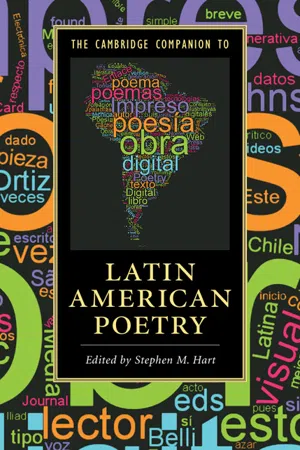
The Cambridge Companion to Latin American Poetry
About this book
The Cambridge Companion to Latin American Poetry provides historical context on the evolution of the Latin American poetic tradition from the sixteenth century to the present day. It is organized into three parts. Part I provides a comprehensive, chronological survey of Latin American poetry and includes separate chapters on Colonial poetry, Romanticism/modernism, the avant-garde, conversational poetry, and contemporary poetry. Part II contains six succinct essays on the major figures Sor Juana Inés de la Cruz, Gabriela Mistral, César Vallejo, Pablo Neruda, Carlos Drummond de Andrade, and Octavio Paz. Part III analyses specific and distinctive trends within the poetic canon, including women's, LGBT, Quechua, Afro-Hispanic, Latino/a and New Media poetry. This Companion also contains a guide to further reading as well as an essay on the best English translations of Latin American poetry. It will be a key resource for students and instructors of Latin American literature and poetry.
Information
Table of contents
- Cover
- Half-title page
- Title page
- Copyright page
- Contents
- List of Illustrations
- Notes on Contributors
- Preface
- Chronology
- Part I History
- Part II Six Key Figures
- Part III Diversity and Heterogeneity
- Guide to Further Reading
- Select Bibliography
- Index
Trusted by 375,005 students
Access to over 1.5 million titles for a fair monthly price.
Study more efficiently using our study tools.
Frequently asked questions
Yes, you can cancel anytime from the Subscription tab in your account settings on the Perlego website. Your subscription will stay active until the end of your current billing period. Learn how to cancel your subscription
No, books cannot be downloaded as external files, such as PDFs, for use outside of Perlego. However, you can download books within the Perlego app for offline reading on mobile or tablet. Learn how to download books offline
We are an online textbook subscription service, where you can get access to an entire online library for less than the price of a single book per month. With over 1.5 million books across 990+ topics, we’ve got you covered! Learn about our mission
Look out for the read-aloud symbol on your next book to see if you can listen to it. The read-aloud tool reads text aloud for you, highlighting the text as it is being read. You can pause it, speed it up and slow it down. Learn more about Read Aloud
Yes! You can use the Perlego app on both iOS and Android devices to read anytime, anywhere — even offline. Perfect for commutes or when you’re on the go.
Please note we cannot support devices running on iOS 13 and Android 7 or earlier. Learn more about using the app
Please note we cannot support devices running on iOS 13 and Android 7 or earlier. Learn more about using the app
Yes, you can access The Cambridge Companion to Latin American Poetry by Stephen M. Hart in PDF and/or ePUB format, as well as other popular books in Literature & Latin American & Caribbean Literary Criticism. We have over 1.5 million books available in our catalogue for you to explore.