- 310 pages
- English
- PDF
- Available on iOS & Android
eBook - PDF
About this book
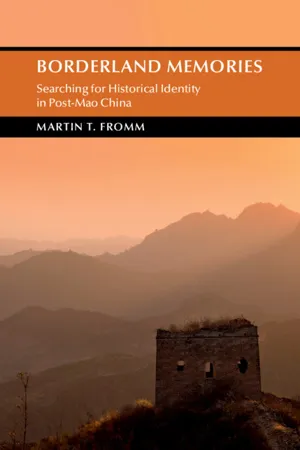
In the 1980s, as China transitioned to the post-Mao era, a state-sponsored oral history project led to the publication of local, regional, and national histories. They took the form of written and transcribed personal testimonies of events that preceded the turmoil of both the Cultural Revolution and, in many cases, the Communist victory in 1949. Known as wenshi ziliao, these publications represent an intense process of historical memory production that has received little scholarly attention. Hitherto unexamined archival materials and oral histories reveal unresolved tensions in post-Cultural Revolution reconciliation and mobilization, informing negotiations between local elites and the state, and between Party and non-Party organizations. Taking the northeast Russia–Manchuria borderlands as a case study, Martin T. Fromm examines the creation of post-Mao identities, political mobilization, and knowledge production in China.
Information
Table of contents
- Cover
- Half-title page
- Series page
- Title page
- Copyright page
- Dedication
- Contents
- Acknowledgments
- Introduction
- 1 Reconfiguring Cultural Production in the Post-Mao Transition
- 2 Borderland Ambiguities in Narratives of Modernization and Liberation
- 3 Relocating the Nation outside the Nation: Forging a Borderland-Centered Nationalist Discourse
- 4 The “Historical Science” of Wenshi Ziliao
- 5 Affective Community and Historical Rehabilitation: “Widely Making Friends” to Resecure Political Loyalty
- 6 Mobilizing a “Patriotic United Front”
- 7 Local, Regional, and National Dynamics of Wenshi Ziliao Production
- Conclusion
- References
- Index
Trusted by 375,005 students
Access to over 1.5 million titles for a fair monthly price.
Study more efficiently using our study tools.
Frequently asked questions
Yes, you can cancel anytime from the Subscription tab in your account settings on the Perlego website. Your subscription will stay active until the end of your current billing period. Learn how to cancel your subscription
No, books cannot be downloaded as external files, such as PDFs, for use outside of Perlego. However, you can download books within the Perlego app for offline reading on mobile or tablet. Learn how to download books offline
Perlego offers two plans: Essential and Complete
- Essential is ideal for learners and professionals who enjoy exploring a wide range of subjects. Access the Essential Library with 800,000+ trusted titles and best-sellers across business, personal growth, and the humanities. Includes unlimited reading time and Standard Read Aloud voice.
- Complete: Perfect for advanced learners and researchers needing full, unrestricted access. Unlock 1.5M+ books across hundreds of subjects, including academic and specialized titles. The Complete Plan also includes advanced features like Premium Read Aloud and Research Assistant.
We are an online textbook subscription service, where you can get access to an entire online library for less than the price of a single book per month. With over 1.5 million books across 990+ topics, we’ve got you covered! Learn about our mission
Look out for the read-aloud symbol on your next book to see if you can listen to it. The read-aloud tool reads text aloud for you, highlighting the text as it is being read. You can pause it, speed it up and slow it down. Learn more about Read Aloud
Yes! You can use the Perlego app on both iOS and Android devices to read anytime, anywhere — even offline. Perfect for commutes or when you’re on the go.
Please note we cannot support devices running on iOS 13 and Android 7 or earlier. Learn more about using the app
Please note we cannot support devices running on iOS 13 and Android 7 or earlier. Learn more about using the app
Yes, you can access Borderland Memories by Martin T. Fromm in PDF and/or ePUB format, as well as other popular books in History & Asian History. We have over 1.5 million books available in our catalogue for you to explore.