- 416 pages
- English
- PDF
- Available on iOS & Android
eBook - PDF
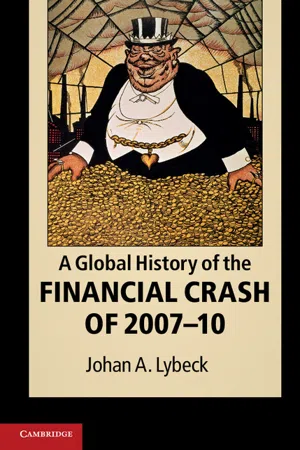
A Global History of the Financial Crash of 2007–10
About this book
We have just experienced the worst financial crash the world has seen since the Great Depression of the 1930s. While real economies in general did not crash as they did in the 1930s, the financial parts of the economy certainly did, or, at least, came very close to doing so. Hundreds of banks in the United States and Europe have been closed by their supervisory authorities, forcibly merged with stronger partners, nationalized or recapitalized with the tax payers' money. Banks and insurance companies had, by mid 2010, already written off some 2000 billion dollars in credit write-downs on loans and securities. In this book, Johan Lybeck draws on his experience as both an academic economist and a professional banker to present a detailed yet non-technical analysis of the crash. He describes how the crisis began in early 2007, explains why it happened and shows how it compares to earlier financial crises.
Information
Table of contents
- Cover
- A Global History of the Financial Crash of 2007–2010
- Title
- Copyright
- Contents
- Figures
- Tables
- Preface
- Acknowledgments
- Abbreviations
- 1: Introduction
- 2: Financial crises in the USA and Europe, but not in Asia
- 3: Could today’s financial crisis have been foreseen?
- 4: The US housing market and the subprime crisis
- 5: Securitization and derivatives spread the crisis around the world
- 6: Liquidity risk aspects of the crisis and a comparison with 1907 and 1929
- 7: Credit risk aspects of the crisis, rating and solvency
- 8: Financial crises in modern history: similarities and differences
- 9: Worldwide changes in regulation and supervision as a result of the crisis
- 10: Outstanding issues
- Bibliography
- Index
Trusted by 375,005 students
Access to over 1.5 million titles for a fair monthly price.
Study more efficiently using our study tools.
Frequently asked questions
Yes, you can cancel anytime from the Subscription tab in your account settings on the Perlego website. Your subscription will stay active until the end of your current billing period. Learn how to cancel your subscription
No, books cannot be downloaded as external files, such as PDFs, for use outside of Perlego. However, you can download books within the Perlego app for offline reading on mobile or tablet. Learn how to download books offline
Perlego offers two plans: Essential and Complete
- Essential is ideal for learners and professionals who enjoy exploring a wide range of subjects. Access the Essential Library with 800,000+ trusted titles and best-sellers across business, personal growth, and the humanities. Includes unlimited reading time and Standard Read Aloud voice.
- Complete: Perfect for advanced learners and researchers needing full, unrestricted access. Unlock 1.5M+ books across hundreds of subjects, including academic and specialized titles. The Complete Plan also includes advanced features like Premium Read Aloud and Research Assistant.
We are an online textbook subscription service, where you can get access to an entire online library for less than the price of a single book per month. With over 1.5 million books across 990+ topics, we’ve got you covered! Learn about our mission
Look out for the read-aloud symbol on your next book to see if you can listen to it. The read-aloud tool reads text aloud for you, highlighting the text as it is being read. You can pause it, speed it up and slow it down. Learn more about Read Aloud
Yes! You can use the Perlego app on both iOS and Android devices to read anytime, anywhere — even offline. Perfect for commutes or when you’re on the go.
Please note we cannot support devices running on iOS 13 and Android 7 or earlier. Learn more about using the app
Please note we cannot support devices running on iOS 13 and Android 7 or earlier. Learn more about using the app
Yes, you can access A Global History of the Financial Crash of 2007–10 by Johan A. Lybeck in PDF and/or ePUB format, as well as other popular books in Business & Finance. We have over 1.5 million books available in our catalogue for you to explore.