eBook - PDF
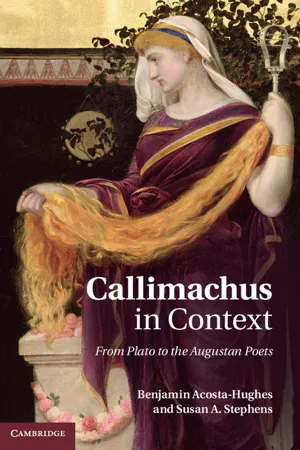
Callimachus in Context
From Plato to the Augustan Poets
- 346 pages
- English
- PDF
- Available on iOS & Android
eBook - PDF
About this book
Scholarly reception has bequeathed two Callimachuses: the Roman version is a poet of elegant non-heroic poetry (usually erotic elegy), represented by a handful of intertexts with a recurring set of images - slender Muse, instructing divinity, small voice, pure waters; the Greek version emphasizes a learned scholar who includes literary criticism within his poetry, an encomiast of the Ptolemies, a poet of the book whose narratives are often understood as metapoetic. This study aims to situate these Callimachuses within a series of interlocking historical and intellectual contexts in order better to understand how they arose. In this narrative of his poetics and poetic reception four main sources of creative opportunism are identified: Callimachus' reactions to philosophers and literary critics as arbiters of poetic authority, the potential of the text as a venue for performance, awareness of Alexandria as a new place, and finally, his attraction for Roman poets.
Information
Table of contents
- Cover
- CALLIMACHUS IN CONTEXT
- Title
- Copyright
- Contents
- Maps
- Acknowledgments
- Abbreviations
- Introduction
- CHAPTER 1: Literary quarrels
- CHAPTER 2: Performing the text
- CHAPTER 3: Changing places
- CHAPTER 4: In my end is my beginning
- Conclusions
- APPENDIX: The Aetia
- Bibliography
- Index locorum
- Subject index
Trusted by 375,005 students
Access to over 1.5 million titles for a fair monthly price.
Study more efficiently using our study tools.
Frequently asked questions
Yes, you can cancel anytime from the Subscription tab in your account settings on the Perlego website. Your subscription will stay active until the end of your current billing period. Learn how to cancel your subscription
No, books cannot be downloaded as external files, such as PDFs, for use outside of Perlego. However, you can download books within the Perlego app for offline reading on mobile or tablet. Learn how to download books offline
Perlego offers two plans: Essential and Complete
- Essential is ideal for learners and professionals who enjoy exploring a wide range of subjects. Access the Essential Library with 800,000+ trusted titles and best-sellers across business, personal growth, and the humanities. Includes unlimited reading time and Standard Read Aloud voice.
- Complete: Perfect for advanced learners and researchers needing full, unrestricted access. Unlock 1.5M+ books across hundreds of subjects, including academic and specialized titles. The Complete Plan also includes advanced features like Premium Read Aloud and Research Assistant.
We are an online textbook subscription service, where you can get access to an entire online library for less than the price of a single book per month. With over 1.5 million books across 990+ topics, we’ve got you covered! Learn about our mission
Look out for the read-aloud symbol on your next book to see if you can listen to it. The read-aloud tool reads text aloud for you, highlighting the text as it is being read. You can pause it, speed it up and slow it down. Learn more about Read Aloud
Yes! You can use the Perlego app on both iOS and Android devices to read anytime, anywhere — even offline. Perfect for commutes or when you’re on the go.
Please note we cannot support devices running on iOS 13 and Android 7 or earlier. Learn more about using the app
Please note we cannot support devices running on iOS 13 and Android 7 or earlier. Learn more about using the app
Yes, you can access Callimachus in Context by Benjamin Acosta-Hughes,Susan A. Stephens in PDF and/or ePUB format, as well as other popular books in History & Ancient History. We have over 1.5 million books available in our catalogue for you to explore.