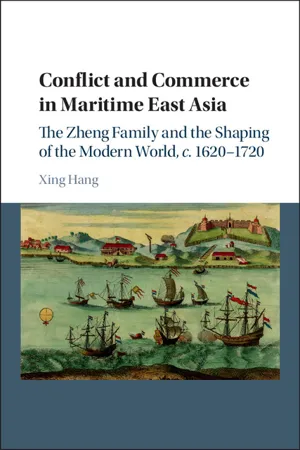
eBook - PDF
Conflict and Commerce in Maritime East Asia
The Zheng Family and the Shaping of the Modern World, c.1620–1720
- 346 pages
- English
- PDF
- Available on iOS & Android
eBook - PDF
Conflict and Commerce in Maritime East Asia
The Zheng Family and the Shaping of the Modern World, c.1620–1720
About this book
The Zheng family of merchants and militarists emerged from the tumultuous seventeenth century amid a severe economic depression, a harrowing dynastic transition from the ethnic Chinese Ming to the Manchu Qing, and the first wave of European expansion into East Asia. Under four generations of leaders over six decades, the Zheng had come to dominate trade across the China Seas. Their average annual earnings matched, and at times exceeded, those of their fiercest rivals: the Dutch East India Company. Although nominally loyal to the Ming in its doomed struggle against the Manchus, the Zheng eventually forged an autonomous territorial state based on Taiwan with the potential to encompass the family's entire economic sphere of influence. Through the story of the Zheng, Xing Hang provides a fresh perspective on the economic divergence of early modern China from western Europe, its twenty-first-century resurgence, and the meaning of a Chinese identity outside China.
Information
Table of contents
- Cover
- Half-title page
- Series page
- Title page
- Copyright page
- Contents
- Figures and maps
- Tables in Appendix 3
- Acknowledgments
- Introduction
- 1 Setting the stage
- 2 From smuggler-pirates to loyal Confucians
- 3 Between trade and legitimacy
- 4 Brave new world
- 5 The Zheng state on Taiwan
- 6 The lure of “China”
- 7 A contingent destruction
- 8 Conclusion
- Appendix 1 Romanization of East Asian languages
- Appendix 2 Measurements and currency conversions
- Appendix 3 Zheng market share, revenues, and profitability, 1640–1683
- Appendix 4 Glossary of Chinese characters
- Bibliography
- Index
Trusted by 375,005 students
Access to over 1.5 million titles for a fair monthly price.
Study more efficiently using our study tools.
Frequently asked questions
Yes, you can cancel anytime from the Subscription tab in your account settings on the Perlego website. Your subscription will stay active until the end of your current billing period. Learn how to cancel your subscription
No, books cannot be downloaded as external files, such as PDFs, for use outside of Perlego. However, you can download books within the Perlego app for offline reading on mobile or tablet. Learn how to download books offline
Perlego offers two plans: Essential and Complete
- Essential is ideal for learners and professionals who enjoy exploring a wide range of subjects. Access the Essential Library with 800,000+ trusted titles and best-sellers across business, personal growth, and the humanities. Includes unlimited reading time and Standard Read Aloud voice.
- Complete: Perfect for advanced learners and researchers needing full, unrestricted access. Unlock 1.5M+ books across hundreds of subjects, including academic and specialized titles. The Complete Plan also includes advanced features like Premium Read Aloud and Research Assistant.
We are an online textbook subscription service, where you can get access to an entire online library for less than the price of a single book per month. With over 1.5 million books across 990+ topics, we’ve got you covered! Learn about our mission
Look out for the read-aloud symbol on your next book to see if you can listen to it. The read-aloud tool reads text aloud for you, highlighting the text as it is being read. You can pause it, speed it up and slow it down. Learn more about Read Aloud
Yes! You can use the Perlego app on both iOS and Android devices to read anytime, anywhere — even offline. Perfect for commutes or when you’re on the go.
Please note we cannot support devices running on iOS 13 and Android 7 or earlier. Learn more about using the app
Please note we cannot support devices running on iOS 13 and Android 7 or earlier. Learn more about using the app
Yes, you can access Conflict and Commerce in Maritime East Asia by Xing Hang in PDF and/or ePUB format, as well as other popular books in History & Asian History. We have over 1.5 million books available in our catalogue for you to explore.