eBook - PDF
Imperatives
About this book
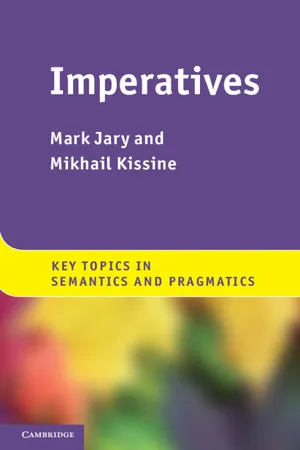
Imperative sentences usually occur in speech acts such as orders, requests, and pleas. However, they are also used to give advice, and to grant permission, and are sometimes found in advertisements, good wishes and conditional constructions. Yet, the relationship between the form of imperatives, and the wide range of speech acts in which they occur, remains unclear, as do the ways in which semantic theory should handle imperatives. This book is the first to look systematically at both the data and the theory. The first part discusses data from a large set of languages, including many outside the Indo-European family, and analyses in detail the range of uses to which imperatives are put, paying particular attention to controversial cases. This provides the empirical background for the second part, where the authors offer an accessible, comprehensive and in-depth discussion of the major theoretical accounts of imperative semantics and pragmatics.
Information
Table of contents
- Cover
- Half-title
- Series information
- Title page
- Copyright information
- Table of contents
- Acknowledgements
- Abbreviations and notation
- Introduction
- Part I The data
- Part II The theories
- An Opinionated Conclusion
- Appendix A Possible worlds and seman
- Appendix B Modality in possible-word semantics
- Appendix C Stalnaker’s common-ground model of assertion
- Glossary
- References
- Index
Trusted by 375,005 students
Access to over 1.5 million titles for a fair monthly price.
Study more efficiently using our study tools.
Frequently asked questions
Yes, you can cancel anytime from the Subscription tab in your account settings on the Perlego website. Your subscription will stay active until the end of your current billing period. Learn how to cancel your subscription
No, books cannot be downloaded as external files, such as PDFs, for use outside of Perlego. However, you can download books within the Perlego app for offline reading on mobile or tablet. Learn how to download books offline
Perlego offers two plans: Essential and Complete
- Essential is ideal for learners and professionals who enjoy exploring a wide range of subjects. Access the Essential Library with 800,000+ trusted titles and best-sellers across business, personal growth, and the humanities. Includes unlimited reading time and Standard Read Aloud voice.
- Complete: Perfect for advanced learners and researchers needing full, unrestricted access. Unlock 1.5M+ books across hundreds of subjects, including academic and specialized titles. The Complete Plan also includes advanced features like Premium Read Aloud and Research Assistant.
We are an online textbook subscription service, where you can get access to an entire online library for less than the price of a single book per month. With over 1.5 million books across 990+ topics, we’ve got you covered! Learn about our mission
Look out for the read-aloud symbol on your next book to see if you can listen to it. The read-aloud tool reads text aloud for you, highlighting the text as it is being read. You can pause it, speed it up and slow it down. Learn more about Read Aloud
Yes! You can use the Perlego app on both iOS and Android devices to read anytime, anywhere — even offline. Perfect for commutes or when you’re on the go.
Please note we cannot support devices running on iOS 13 and Android 7 or earlier. Learn more about using the app
Please note we cannot support devices running on iOS 13 and Android 7 or earlier. Learn more about using the app
Yes, you can access Imperatives by Mark Jary,Mikhail Kissine in PDF and/or ePUB format, as well as other popular books in Languages & Linguistics & Linguistic Semantics. We have over 1.5 million books available in our catalogue for you to explore.