- 338 pages
- English
- PDF
- Available on iOS & Android
eBook - PDF
About this book
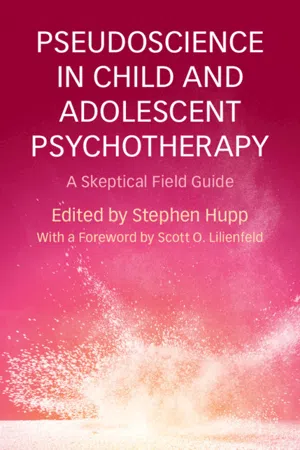
Most infants, children, and adolescents facing mental health challenges - including autism, psychosis, mania, depression, anxiety, and substance use - do not receive evidence-based treatments. Instead, they commonly receive ineffective and even harmful treatments. In this book, leading experts from the fields of clinical psychology, school psychology, developmental psychology, pediatric neurology, applied behavior analysis, and social work identify the most problematic psychotherapy interventions used for each mental health issue. In addition to these primary authors, each chapter includes a side bar from a specialist representing the disciplines of pediatrics, anthropology, neuroscience, and psychology. The contributors work in academia, hospitals, and private practice and include book authors, podcasters, and even a filmmaker. Not only does this book highlight the threats of potentially harmful pseudoscience, it also summarizes treatments that actually have a strong evidence base and deliver far more positive results.
Information
Table of contents
- Cover
- Half-title page
- Title page
- Copyright page
- Dedication
- Contents
- List of Sidebars
- List of Contributors
- Foreword
- Preface
- Acknowledgments
- 1 Critical Thinking about Psychotherapy
- 2 Intellectual and Adaptive Functioning
- 3 Autism Spectrum
- 4 Inattention and Hyperactivity
- 5 Learning
- 6 Tics
- 7 Psychosis
- 8 Bipolar Spectrum
- 9 Depression
- 10 Anxiety
- 11 Obsessions and Compulsions
- 12 Trauma and Attachment
- 13 Feeding
- 14 Eating
- 15 Toileting
- 16 Sleep
- 17 Disruptive Behavior and Conduct
- 18 Substance Use
- 19 Skepticism and Psychotherapy
- Index
Trusted by 375,005 students
Access to over 1.5 million titles for a fair monthly price.
Study more efficiently using our study tools.
Frequently asked questions
Yes, you can cancel anytime from the Subscription tab in your account settings on the Perlego website. Your subscription will stay active until the end of your current billing period. Learn how to cancel your subscription
No, books cannot be downloaded as external files, such as PDFs, for use outside of Perlego. However, you can download books within the Perlego app for offline reading on mobile or tablet. Learn how to download books offline
We are an online textbook subscription service, where you can get access to an entire online library for less than the price of a single book per month. With over 1.5 million books across 990+ topics, we’ve got you covered! Learn about our mission
Look out for the read-aloud symbol on your next book to see if you can listen to it. The read-aloud tool reads text aloud for you, highlighting the text as it is being read. You can pause it, speed it up and slow it down. Learn more about Read Aloud
Yes! You can use the Perlego app on both iOS and Android devices to read anytime, anywhere — even offline. Perfect for commutes or when you’re on the go.
Please note we cannot support devices running on iOS 13 and Android 7 or earlier. Learn more about using the app
Please note we cannot support devices running on iOS 13 and Android 7 or earlier. Learn more about using the app
Yes, you can access Pseudoscience in Child and Adolescent Psychotherapy by Stephen Hupp in PDF and/or ePUB format, as well as other popular books in Psychology & Clinical Psychology. We have over 1.5 million books available in our catalogue for you to explore.