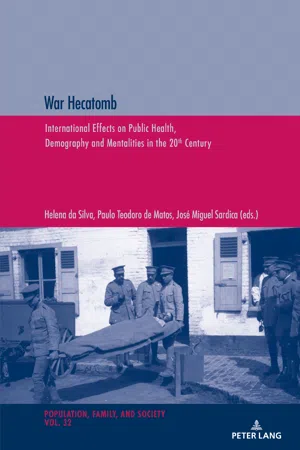
War Hecatomb. International Effects on Public Health, Demography and Mentalities in the 20th Century, offers new insights on the impact of wars (namely, but not exclusively, World War I), by underlining its social and psychological consequences, particularly in public health, demography, and mentalities in different countries. Therefore, it is not just another book on World Wars, since it does not focus primarily on political, diplomatic, military or economic aspects. Instead, the work offers a brand new approach on these wars' consequences, and especially on the civilizational significance of the Great War of 1914-1918. This original view over societies coping with the aftermath of the two world wars reveals how states and different agents were compelled to act and to face the new post-war reality, bringing to light an innovative social agenda while simultaneously trying to cope with the overwhelming phenomenon of physically and mentally scarred multitudes of veterans and their families. The book focuses on the consequences of conflicts in different perspectives and geographic locations. In twelve chapters, several aspects and effects of wars are analysed through different lens.
eBook - PDF
War Hecatomb
International Effects on Public Health, Demography and Mentalities in the 20th Century
- 286 pages
- English
- PDF
- Available on iOS & Android
eBook - PDF
War Hecatomb
International Effects on Public Health, Demography and Mentalities in the 20th Century
About this book
Information
Table of contents
- Cover
- Contents
- Editors’ Preface
- Chapter 1 – From innocence to harshness: the civilizational significance of World War I (José Miguel Sardica)
- Chapter 2 – ‘Silent Deaths’: British Soldier Suicides in the First World War (Simon Walker )
- Chapter 3 – A Eugenic Legislation: Health before, during and after the Great War in Italy (Emilia Musumeci)
- Chapter 4 – “Our Sacrifice for the Country!” War and Gender Identity in Transylvania (Georgeta Fodor, Maria Tătar-Dan)
- Chapter 5 – Public silence: the memory of the influenza epidemic of 1918–19 in Portugal (José Manuel Sobral, Maria Luísa Lima)
- Chapter 6 – The social reception of a novel legal framework for WW1 war orphans: the pupille de la Nation status (Nicolas Todd)
- Chapter 7 – War Trauma, mental health and social consequences of World War I in Romanian Psychology and Psychiatry (1919–1939) (Oana Habor)
- Chapter 8 – (In)complete Citizens: First World War Portuguese Disabled Soldiers and the Reconstruction of Group Identity (Sílvia Correia)
- Chapter 9 – War, Peace and times of transition: Civil demographic losses in Austria during WW I and “recovery” until 1938. An international and intraregional comparison (Peter Teibenbacher)
- Chapter 10 – For the protection of public health: Prisoners of War and Refugees in Quarantine on Saint-George Island, 1922–1925 (Anastasios Zografos)
- Chapter 11 – The impact of the Second World War on the young Polish population (Grażyna Liczbińska, Zbigniew Czapla, Janusz Piontek, Robert M. Malina)
- Chapter 12 – Warfare in the 19th-20th Centuries and Its Effects: A Necessary Evil? (Case Study: World War I) (Ioan Bolovan / Sorina Paula Bolovan)
- Biographical Notes
Trusted by 375,005 students
Access to over 1.5 million titles for a fair monthly price.
Study more efficiently using our study tools.
Frequently asked questions
Yes, you can cancel anytime from the Subscription tab in your account settings on the Perlego website. Your subscription will stay active until the end of your current billing period. Learn how to cancel your subscription
No, books cannot be downloaded as external files, such as PDFs, for use outside of Perlego. However, you can download books within the Perlego app for offline reading on mobile or tablet. Learn how to download books offline
We are an online textbook subscription service, where you can get access to an entire online library for less than the price of a single book per month. With over 1.5 million books across 990+ topics, we’ve got you covered! Learn about our mission
Look out for the read-aloud symbol on your next book to see if you can listen to it. The read-aloud tool reads text aloud for you, highlighting the text as it is being read. You can pause it, speed it up and slow it down. Learn more about Read Aloud
Yes! You can use the Perlego app on both iOS and Android devices to read anytime, anywhere — even offline. Perfect for commutes or when you’re on the go.
Please note we cannot support devices running on iOS 13 and Android 7 or earlier. Learn more about using the app
Please note we cannot support devices running on iOS 13 and Android 7 or earlier. Learn more about using the app
Yes, you can access War Hecatomb by Paulo de Teodoro Matos,Helena Da Silva,José Miguel Sardica, Paulo de Teodoro Matos, Helena Da Silva, José Miguel Sardica in PDF and/or ePUB format, as well as other popular books in History & Eastern European History. We have over 1.5 million books available in our catalogue for you to explore.