Art and Resistance: Studies in Modern Indian Theatres
eBook - PDF

Art and Resistance: Studies in Modern Indian Theatres

  1. English
  2. PDF
  3. Available on iOS & Android
eBook - PDF

Art and Resistance: Studies in Modern Indian Theatres

About this book

This volume begins with the assumption that "Hindu" should not be conflated with "Indian" (as in the case of Orientalist criticism of Indian theatre) and that modern Indian theatre need not have its starting point in classical Sanskrit drama (as many Indologists would assert). Rather, this volume uses the insights of reception theory's critique of nationalist historiography to explore a possible framework with which one might theoretically locate the issues inherent in the terms "modern Indian theatre."

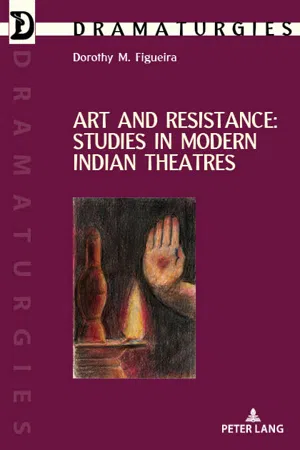
Following the work of the eminent Indian comparatist, Sisir Kumar Das, this volume looks at how modernity in Indian theatre entails attempts of various Indian language groups to adjust to the forced cohabitation with both foreign and indigenous traditions. Rather than looking at Indian theatre as solely a process of Westernization or Sanskritization, this book looks at it as a response. The aesthetics of reception is then seen as a transactional and dialogical process wherein one is not always just responding to the Western or the classical Indian contexts. As opposed to most postcolonial and Indological readings, this volume traces the domain of the social imagination that has shaped modern Indian sensibilities across various languages and thereby resisting the hermetic aesthetic of reliance on hegemonic languages such as Sanskrit and English. The cover tries to reflect the overall approach of the volume. A theatrical play begins with the lighting of the ritual lamp to signify drama being given to humanity by Brahma, the Creator. According to the compendium on dramatic arts ( The Natyashastra, chapter 21), the hand gesture depicted here heralds the ensuing dramatic action.

Frequently asked questions

Yes, you can cancel anytime from the Subscription tab in your account settings on the Perlego website. Your subscription will stay active until the end of your current billing period. Learn how to cancel your subscription.
No, books cannot be downloaded as external files, such as PDFs, for use outside of Perlego. However, you can download books within the Perlego app for offline reading on mobile or tablet. Learn more here.
Perlego offers two plans: Essential and Complete
  • Essential is ideal for learners and professionals who enjoy exploring a wide range of subjects. Access the Essential Library with 800,000+ trusted titles and best-sellers across business, personal growth, and the humanities. Includes unlimited reading time and Standard Read Aloud voice.
  • Complete: Perfect for advanced learners and researchers needing full, unrestricted access. Unlock 1.4M+ books across hundreds of subjects, including academic and specialized titles. The Complete Plan also includes advanced features like Premium Read Aloud and Research Assistant.
Both plans are available with monthly, semester, or annual billing cycles.
We are an online textbook subscription service, where you can get access to an entire online library for less than the price of a single book per month. With over 1 million books across 1000+ topics, we’ve got you covered! Learn more here.
Look out for the read-aloud symbol on your next book to see if you can listen to it. The read-aloud tool reads text aloud for you, highlighting the text as it is being read. You can pause it, speed it up and slow it down. Learn more here.
Yes! You can use the Perlego app on both iOS or Android devices to read anytime, anywhere — even offline. Perfect for commutes or when you’re on the go.
Please note we cannot support devices running on iOS 13 and Android 7 or earlier. Learn more about using the app.
Yes, you can access Art and Resistance: Studies in Modern Indian Theatres by Dorothy Figueira in PDF and/or ePUB format, as well as other popular books in Literature & German Literary Criticism. We have over one million books available in our catalogue for you to explore.

Information

Table of contents

  1. Cover
  2. Table of Contents
  3. Preface (Dorothy M. Figueira)
  4. Introduction: Reconfiguring Nationhood through Performance? (Dorothy M. Figueira)
  5. I. Troupes/Troops
  6. II. Soldiers
  7. Notes on Contributors